WISE Launch Scheduled for Dec. 11
Dec 04, 2009
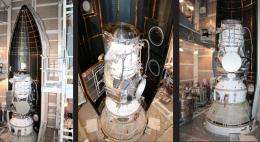
WISE is shown inside one-half of the nose cone, or fairing, that will protect it during launch. The spacecraft is clamped to the top of the rocket above the white conical fitting. The fairing will split open like a clamshell about five minutes after launch. Image credit: United Launch Alliance/ JPL-Caltech

(PhysOrg.com) -- Launch of NASA's Wide-field Infrared Survey Explorer (WISE) from Vandenberg Air Force Base in California is scheduled for Dec. 11.

Launch and mission managers will gather at Vandenberg today for the Flight Readiness Review to verify the Delta II rocket and its payload are ready for liftoff.

At Vandenberg's Space Launch Complex 2, the spacecraft is safely tucked into in the outer nose cone, or "fairing," that will protect it during its launch and ascent.

The WISE spacecraft will circle Earth over the poles, scanning the entire sky one-and-a-half times in nine months. The mission will uncover hidden cosmic objects, including the coolest stars, dark asteroids and the most luminous galaxies.

More information: NASA's WISE infrared satellite to reveal new galaxies, stars, asteroids

Provided by JPL/NASA (news : web)

Explore further: Curiosity Mars rover drills second rock target

add to favorites email to friend print save as pdf

Related Stories

WISE Snug in Its Nose Cone; Launch Set for Dec. 9

Dec 01, 2009

NASA's Wide-field Infrared Survey Explorer has been wrapped in the outer nose cone, or "fairing," that will protect it during its scheduled Dec. 9 launch from Vandenberg Air Force Base, Calif.

WISE Is Chilling Out

Nov 11, 2009

(PhysOrg.com) -- Engineers are busy cooling the science instrument on NASA's Wide-field Infrared Survey Explorer, or WISE. The spacecraft is scheduled to blast into space from Vandenberg Air Force Base in ...

Recommended for you

Proba-V opens its eyes

14 hours ago

(Phys.org) —Earth watcher Proba-V is in good health following its launch last week. The Vegetation imager has been switched on and the first image has been captured over western France.

Mice, gerbils perish in Russia space flight

May 19, 2013

A number of mice and eight gerbils sent into space in a Russian capsule destined to find out how well organisms can withstand extended flights perished during their journey, scientists said Sunday as the ...

Mars rover Opportunity examines clay clues in rock

May 18, 2013

(Phys.org) —NASA's senior Mars rover, Opportunity, is driving to a new study area after a dramatic finish to 20 months on "Cape York" with examination of a rock intensely altered by water.

User comments : 0

More news stories

Slow earthquakes: It's all in the rock mechanics

(Phys.org) —Earthquakes that last minutes rather than seconds are a relatively recent discovery, according to an international team of seismologists. Researchers have been aware of these slow earthquakes, ...

Lab sets a new record for creating heralded photons

(Phys.org) —Entanglement, by general consensus of physicists, is the weirdest part of quantum science. To say that two particles, A and B, are entangled means that they are actually two parts of an inseparable ...

Protein study suggests drug side effects are inevitable

A new study of both computer-created and natural proteins suggests that the number of unique pockets – sites where small molecule pharmaceutical compounds can bind to proteins – is surprisingly small, meaning drug side ...

Do salamanders hold the solution to regeneration?

Salamanders' immune systems are key to their remarkable ability to regrow limbs, and could also underpin their ability to regenerate spinal cords, brain tissue and even parts of their hearts, scientists have ...