King crab family bigger than ever
Dec 02, 2009
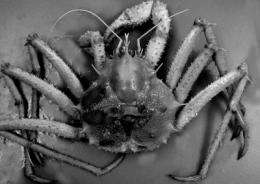
The image shows Lithodes galapagensis, the only king crab species yet recorded from the seas around the Galapagos Islands. Credit: NOCS

Sally Hall, a PhD student at the University of Southampton's School of Ocean and Earth Science (SOES) at the National Oceanography Centre, Southampton (NOCS) has formally described four new species of king crab, all from the deep sea.

Hall discovered the new in the Smithsonian Collections of the National Museum of Natural History in Washington. Explaining the significance of the find, she said: "King crabs include some of the largest currently inhabiting Earth and are fished by humans, particularly from the shallower waters of the polar regions. The new discoveries increase the total number of king crab species known to 113."

The new species are Paralomis nivosa from the Philippines, P. makarovi from the , P. alcockiana from South Carolina, and Lithodes galapagensis from the Galapagos archipelago - the first and only king crab species yet recorded from the seas around the . P. nivosa and P. makarovi came from previously unidentified samples collected in the early part of the twentieth century by the US Bureau of Fisheries steamer, Albatross.

King crabs were first formally described in 1819. They are now known from subtidal waters at high latitudes, but deep-sea species occur in most of the world's oceans, typically living at depths between 500 and 1500 metres.

"We are only now beginning to understand the incredible diversity of animals living in the deep sea," said Hall: "It is incredible that the Albatross collection is still yielding new information, even though it is over 100 years since this survey of deep-sea life began."

It is now clear that species of deep-sea king crab live in most areas of the world's oceans, but many more species remain to be discovered. "The oceans off eastern Africa, the Indian Ocean and the Southern Ocean are all particularly poorly sampled," said Hall: "We need to know which king crab species live where before we can fully understand their ecology and evolutionary success."

More information: Hall, S. & Thatje, S. Four new species of the family Lithodidae (Decapoda: Anomura) from the collections of the National Museum of Natural History, Smithsonian Institution. Zootaxa 2302, 31-47 (2009). www.mapress.com/zootaxa/2009/f/z02302p047f.pdf

Source: National Oceanography Centre, Southampton

Explore further: Asian lady beetles use biological weapons against their European relatives

add to favorites email to friend print save as pdf

Related Stories

New study reveals king crabs go deep to avoid hot water

Jul 02, 2009

Researchers from the University of Southampton have drawn together 200 years' worth of oceanographic knowledge to investigate the distribution of a notorious deep-sea giant - the king crab. The results, published this week ...

Crab nabbed; circumstances fishy

Aug 10, 2006

MIT researchers have confirmed the first sighting of a Dungeness crab in the Atlantic Ocean. The male, whose species is common on North America's West Coast, was caught off Thatcher Island, Massachusetts, on ...

Scientists discover new life in the Antarctic deep sea

May 16, 2007

Scientists have found hundreds of new marine creatures in the vast, dark deep-sea surrounding Antarctica. Carnivorous sponges, free-swimming worms, crustaceans, and molluscs living in the Weddell Sea provide ...

Recommended for you

Climate change may have little impact on tropical lizards

18 hours ago

A new Dartmouth College study finds human-caused climate change may have little impact on many species of tropical lizards, contradicting a host of recent studies that predict their widespread extinction in a rapidly warming ...

Wetlands: value to locals matters most

18 hours ago

A new way of valuing ecosystem services, incorporating the local perspective, is the driving force behind a project assessing aquatic ecosystems in highland areas of Asia

Symbolic saviour of an endangered species

May 16, 2013

In 2006 Berlin Zoo saw the birth of their first polar bear cub in 33 years. A retired circus polar bear gave birth to two cubs at the zoo. One of them died soon after, but Knut survived. At only a month old he became the ...

User comments : 0

More news stories

Front-row seats to climate change

By day, insects provide the white noise of the South, but the night belongs to the amphibians. In a typical year, the Southern air hangs heavy from the humidity and the sounds of wildlife.

Climate change may have little impact on tropical lizards

A new Dartmouth College study finds human-caused climate change may have little impact on many species of tropical lizards, contradicting a host of recent studies that predict their widespread extinction in a rapidly warming ...

US seizes Bitcoin operator accounts

US authorities seized the accounts of a Bitcoin digital currency exchange operator, claiming it was functioning as an "unlicensed money service business," court documents showed Friday.

Chinese, Indian airlines face EU pollution fines

Eight Chinese and two Indian airlines face fines of up to several million euros for not paying for their greenhouse gas emissions during flights within the bloc, the European Commission said on Friday.

Alaska volcano shoots ash 15,000 feet into the air

(AP)—One of Alaska's most restless volcanoes has shot an ash cloud 15,000 feet into the air in an ongoing eruption that has drawn attention from a nearby community but isn't expected to threaten air traffic.