Pickin' Up Good Vibrations to Produce Green Electricity
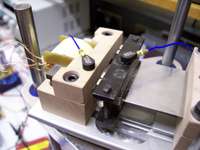
(PhysOrg.com) -- Vibrations from the environments we live and work in could be much more widely harnessed as a clean source of electricity, due to cutting-edge UK research.
Known as 'energy harvesting', the concept has been around for over a decade, but researchers from the University of Bristol aim to make it possible to make use of a much wider range of vibrations than is currently possible.
It's hoped that within five years 'energy harvesting' could be powering many more of our devices from heart monitors to mobile phones.
The work is funded by the Engineering and Physical Sciences Research Council (EPSRC).
The team are exploring how vibrations caused by machines such as helicopters and trains could be used to produce power. Vibrations from household appliances and the movement of the human body could also be harnessed in this way.
Commercial energy-harvesting devices already exist which, for instance, use vibrations from industrial pumps to power sensors monitoring the pumps' condition.
"Vibration energy-harvesting devices use a spring with a mass on the end", says Dr Stephen Burrow, who is leading the project. "The mass and spring exploit a phenomenon called resonance to amplify small vibrations, enabling useful energy to be extracted. Even just a few milliwatts can power small electronic devices like a heart rate monitor or an engine temperature sensor, but it can also be used to recharge power-hungry devices like MP3 players or mobile phones."
But existing devices can only exploit vibrations that have a narrow range of frequencies (the frequency is the number of vibrations occurring per second). If the vibrations don't occur at the right frequency, very little power can be produced and it will be too low to be useable. This is a big problem in applications like transport or human movement where the frequency of vibrations change all the time.
However, the Bristol team are developing a new type of device where the mass and spring resonate over a much wider range of frequencies. This would enable a much wider range of vibrations to be exploited and so increase the overall contribution that energy harvesting could make to energy supplies. The team believes it can achieve this by exploiting the properties of non-linear springs which allow the energy harvester to respond to a wider range of vibration frequencies than conventional springs.
Energy harvesters generate low-level power on a similar scale to batteries but without the need for battery replacement or disposal of potentially dangerous and polluting chemicals. They are also suited to applications where hard wiring would be impracticable, vulnerable to damage or difficult to access for maintenance purposes.
Energy harvesters could be used extensively, for example, to provide power for wireless monitoring and diagnostic sensors that generate data on:
- a person's heart rate, body temperature or blood pressure
- stresses experienced by engine components, structural elements in buildings etc
- brake temperatures in railway rolling stock
"There's a huge amount of free, clean energy out there in the form of vibrations that just can't be tapped at the moment," says Dr Burrow. "Wider-frequency energy harvesters could make a valuable contribution to meeting energy needs more efficiently and sustainably."
If the research at Bristol succeeds in achieving its objectives, wider-frequency energy harvesting devices could be available for real-world use within five years.
Source: Engineering and Physical Sciences Research Council (news : web)


