RNA on the move

Nov 26, 2009
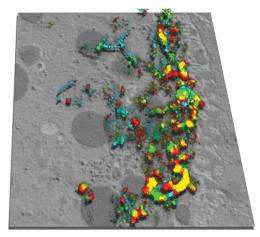
This electron microscopy image (grey) shows the posterior pole of a Drosophila oocyte, and superimposed on it is a projection of the movement of oskar mRNA in this region, recorded from a different oocyte at the same developmental stage. During this one-minute recording, the RNA moved from starting points labelled red to endpoints labelled green, via trajectories shown in blue. Image credit: Ephrussi / EMBL

In the fruit fly Drosophila, oskar mRNA, which is involved in defining the animal’s body axes, is produced in the nuclei of nurse cells neighbouring the oocyte, and must be transported to the oocyte and along its entire length before being translated into protein.

Scientists in the group of Anne Ephrussi at the European Molecular Biology Laboratory (EMBL) in Heidelberg, Germany, have visualized the molecular mechanism that underlies this localisation process. In a study published today in Cell, they showed for the first time that, upon export from the nucleus of nurse cells into the cytosol - the semifluid that surrounds a cell’s nucleus -RNA particles recruit two , kinesin and dynein, which transport the to its final location in the oocyte.

By combining immunofluorescence with electron microscopy imaging, the EMBL scientists were able to discriminate where different molecules critical for oskar mRNA transport are recruited, thus defining a hierarchy of RNA particle assembly. These findings not only increase our understanding of development, but could also shed light on processes underlying the function of and axons in neurons, and - which is implicated in learning and memory formation - as these also entail the transport and localised translation of RNA.

More information: Trucco, A., Gaspar, I. & Ephrussi, A. Assembly of Endogenous oskar mRNA Particles for Motor-Dependent Transport in the Drosophila Oocyte. Cell, 25 November 2009.

Provided by European Molecular Biology Laboratory (news : web)

Explore further: Minus environment, patterns still emerge: Computational study tracks E. coli cells' regulatory mechanisms

add to favorites email to friend print save as pdf

Related Stories

How nerve cells stay in shape

Jan 17, 2006

Nerve cells store and transmit information via special contact sites called synapses. Synapses also play a role in determining what we remember and what we forget. When we learn, both the structure and the ...

Getting wise to the influenza virus' tricks

May 04, 2008

Influenza is currently a grave concern for governments and health organisations around the world. The worry is the potential for highly virulent bird flu strains, such as H5N1, to develop the ability to infect humans easily. ...

A unique arrangement for egg cell division

Aug 09, 2007

Which genes are passed on from mother to child is decided very early on during the maturation of the egg cell in the ovary. In a cell division process that is unique to egg cells, half of the chromosomes are eliminated from ...

Recommended for you

Intestinal bacteria protect against E. coli O157:H7

May 20, 2013

A cocktail of non-pathogenic bacteria naturally occurring in the digestive tract of healthy humans can protect against a potentially lethal E. coli infection in animal models according to research presented today at the 11 ...

User comments : 0

More news stories

If you can remember it, you can remember it wrong

(Medical Xpress)—Native peoples in regions where cameras are uncommon sometimes react with caution when their picture is taken. The fear that something must have been stolen from them to create the photo ...

Reducing caloric intake delays nerve cell loss

Activating an enzyme known to play a role in the anti-aging benefits of calorie restriction delays the loss of brain cells and preserves cognitive function in mice, according to a study published in the May ...

B vitamins could delay dementia

(Medical Xpress)—Despite spending billions of dollars on research and development, drug companies have been unable to come up with effective treatments for dementia and Alzheimer's Disease (AD). Now, A. ...

New method for producing clean hydrogen

Duke University engineers have developed a novel method for producing clean hydrogen, which could prove essential to weaning society off of fossil fuels and their environmental implications.