Straightening messy correlations with a quantum comb
Nov 23, 2009
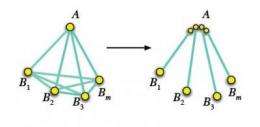
Physicists have shown that complicated quantum entanglements can be transformed into an arrangement where the entanglement fans out neatly from the hub qubit to each of the other qubits. Credit: Dong Yang and Jens Eisert

Quantum computing promises ultra-fast communication, computation and more powerful ways to encrypt sensitive information. But trying to use quantum states as carriers of information is an extremely delicate business. Now two physicists have shown, mathematically, how to gently tease out unwanted knots in quantum communication, while keeping the information intact. Their work is reported in the current issue of Physical Review Letters and highlighted with a Viewpoint in Physics.

When two particles are entangled, they effectively act as a single entity, even though they might be on opposite ends of the galaxy. Physicists can code information into particles to make , or qubits, then entangle the qubits in an orderly fashion to form an entangled bit, or ebit. Ebits can then be used to create incredibly tough codes or teleport information between two distant systems. But messy entanglements among particles make qubits more susceptible to losing their encoded information.

Now Dong Yang and Jens Eisert of the University of Potsdam have shown how to delicately comb out a snarl of entanglements among many qubits while keeping the information intact. They designate one as a hub and then use a combination of two existing quantum protocols to transform the original cat's cradle into an arrangement where entanglement fans out neatly from the hub qubit to each of the other qubits.

This looks like a primitive model for a quantum World Wide Web: individual users each form an ebit with a single quantum search engine, and send queries and receive results via quantum teleportation.

More information: Dong Yang and Jens Eisert, Phys. Rev. Lett. 103, 220501 (2009) - Published November 23, 2009, Download PDF (free)

Source: American Physical Society

Explore further: A quantum simulator for magnetic materials

add to favorites email to friend print save as pdf

Related Stories

Creating a six-qubit cluster state

Nov 02, 2009

(PhysOrg.com) -- Many scientists believe that quantum entanglement is required in order for effective quantum computing. Entanglement takes place when there is a connection that exists between two objects - even when they ...

A Quantum CPU: the Pentium Q?

May 23, 2006

A new design scheme for a quantum processor core makes potential quantum computers more technically feasible, more efficient, and in many cases faster by keeping all of the quantum bits active all the time, rather than switching ...

2 qubits in action, new step towards the quantum computer

Jun 14, 2007

Researchers at Delft University of Technology have succeeded in carrying out calculations with two quantum bits, the building blocks of a possible future quantum computer. The Delft researchers are publishing ...

Quantum Communication Over Flawed Networks may be Possible

Dec 14, 2007

If successfully implemented, quantum communication could be an extremely secure method of transmitting information – but there are major roadblocks to pass. Recently, physicists suggested a way, at least in theory, to overcome ...

Recommended for you

A quantum simulator for magnetic materials

21 hours ago

Physicists understand perfectly well why a fridge magnet sticks to certain metallic surfaces. But there are more exotic forms of magnetism whose properties remain unclear, despite decades of intense research. ...

Researchers forward quest for quantum computing

May 23, 2013

Research teams from UW-Milwaukee and the University of York investigating the properties of ultra-thin films of new materials are helping bring quantum computing one step closer to reality.

Hydrogen atoms under the magnifying glass

May 22, 2013

To describe the microscopic properties of matter and its interaction with the external world, quantum mechanics uses wave functions, whose structure and time dependence is governed by the Schrödinger equation. ...

Making quantum encryption practical

May 21, 2013

One of the many promising applications of quantum mechanics in the information sciences is quantum key distribution (QKD), in which the counterintuitive behavior of quantum particles guarantees that no one can eavesdrop on ...

Lab sets a new record for creating heralded photons

May 20, 2013

(Phys.org) —Entanglement, by general consensus of physicists, is the weirdest part of quantum science. To say that two particles, A and B, are entangled means that they are actually two parts of an inseparable ...

Competition in the quantum world

May 20, 2013

Innsbruck physicists led by Rainer Blatt and Peter Zoller experimentally gained a deep insight into the nature of quantum mechanical phase transitions. They are the first scientists that simulated the competition ...

User comments : 0

More news stories

A quantum simulator for magnetic materials

Physicists understand perfectly well why a fridge magnet sticks to certain metallic surfaces. But there are more exotic forms of magnetism whose properties remain unclear, despite decades of intense research. ...

Spheres can form squares

Everybody who has tried to stack oranges in a box knows that a regular packing of spheres in a flat layer naturally leads to a hexagonal pattern, where each sphere is surrounded by six neighbours in a honeycomb-like ...