Smartphone app illuminates power consumption
Nov 20, 2009

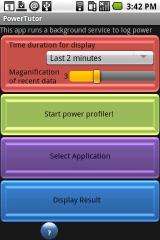
(PhysOrg.com) -- A new application for the Android smartphone shows users and software developers how much power their applications are consuming. PowerTutor was developed by doctoral students and professors at the University of Michigan.

Battery-powered cell phones serve as hand-held computers and more these days. We run power-hungry applications while we depend on the phones to be available in emergencies.

"Today, we expect our phones to realize more and more functions, and we also expect their batteries to last," said Lide Zhang, a doctoral student in the Department of Electrical Engineering and Computer Science and one of the application's developers. "PowerTutor will help make that possible."

PowerTutor will enable software developers to build more efficient products, said Birjodh Tiwana, a doctoral student in the Department of Electrical Engineering and Computer Science and another of the program's developers. Tiwana said PowerTutor will allow users to compare the power consumption of different applications and select the leanest version that performs the desired task. Users can also watch how their actions affect the phone's battery life.

PowerTutor shows in real time how four different phone components use power: the screen, the network interface, the processor, and the global positioning system receiver.

To create the application, the researchers disassembled their phones and installed electrical current meters. Then they determined the relationship between the phone's internal state (how bright the screen is, for example) and the actual power consumption. That allowed them to produce a software model capable of estimating the power use of any program the phone is running with less than 5 percent error.
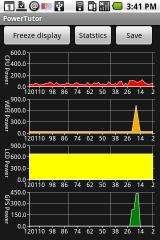
PowerTutor can also provide a history. It is available free at the Market at http://www.android.com/market/ .

PowerTutor was developed under the direction of associate professor Robert Dick and assistant professor Morley Mao, both in the Department of and , and Lei Yang, a software engineer at Google. The work is supported by Google and the National Science Foundation, and was done in collaboration with the joint University of Michigan and Northwestern University Empathic Systems Project.

Provided by University of Michigan (news : web)

Explore further: Mobile app to help fight against racism in France

add to favorites email to friend print save as pdf

Related Stories

Researchers double cell phone memory through software alone

Sep 27, 2007

Cell phones are increasingly sophisticated -- sporting such features as cameras, music players, games, video clips, Internet access and, lest we forget, the capability to phone someone -- but these features come at a price: ...

Google Gets Ready For The Next Version of Android

Apr 14, 2009

(PhysOrg.com) -- Android 1.5 is right around the corner and this version promises better camera and GPS performance, support for video recording and Bluetooth stereo. Also included in this new version is support ...

Motorola, in need of hit, shows off Android phone

Sep 10, 2009

(AP) -- Struggling phone maker Motorola unveiled its first device using Google's Android system Thursday, banking on it to power features that will attract consumers looking to use their phones to connect ...

Recommended for you

Mobile app to help fight against racism in France

6 hours ago

A French anti-racism association is launching a mobile application it hopes will help eradicate racist graffiti by enabling users to take photos of offensive tags, geo-locate them and get them removed.

Google Drive sports new view and scan enhancements

May 23, 2013

(Phys.org) —Google Drive has a new look and functions. The makeover in Google Drive features scanning and interface enhancements that put the user into "card" mode. The enhancements make it easy for the ...

Model will unlock mysteries of the voice

May 22, 2013

Swedish researchers are leading the development of the world's first comprehensive model of the human voice, which could contribute to better voice care, voice prosthetics, talking robots and teaching opportunities.

Patented system better secures digitally stored data

May 21, 2013

(Phys.org) —Arizona State University computer scientist Gail-Joon Ahn has been granted a U.S. patent for a novel identity management system that helps protect personal identity information stored on digital devices.

UC Davis startup changes listening experience

May 20, 2013

Fifteen years of research at the University of California, Davis, is being turned into commercial products by Dysonics, a startup company based in San Francisco. Since becoming the first "graduate" from the Engineering Translational ...

User comments : 0

More news stories

Google eyes emerging markets networks

Google has become deeply involved in a series of projects to build and operate wireless networks in emerging markets including sub-Saharan Africa and Southeast Asia, a report said Friday.

Facial-recognition technology proves its mettle

(Phys.org) —In a study that evaluated some of the latest in automatic facial recognition technology, researchers at Michigan State University were able to quickly identify one of the Boston Marathon bombing ...

Drones may violate international law

(Phys.org) —As President Obama gives a speech on national security—including defending U.S. use of drones to combat terrorism—Leila Sadat, JD, international law expert and professor of law at Washington University in ...

Galaxies fed by funnels of fuel

(Phys.org) —Computer simulations of galaxies growing over billions of years have revealed a likely scenario for how they feed: a cosmic version of swirly straws.