GPS to track blue sheep and snow leopard
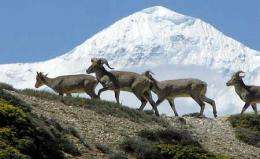
(PhysOrg.com) -- Scientists hope to improve the survival odds of the endangered snow leopard in Nepal by venturing into the remote Himalayas to study its main prey, the Bharal or blue sheep.
Project leader Nepali PhD student Achyut Aryal, who is enrolled at the Institute of Natural Sciences at the Albany campus, says it is the first use of global positioning satellite technology to track the Bharal, and the first use of the technology for conservation purposes in Nepal.
Detailed information on population estimates and distribution for blue sheep and snow leopards is vital for conservation management, says Associate Professor Dianne Brunton, co-supervisor of the study and head of the Ecology and Conservation Group at the institute. She will travel to Nepal next year to carry out further observational field work and data collection, including snow leopard scat samples.
Mr Aryal and co-researcher Massey nutritional ecology professor David Raubenheimer are currently in the Annapurna Conservation Area of Nepal, performing the initial stages of the work. It took the men several days of travel by foot and on horseback to reach the study site near the Tibetan border.
The initial study of the animals' movements, grazing habits and population structure within a limited range will pave the way for the next phase of the study using GPS transmitters. These will allow researchers to track the movements of 10 sheep in different herds for two years continuously across the vast, inaccessible high altitude region on computer screens in New Zealand.
"To date there has been little study of the home range, movement and habitat use of blue sheep in this region," Mr Aryal says. They resemble mountain goats with blue-tinged hair and curled horns and are preyed on by other high altitude species such as the brown bear as well as human trophy hunters.
Lack of data is due to the extreme logistical difficulties of working at 3000m to 6500m altitudes with a climate characterised as cold desert, dominated by strong winds and high solar radiation, says Mr Aryal. "However, this region is one of the last refuges for species such as snow leopards, brown bear, wolf, lynx and, importantly, their keystone prey species, the blue sheep."
.
Population estimates for the snow leopard worldwide are currently between 5000 and 10,000, with numbers declining due to being hunted for fur and as a trophy, killing by farmers because of its reputation as a livestock predator, and loss of food due to trophy hunting. “There is evidence that climate change is causing the blue sheep to come into frequent contact with local villages” says Professor Raubenheimer. “There they raid the precious crops, and also attract snow leopards into the vicinity of the livestock.”
Satellite tracking has previously been used by Massey scientists in the study of godwits migrating from Alaska to New Zealand, and frogs. Dr Brunton hopes New Zealand school pupils will become involved in the snow leopard and blue sheep study next year by observing the movement of the satellite-tracked animals on classroom computers.
Provided by Massey University (news : web)


