Spying on Corn Rootworm Predators Nightlife
Oct 31, 2009 By Don Comis
Spying on Corn Rootworm Predators Nightlife
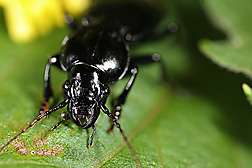
Nocturnal predators like the carabid beetle, Cyclotrachelus alternans, have a large appetite for corn rootworms, the most costly pest of corn in the world.

(PhysOrg.com) -- Agricultural Research Service (ARS) entomologist Jonathan G. Lundgren, while exploring corn fields at night, has found a very different group of predators than the ones that feed during the day. It turns out that these night-time predators have a great appetite for corn rootworms, the most costly pest of corn in the world.

Research on day-active and night-active predatory insects is important for scientists who are developing strategies that maximize the potential of the natural predators in crop pest control.

During his night studies, Lundgren focuses on the top few inches of the soil surface, where rootworm larvae do most of their damage to corn roots. Lundgren works at the ARS North Central Agricultural Research Laboratory in Brookings, S.D.

He’s found that during the night, there is abundant and diverse life underground, with predators including ground beetles, rove beetles, spiders, crickets, and daddy-longlegs.

Wondering how so many and such diverse species could manage in the confines of the upper surface of near corn roots, Lundgren's research revealed the answer might be separation by time, with some insects confining their activity to as little as a three-hour window.

The scientists have two ways to spy on predators. One is to place pinned rootworms as sentinels. The researchers come back later with a red light to see which rootworms have been attacked and which predators are hanging around. Insects can’t see red light. The second way is to collect predators in a timed trap. Trapped predators are analyzed for corn rootworm DNA. This gives researchers information about how long the predators are hunting and the amount of rootworms the predators eat.

Lundgren found that one common carabid beetle, Poecilus chalcites, prefers day work, while another common carabid, Cyclotrachelus alternans, works a night shift, from 10 p.m. to 3 a.m. Wolf spiders search for rootworms during the night, while some other spiders hunt during the day.

Provided by USDA Agricultural Research Service

Explore further: Detour ahead: Cities, farms reroute animals seeking cooler climes

add to favorites email to friend print save as pdf

Related Stories

Time of Day Tempers Tadpoles' Response to Predators

Aug 10, 2006

To a tiny tadpole, life boils down to two basic missions: eat, and avoid being eaten. But there's a trade-off. The more a tadpole eats, the faster it grows big enough to transform into a frog; yet finding food requires being ...

No Mistaking this Bug with New Insect ID Technique

Sep 10, 2009

(PhysOrg.com) -- Misidentifying boll weevils caught in pheromone traps could be easier to avoid, thanks to a new DNA fingerprinting method devised by Agricultural Research Service (ARS) scientists and their ...

Predators prefer to hunt small-brained prey

Aug 02, 2006

Predators such as leopards and chimpanzees consistently target smaller-brained prey less capable of escape; research at the University of Liverpool has shown.

Recommended for you

Hong Kong dolphin numbers dwindling quickly

16 hours ago

Conservationists Tuesday warned that the number of rare Chinese white dolphins in Hong Kong waters has fallen to its lowest level in a decade of monitoring, and urged the government to immediately create more protected areas.

WWF urges Romania, Bulgaria to protect wild sturgeon

19 hours ago

Conservationist group WWF on Tuesday urged Romania and Bulgaria, home to the last viable wild sturgeon populations in the European Union, to protect the species, threatened by illegal fishing and caviar trade.

New resource to record Britain's trees launched

21 hours ago

Treezilla, the monster map of trees, was launched by The Open University and partners on 14 June 2013. The citizen science project aims to map every tree in Britain through Treezilla.org and the related apps.

Study reveals disease-causing parasites in dead otters

23 hours ago

Research undertaken by the Cardiff University Otter Project has revealed a number of disease-causing parasites in the bodies of dead otters. The findings were revealed at the BBC Summer of Wildlife event ...

User comments : 0

More news stories

Origins of 'The Hoff' crab revealed (w/ Video)

The history of a new type of crab, nicknamed 'The Hoff' because of its hairy chest, which lives around hydrothermal vents deep beneath the Southern Ocean and Indian Ocean, has been revealed for the first ...

Cape Wind gets $200M investment from Danish fund

The Cape Wind offshore wind project has secured a $200 million investment from a Danish pension fund in what the wind farm's president said Tuesday is a milestone for the long-delayed project.