Next-generation microcapsules deliver 'chemicals on demand'
Oct 28, 2009
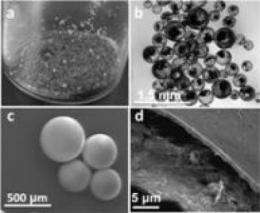
A new generation of microcapsules, shown above, promise to deliver "chemicals on demand" for a wide range of uses, including medicine and personal care. Credit: The American Chemical Society

Scientists in California are reporting development of a new generation of the microcapsules used in carbon-free copy paper, in which capsules burst and release ink with pressure from a pen. The new microcapsules burst when exposed to light, releasing their contents in ways that could have wide-ranging commercial uses from home and personal care to medicine. Their study appears in the Journal of the American Chemical Society.

Jean Fréchet, Alex Zettl and colleagues note that liquid-filled have many other uses, including self-healing plastics. Those plastics contain one group of microscapsules filled with monomer and another with a catalyst. When scratches rip open the capsules, the contents flow, mix, and form a seal. Microcapsules that burst open when exposed to light would have great advantages, the scientists say. Light could be focused to a pinpoint to kill cancer cells, for instance, or shined over an large area to print a pattern.

The new microcapsules consist of nylon spheres about the size of a grain of sand. They enclose a liquid chemical sprinkled with carbon nanotubes. The nanotubes convert laser light to heat that bursts the nylon capsule, releasing the chemical. Using such a system, doctors, for example, might inject microcapsules containing anti-cancer drugs to specific cells and make the capsules burst upon exposure to laser light, delivering their contents precisely where and when they are needed in the body.

More information: "Chemicals On Demand with Phototriggerable Microcapsules", , http://pubs.acs.org/stoken/presspac/presspac/full/10.1021/ja905378v

Source: American Chemical Society (news : web)

Explore further: Researchers perform fastest measurements ever made of ion channel proteins

add to favorites email to friend print save as pdf

Related Stories

Microcapsules open in tumor cells

Aug 23, 2006

Medicines are most helpful when they directly affect the diseased organs or cells - for example, tumour cells. Scientists at the Max Planck Institute of Colloids and Interfaces in Potsdam, Germany, and Ludwig-Maximilian-University ...

Tiny capsules deliver drugs

Jan 12, 2009

A tiny particle syringe composed of polymer layers and nanoparticles may provide drug delivery that targets diseased cells without harming the rest of the body, according to a team of chemical engineers. This ...

Chemical signaling may power nanomachines

Mar 31, 2008

In a finding that could provide controlled motion in futuristic nanomachines used for drug delivery, fuel cells, and other applications, researchers in Pennsylvania report that chemical signaling between synthetic ...

Recommended for you

How gold nanoparticles can help fight ovarian cancer

1 hour ago

Positively charged gold nanoparticles are usually toxic to cells, but cancer cells somehow manage to avoid nanoparticle toxicity. Mayo Clinic researchers found out why, and determined how to make the nanoparticles effective ...

Advance in nanotech gene sequencing technique

May 20, 2013

(Phys.org) —The allure of personalized medicine has made new, more efficient ways of sequencing genes a top research priority. One promising technique involves reading DNA bases using changes in electrical ...

How nanotechnology could keep your heart healthy

May 17, 2013

Since the heart is such a delicate and critical organ, clinicians usually opt not to intervene with the dead cells that remain after a heart attack or cardiac disease. "But we think that all heart attacks deserve some kind ...

User comments : 0

More news stories

How gold nanoparticles can help fight ovarian cancer

Positively charged gold nanoparticles are usually toxic to cells, but cancer cells somehow manage to avoid nanoparticle toxicity. Mayo Clinic researchers found out why, and determined how to make the nanoparticles effective ...

Advance in nanotech gene sequencing technique

(Phys.org) —The allure of personalized medicine has made new, more efficient ways of sequencing genes a top research priority. One promising technique involves reading DNA bases using changes in electrical ...

Game system castAR debuts at Maker Faire

(Phys.org) —Two tech talents, formerly employees at video game publisher Valve, have been working on their own vision in the form of game-ready glasses. Their company, Technical Illusions, will seek to ...

Glaucoma drug can cause droopy eyelids

Prostaglandin analogues (PGAs), drugs which lower intraocular pressure, are often the first line of treatment for people with glaucoma, but their use is not without risks. PGAs have long been associated with blurred vision, ...