Researchers identify dominant chemical that attracts mosquitoes to humans
Oct 26, 2009
mosquito
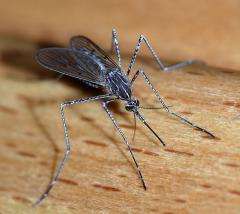
A female mosquito of the Culicidae family (Culiseta longiareolata). Image: Wikipedia

Scientists at the University of California, Davis, have identified the dominant odor naturally produced in humans and birds that attracts the blood-feeding Culex mosquitoes, which transmit West Nile virus and other life-threatening diseases.

The groundbreaking research, published this week in the early online edition of the , explains why mosquitoes shifted hosts from birds to humans and paves the way for key developments in mosquito and disease control.

Entomology professor Walter Leal and postdoctoral researcher Zain Syed found that nonanal (sounds like NAWN-uh-nawl) is the powerful semiochemical that triggers the mosquitoes' keen sense of smell, directing them toward a blood meal. A semiochemical is a chemical substance or mixture that carries a message.

"Nonanal is how they find us," Leal said. "The antennae of the Culex quinquefasciatus are highly developed to detect even extremely low concentrations of nonanal." Mosquitoes detect smells with the olfactory receptor neurons of their antennae.

Birds, the main hosts of mosquitoes, serve as the reservoir for the West Nile virus, Leal said. When infected mosquitoes take a blood meal, they transmit the virus to their hosts, which include birds, humans, horses, dogs, cats, bats, chipmunks, skunks, squirrels and domestic rabbits. Since 1999, the U.S. Centers for Disease Control and Prevention have recorded 29,397 human cases and 1,147 fatalities in the United States alone.

The UC Davis researchers tested hundreds of naturally occurring compounds emitted by people and birds. They collected chemical odors from 16 adult human subjects, representing multiple races and ethnic groups.

"We then determined the specificity and sensitivity of the olfactory receptor neurons to the isolated compounds on the antennae of the ," Syed said.

Leal and Syed found that nonanal acts synergistically with , a known mosquito attractant. "We baited mosquito traps with a combination of nonanal and carbon dioxide and we were drawing in as many as 2,000 a night in Yolo County, near Davis," Syed said. "Nonanal, in combination with carbon dioxide, increased trap captures by more than 50 percent, compared to traps baited with carbon dioxide alone."

Source: University of California - Davis

Explore further: Keeping fruit, vegetables and cut flowers fresh longer

add to favorites email to friend print save as pdf

Related Stories

Montana mosquito season is extended

Sep 14, 2006

Unusually long-lasting hot weather conditions in Montana have prompted U.S. scientists to extend the season for mosquitoes that carry the West Nile virus.

Recommended for you

Attacking MRSA with metals from antibacterial clays

14 hours ago

In the race to protect society from infectious microbes, the bugs are outrunning us. The need for new therapeutic agents is acute, given the emergence of novel pathogens as well as old foes bearing heightened antibiotic resistance.

Keeping fruit, vegetables and cut flowers fresh longer

May 15, 2013

New technology offers the promise of reducing billions of dollars of losses that occur each year from the silent, invisible killer of fruits, vegetables and cut flowers—a gas whose effects are familiar to everyone who has ...

Why don't beetles freeze in the winter?

May 14, 2013

For 37 years, Queen's University Biochemistry professor Peter Davies has been unraveling the mystery of why some organisms including insects and fish don't freeze in the winter. His research into insect antifreeze protein ...

The molecular basis of strawberry aroma

May 13, 2013

You know that summer is here when juicy red strawberries start to appear on the shelves. In Germany, this seasonal fruit has never been more popular: on average 3.5 kilos per head were consumed in 2012—a ...

A new dimension for 3-D protein structures

May 13, 2013

(Phys.org) —3D structures of biological molecules like proteins directly affect the way they behave in our bodies. EPFL scientists have developed a new infrared-UV laser method to more accurately determine ...

User comments : 5

Adjust slider to filter visible comments by rank

Display comments: newest first

tkjtkj
5 / 5 (1) Oct 26, 2009
it would have been helful had the article said more about such an interesting chemical ..

What other 'messages' does it communicate? Is it part of a collection of sex pheremones? Where is it made? How? Here's some answers:
http://en.wikiped.../Nonanal
Also called: nonanaldehyde ..fruity smell ...
Seems its a chemical that's its also added to foods and to perfume!
Arikin
5 / 5 (1) Oct 27, 2009
Hmmm... put the chemicals in the hollow center of a bug zapper. Come and get it, Zap!

Or do they plan to mask our smelly semiochemical with a spray on? :-)
FerretPD
not rated yet Oct 27, 2009
I thought nonanol was a repellent...they didn't specify *which* type of nonanol...
and I wonder when we'll see attractant baits for bbug zappers (I have a little list...)
david_42
5 / 5 (1) Oct 27, 2009
Nonanal, not nonanol.
FerretPD
not rated yet Oct 28, 2009
Well, *duh*. (wanders off, mumbling to himself: "One little letter...")

More news stories

Attacking MRSA with metals from antibacterial clays

In the race to protect society from infectious microbes, the bugs are outrunning us. The need for new therapeutic agents is acute, given the emergence of novel pathogens as well as old foes bearing heightened antibiotic resistance.

Beautiful 'flowers' self-assemble in a beaker

By simply manipulating chemical gradients in a beaker of fluid, materials scientists at Harvard have found that they can control the growth behavior of crystals to create precisely tailored structures—such ...

Making gold green: New non-toxic method for mining gold

Northwestern University scientists have struck gold in the laboratory. They have discovered an inexpensive and environmentally benign method that uses simple cornstarch—instead of cyanide—to isolate gold from raw materials ...

US seizes Bitcoin operator accounts

US authorities seized the accounts of a Bitcoin digital currency exchange operator, claiming it was functioning as an "unlicensed money service business," court documents showed Friday.

Alaska volcano shoots ash 15,000 feet into the air

(AP)—One of Alaska's most restless volcanoes has shot an ash cloud 15,000 feet into the air in an ongoing eruption that has drawn attention from a nearby community but isn't expected to threaten air traffic.

Chinese, Indian airlines face EU pollution fines

Eight Chinese and two Indian airlines face fines of up to several million euros for not paying for their greenhouse gas emissions during flights within the bloc, the European Commission said on Friday.