Study shows how carbon nanotubes can affect lining of the lungs
Oct 25, 2009
Study shows how carbon nanotubes can affect lining of the lungs
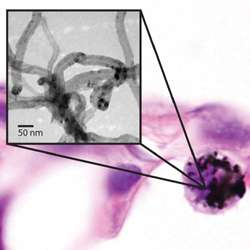
Inhaled carbon nanotubes accumulate within cells at the pleural lining of the lung as visualized by light microscopy.

(PhysOrg.com) -- Carbon nanotubes are being considered for use in everything from sports equipment to medical applications, but a great deal remains unknown about whether these materials cause respiratory or other health problems. Now a collaborative study from North Carolina State University, The Hamner Institutes for Health Sciences, and the National Institute of Environmental Health Sciences shows that inhaling these nanotubes can affect the outer lining of the lung, though the effects of long-term exposure remain unclear.

Using mice in an study, the researchers set out to determine what happens when multi-walled carbon nanotubes are inhaled. Specifically, researchers wanted to determine whether the nanotubes would be able to reach the pleura, which is the tissue that lines the outside of the lungs and is affected by exposure to certain types of asbestos fibers which cause the cancer mesothelioma. The researchers used inhalation exposure and found that inhaled nanotubes do reach the pleura and cause health effects.

Short-term studies described in the paper do not allow conclusions about long-term responses such as cancer. However, the inhaled nanotubes "clearly reach the target tissue for mesothelioma and cause a unique pathologic reaction on the surface of the pleura, and caused fibrosis," says Dr. James Bonner, associate professor of environmental and molecular toxicology at NC State and senior author of the study. The "unique reaction" began within one day of inhalation of the nanotubes, when clusters of (lymphocytes and monocytes) began collecting on the surface of the pleura. Localized fibrosis, or scarring on parts of the pleural surface that is also found with exposure, began two weeks after inhalation.

The study showed the immune response and fibrosis disappeared within three months of exposure. However, this study used only a single exposure to the nanotubes. "It remains unclear whether the pleura could recover from chronic, or repeated, exposures," Bonner says. "More work needs to be done in that area and it is completely unknown at this point whether inhaled carbon nanotubes will prove to be carcinogenic in the lungs or in the pleural lining."

The mice received a single inhalation exposure of six hours as part of the study, and the effects on the pleura were only evident at the highest dose used by the researchers - 30 milligrams per cubic meter (mg/m3). The researchers found no health effects in the mice exposed to the lower dose of one mg/m3.

More information: The study, "Inhaled Carbon Nanotubes Reach the Sub-Pleural Tissue in Mice," the study is published in the Oct. 25 issue of Nature Nanotechnology

Source: North Carolina State University (news : web)

Explore further: Professor's coatings could help medical implants function better

add to favorites email to friend print save as pdf

Related Stories

Clemson researchers develop nanotechnology

Oct 03, 2006

Picture a spider web coated with sugar. But instead of luring in unsuspecting creatures, this spider web pulls in deadly anthrax spores, rendering them harmless.

Nanotube risk assessment

Sep 18, 2009

Italian scientists suggest that we need a much more detailed toxicological approach to hazard assessment before judgement regarding the long-term safety of carbon nanotubes can be made. They outline their results in the International Jo ...

Recommended for you

3D printing tiny batteries

8 hours ago

(Phys.org) —3D printing can now be used to print lithium-ion microbatteries the size of a grain of sand. The printed microbatteries could supply electricity to tiny devices in fields from medicine to communications, ...

World's most powerful microscope ready for research

14 hours ago

(Phys.org) —The world's most powerful microscope, which resides in a specially constructed room at the University of Victoria, has now been fully assembled and tested, and has a lineup of scientists and businesses eager ...

Future looks bright for carbon nanotube solar cells

14 hours ago

(Phys.org) —In an approach that could challenge silicon as the predominant photovoltaic cell material, University of Wisconsin-Madison materials engineers have developed an inexpensive solar cell that exploits ...

Hybrid material as gold-leaf substitute

16 hours ago

(Phys.org) —A team of researchers headed by Professor Raffaele Mezzenga has created a hybrid material out of gold and milk proteins that looks like a wafer-thin gold leaf. Thanks to its properties, it could ...

User comments : 1

Adjust slider to filter visible comments by rank

Display comments: newest first

NotAsleep
not rated yet Oct 28, 2009
Wow... how does that exposure relate to aerosol sunscreen use? People that liked to spray their face may be in some trouble

More news stories

3D printing tiny batteries

(Phys.org) —3D printing can now be used to print lithium-ion microbatteries the size of a grain of sand. The printed microbatteries could supply electricity to tiny devices in fields from medicine to communications, ...

Future looks bright for carbon nanotube solar cells

(Phys.org) —In an approach that could challenge silicon as the predominant photovoltaic cell material, University of Wisconsin-Madison materials engineers have developed an inexpensive solar cell that exploits ...

Hybrid material as gold-leaf substitute

(Phys.org) —A team of researchers headed by Professor Raffaele Mezzenga has created a hybrid material out of gold and milk proteins that looks like a wafer-thin gold leaf. Thanks to its properties, it could ...

World's most powerful microscope ready for research

(Phys.org) —The world's most powerful microscope, which resides in a specially constructed room at the University of Victoria, has now been fully assembled and tested, and has a lineup of scientists and businesses eager ...