Final look at ESA's SMOS and Proba-2 satellites
Oct 21, 2009
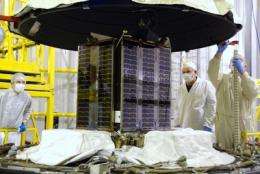
Proba-2 being covered by the SMOS launch adapter before both satellites were encapsulated within the Rockot fairing. Credits: ESA

As preparations for the launch of SMOS and Proba-2 continue on schedule, the engineers and technicians at the Russian launch site say goodbye as both satellites are encapsulated within the half-shells of the Rockot fairing.

Volker Liebig, ESA's Director of Earth Observation Programmes, said, "Today, with the encapsulation of the SMOS in the launcher fairing, we have made an important step towards the launch of this key environmental mission, which will investigate two parameters of the complex . I am looking forward to the launch in a few days!"

The small Proba-2 satellite had already been mated to the Breeze-KM, which is the upper stage of the Russian Rockot, and sealed from view by the SMOS launch adapter above. In launch configuration, Proba-2 sits underneath the SMOS satellite, for injection into orbit after SMOS.
Proba-2 is the second in ESA's Project for Onboard Autonomy series. Although it is less than a cubic metre, incorporates a total of 17 technology developments and four scientific experiments that focus on solar and space weather.

This video is not supported by your browser at this time.
SMOS will provide global maps of soil moisture and ocean salinity, which are two key variables linked to Earth's water cycle. The maps of ocean salinity will further our knowledge of ocean circulation patterns and their role in the climate system. Credits: ESA - AOES Medialab

Michel Courtois, ESA's Director of Technical and Quality Managment, said, "The encapsulation of the Proba-2 satellite was an emotional moment for the project team in Plesetsk. After five years of hard work, our satellite is one step closer to launch, ready to show the importance of in-orbit demonstration of new technologies."

The Proba-2 technology demonstrator is taking advantage of the launch of the 'Soil Moisture and Ocean Salinity' (SMOS) mission, which will make advances in our understanding of Earth's water cycle.

By employing novel technology in space, SMOS will provide the data to produce global maps of at least every three days and global maps of sea-surface salinity averaged over 30 days. Through this regular and consistent mapping, the mission will improve our understanding of the role these two key variables play in regulating the water cycle.

Information from SMOS will also improve weather and climate models, and have practical applications in areas such as agriculture and resource management. The data on sea-surface salinity will further our knowledge of ocean circulation patterns and the role they play in the climate system.

Both and SMOS have been at the Plesetsk Cosmodrome in northern Russia since September, initially taking turns in the cleanroom for the early part of the launch campaign. Over the last week or so, the teams have been working in parallel to mate the satellites to the upper stage of the launcher and now encapsulate them within the fairing. This proved quite emotional for the teams, as both missions have been a number of years in the making.

Now protecting both satellites from the rigors of launch, the half-shells will not open until three minutes after launch, which is scheduled for 2 November at 02: 50 CET (01:50 UT). The next important step in the preparation schedule will be to roll out the 'upper composite' to the launch pad on 26 October, for mating with the rest of the rocket.

Source: European Space Agency (news : web)

Explore further: Dark, massive asteroid to fly by Earth on May 31

add to favorites email to friend print save as pdf

Related Stories

SMOS arrives safely at Russian launch site

Sep 18, 2009

After leaving Thales Alenia Space in the south of France on 15 September, ESA’s SMOS Earth Explorer has arrived safely at the Plesetsk Cosmodrome in northern Russia, where it will be prepared for launch ...

SMOS ready to ship to launch site

May 28, 2009

ESA's next Earth Explorer, SMOS, has just passed the all-important Flight Acceptance Review, signifying that all the elements that make up the mission are in place for launch later this year. The satellite ...

SMOS water mission on track for launch

Feb 12, 2009

Following word from Eurockot that launch of the Earth Explorer SMOS satellite can take place between July and October this year, ESA, CNES and the prime contractor Thales Alenia Space are now making detailed preparations ...

Proba-2 satellite flies into its Russian launch site

Sep 07, 2009

(PhysOrg.com) -- Proba-2 has reached Plesetsk Cosmodrome in northern Russia, where it is being prepared for launch this November. Among the smallest satellites ever built by ESA, it was transported there aboard ...

GOCE gravity satellite moves to launch pad

Mar 11, 2009

(PhysOrg.com) -- With liftoff just five days away, ESA's GOCE spacecraft - encased in the protective half-shells of the launcher fairing - has been transported from the cleanroom and installed in the launch ...

Recommended for you

Dark, massive asteroid to fly by Earth on May 31

20 hours ago

It's 1.7 miles long. Its surface is covered in a sticky black substance similar to the gunk at the bottom of a barbecue. If it impacted Earth it would probably result in global extinction. Good thing it is ...

Research team explains 'Lazarus' comets

23 hours ago

Astronomers from the University of Antioquia have discovered a graveyard of comets. These once-dormant comets, dubbed by astronomers as "The Lazarus comets," are now rejuvenated.

NASA ships sensors for seafaring satellite to France

May 24, 2013

(Phys.org) —Three NASA-built instruments that are integral components of the next in a series of U.S./European ocean altimetry satellites have arrived in France for integration with their spacecraft in ...

Trip into space with DiCaprio costs $1.55m

May 24, 2013

Leonardo DiCaprio is going to get closer to stars of a different kind as he heads into space aboard the Virgin Galactic, and a well-heeled bidder at the Cannes Film Festival has paid 1.2 million euros (1.5 million) to be ...

User comments : 0

More news stories

Galaxies fed by funnels of fuel

(Phys.org) —Computer simulations of galaxies growing over billions of years have revealed a likely scenario for how they feed: a cosmic version of swirly straws.

Source of life running out: water scientists

The majority of people on Earth people will face severe water shortages within a generation or two if pollution and waste continues unabated, scientists warned at a conference in Bonn Friday.

Dark, massive asteroid to fly by Earth on May 31

It's 1.7 miles long. Its surface is covered in a sticky black substance similar to the gunk at the bottom of a barbecue. If it impacted Earth it would probably result in global extinction. Good thing it is ...

Yahoo, pay-TV operators among Hulu bidders

Online video site Hulu is again up for sale, with Yahoo and pay TV operators DirecTV and Time Warner Cable among the seven bidders, according to a person with direct knowledge of the matter.

Radiation leak at Japan lab; small impact expected

An atomic research lab in northern Japan has reported a radiation leak that may have affected about 50 people, though none were hospitalized and no impact was expected outside the facility, the lab's operator ...