Evolution axe goes on display
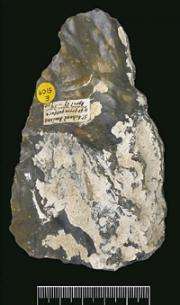
(PhysOrg.com) -- A flint hand axe that helped reveal the very ancient age of humankind goes on display at the Natural History Museum October 2009.
The human-made hand axe was discovered in 1859, the same year Charles Darwin published On the Origin of Species, and was the first strong evidence that humans had been living on the planet for much longer than previously thought.
Until the 19th century, most people believed humans had been on Earth for only a few thousands of years. However, this hand axe, probably used by our ancient relatives to cut and prepare meat and skins, was uncovered together with woolly mammoth and rhino remains and showed that humans were living on Earth many thousands of years earlier.
The 2 geologists Joseph Prestwich and John Evans made the discovery and presented the axe at a lecture to the Royal Society.
From then on it began to be more widely accepted that humans had existed on Earth at a much earlier date than previously thought. Since then scientists have gathered extensive evidence for human evolution.
The hand axe is now thought to be about 400,000 years old. Much older stone tools have since been found in Africa by archaeologists. The oldest known artefacts in the world were found in Ethiopia and were made by our very distant ancestors over 2.5 million years ago.
The hand axe was uncovered in 1859 in northern France by workers mining gravel. Crucially, before it was removed from the ground it was photographed.
This meant that scientists could use information such as the position of the item, what other artefacts and fossils were close by, and the type of surrounding rock, to investigate the item scientifically. This was the very first time photography was used to provide precise location evidence for an archaeological discovery.
Joseph Prestwich made many other important geological discoveries, and after his death in 1896 his large collection of fossils and other artefacts was donated to the Natural History Museum.
The axe specimen lay unheralded in the collections for over 100 years and was uncovered again by researchers Robert Kruszynski and Clive Gamble earlier this year, and they published an article about it in the journal Antiquity.
Kruszynski says of their uncovering of the specimen, 'We were able to reconstruct the occasion of the very first endorsement of the great antiquity of human tool-making.'
'The hand axe was donated in 1896 and it is exciting to see it displayed in the Museum for the first time.'
The hand axe display is timely as it coincides with this year’s celebration of Charles Darwin’s 150th anniversary of On the Origin of Species and 200th anniversary of his birth. There are nationwide events taking place as part of a initiative called Darwin200.
The special display called ‘The Axe that revealed the age of mankind’ is in Dinosaur Way in the Blue Zone and is open until December.
Provided by American Museum of Natural History (news : web)


