The Philippines may finally get a break from Tropical Depression Parma
October 8, 2009

The Philippines may finally get a break from Tropical Depression Parma

Enlarge

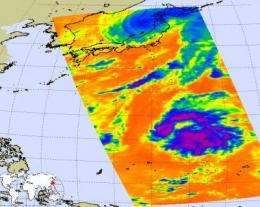
The Aqua satellite captured both Extra-Tropical Storm Melor (top of image) over northwestern Japan, and Tropical Depression Parma (bottom of image) still over the Philippines on Oct. 8 at 0353 UTC (Oct. 7, 11:53 p.m. ET). The infrared image from Aqua's AIRS instrument showed some high, cold, thunderstorm cloud tops (purple) as cold as -63F still in Parma, but warmer and less powerful thunderstorms in Melor. Credit: NASA JPL, Ed Olsen

The Philippines can't seem to get rid of what is now a deadly and annoying Tropical Depression Parma, but forecasters are now providing hope.

Parma may have weakened into a , but its still causing a lot of trouble for the residents of the today. Parma is again moving over Luzon and is expected to finally reach the South China Sea on Friday.

Warnings are still up for many areas of the Philippines again today. Public storm warning signal One is in force in Batanes Group of Islands, Cagayan, Babuyan Islands, Calayan Islands, Isabela, Ilocos Norte & Sur, Apayao, Abra, Kalinga, Ifugao, Mountain Province, Benguet, La Union, Pangasinan, Nueva Viscaya, Quirino, Aurora, Nueva Ecija, Tarlac, Pampanga, Zambales, Bataan and Bulacan.

Parma's center at 11 a.m. EDT today, October 8 was 145 miles north of Manila, near 17.1 North and 121.0 East. Parma had sustained winds near 35 mph and was moving west at 8 mph.
The Philippines may finally get a break from Tropical Depression Parma
Enlarge

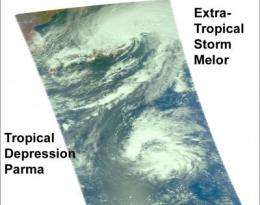
AIRS on NASA's Aqua satellite captured this visible image of both Extra-Tropical Storm Melor (top) over Japan, and Tropical Depression Parma (bottom) over the Philippines on Oct. 8. Credit: NASA JPL, Ed Olsen

The Aqua satellite captured both Extra-Tropical Melor over northwestern Japan, and Tropical Depression Parma still over the Philippines on October 8 at 0353 UTC (Oct. 7, 11:53 p.m. ET). The infrared image from Aqua's AIRS instrument showed some high, cold, thunderstorm cloud tops as cold as -63F still in Parma, but warmer and less powerful thunderstorms in Melor. Those higher, colder thunderstorms in Parma are areas where moderate to heavy rainfall is occurring.

Parma is expected to keep together until it finally moves over the South China Sea and may re-intensify once over open water.

In terms of the Philippines, Parma looks like the short-term end of this tragic, wet period for residents there. Even though a new tropical depression has formed north of Guam, it is forecast to head north then northeast and away from the Philippines.

Source: JPL/NASA (news : web)


Rank not rated yet
Relevant PhysicsForums posts

More news stories

Land and sea species differ in climate change response: study

(Phys.org) -- Marine and terrestrial species will likely differ in their responses to climate warming, new research by Simon Fraser University and Australia’s University of Tasmania has found.

Space & Earth / Environment

created 8 hours ago | popularity 4 / 5 (5) | comments 6 | with audio podcast

Yale study concludes public apathy over climate change unrelated to science literacy

Are members of the public divided about climate change because they don't understand the science behind it? If Americans knew more basic science and were more proficient in technical reasoning, would public consensus match ...

Space & Earth / Environment

created 10 hours ago | popularity 4.8 / 5 (6) | comments 24 | with audio podcast

10 million years needed to recover from mass extinction

It took some 10 million years for Earth to recover from the greatest mass extinction of all time, latest research has revealed.

Space & Earth / Earth Sciences

created 10 hours ago | popularity 4 / 5 (4) | comments 1 | with audio podcast

Sophisticated simulations predict future warming

The chances of our planet being hit by a global warming of 3 degrees Celsius by 2050 is as likely as it being hit by an increase of 1.4 degrees, new research shows. Presented in the journal Nature Geoscience, the British study ...

Space & Earth / Earth Sciences

created May 22, 2012 | popularity 3.8 / 5 (11) | comments 51

Aliens don't want to eat us, says former SETI director

Alien life probably isn’t interested in having us for dinner, enslaving us or laying eggs in our bellies, according to a recent statement by former SETI director Jill Tarter.

Space & Earth / Space Exploration

created May 25, 2012 | popularity 4.4 / 5 (15) | comments 41


'Unzipped' carbon nanotubes could help energize fuel cells, batteries

Multi-walled carbon nanotubes riddled with defects and impurities on the outside could replace some of the expensive platinum catalysts used in fuel cells and metal-air batteries, according to scientists at ...

Change in developmental timing was crucial in the evolutionary shift from dinosaurs to birds: study

At first glance, it's hard to see how a common house sparrow and a Tyrannosaurus Rex might have anything in common. After all, one is a bird that weighs less than an ounce, and the other is a dinosaur that ...

Computer model used to pinpoint prime materials for efficient carbon capture

When power plants begin capturing their carbon emissions to reduce greenhouse gases – and to most in the electric power industry, it's a question of when, not if – it will be an expensive undertaking.

T cells 'hunt' parasites like animal predators seek prey, study shows

By pairing an intimate knowledge of immune-system function with a deep understanding of statistical physics, a cross-disciplinary team at the University of Pennsylvania has arrived at a surprising finding: T cells use a movement ...

Stunning image of smallest possible five-ringed structure

Scientists have created and imaged the smallest possible five-ringed structure – about 100,000 times thinner than a human hair – and you'll probably recognise its shape.

Browser wars flare in mobile space

The browser wars are heating up again, but this time the fight is for dominance of the mobile Internet.