Seven new luminescent mushroom species discovered
Oct 05, 2009
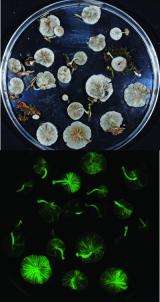
A new luminescent fungus, Mycena silvaelucens, discovered by San Francisco State University Professor Dennis Desjardin and former SF State graduate student Brian Perry has been reported in the journal Mycologia. The species was collected in the grounds of an Orangutan Rehabilitation Center in Borneo, Malaysia and was found on the bark of a standing tree. The mushrooms are tiny with each cap measuring less than 18 millimeters in diameter. Credit: Brian Perry, University of Hawaii

Seven new glow-in-the-dark mushroom species have been discovered, increasing the number of known luminescent fungi species from 64 to 71. Reported today in the journal Mycologia, the new finds include two new species named after movements in Mozart's Requiem. The discoveries also shed light on the evolution of luminescence, adding to the number of known lineages in the fungi 'family tree' where luminescence has been reported.

San Francisco State University Biology Professor Dennis Desjardin and colleagues discovered the in Belize, Brazil, Dominican Republic, Jamaica, Japan, Malaysia and Puerto Rico. The discoveries include four new to science and three new reports of luminescence in known species. Three quarters of glowing mushrooms, including the species described in the study, belong to the Mycena genus, a group of mushrooms that feed off and decompose organic matter as a source of nutrients to sustain their growth.

"What interests us is that within Mycena, the luminescent species come from 16 different lineages, which suggests that evolved at a single point and some species later lost the ability to glow," said Desjardin, lead author of the study. He believes that some fungi glow in order to attract nocturnal animals that aid in the dispersal of the mushroom's spores which are similar to seeds and are capable of growing into new organisms.

"It's pretty unusual to find this many luminescent species, typically only two to five percent of the species we collect in the field glow," Desjardin said. "I'm certain there are more out there."
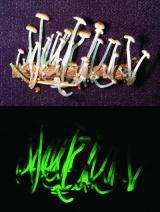
A new luminescent fungus, Mycena luxaeterna discovered by San Francisco State University Professor Dennis Desjardin and Professor Cassius V. Stevani from the University of Sao Paulo has been reported in the journal Mycologia. The species was collected in Sao Paulo, Brazil and was found on sticks in an Atlantic forest habitat. These mushrooms are tiny with each cap measuring less than 8 millimeters in diameter and their stems have a jelly-like texture. The species' name was inspired by Mozart's Requiem. Credit: Cassius V. Stevani, Chemistry Institute, University of Sao Paulo

The newly discovered fungi glow constantly, emitting a bright, yellowish-green light, and are tiny, with caps smaller than one centimeter across.

Desjardin has named two of the new species Mycena luxaeterna (eternal light) and Mycena luxperpetua (perpetual light), names inspired by Mozart's Requiem and the fact that these glow 24 hours a day. To date, Desjardin has discovered more than 200 new fungi species and together with these latest findings, has discovered nearly a quarter of all known luminescent fungi.

More information: "Luminescent Mycena: new and noteworthy species" was published online in the journal Mycologia on Oct. 5 and will appear in the March/April 2010 print issue.

Source: San Francisco State University (news : web)

Explore further: Honeybees trained in Croatia to find land mines

add to favorites email to friend print save as pdf

Related Stories

Long-term co-evolution stability studied

Jun 27, 2006

U.S. biologists say the world's fungus-farming ants cultivate essentially the same fungus and aren't as critical to fungi reproduction as had been thought.

Tree-killing fungus officially named by scientists

Jun 30, 2008

The USDA Forest Service Southern Research Station (SRS) today announced that an SRS scientist and other researchers have officially named the fungus responsible for killing redbay and other trees in the coastal plains of ...

The Evolution of Our Fungi Relatives

Oct 19, 2006

In the latest installment of a major international effort to probe the origins of species, a team of scientists has reconstructed the early evolution of fungi, the biological kingdom now believed to be animals' ...

New light shed on marine luminescence

Feb 23, 2009

The phenomenon of light emission by living organisms, bioluminescence, is quite common, especially in marine species. It is known that light is generated by chemical reactions in which oxygen molecules play ...

Recommended for you

Lovelorn frogs bag closest crooner

5 hours ago

What lures a lady frog to her lover? Good looks, the sound of his voice, the size of his pad or none of the above? After weighing up their options, female strawberry poison frogs (Oophaga pumilio) bag th ...

Honeybees trained in Croatia to find land mines

22 hours ago

(AP)—Mirjana Filipovic is still haunted by the land mine blast that killed her boyfriend and blew off her left leg while on a fishing trip nearly a decade ago. It happened in a field that was supposedly ...

Front-row seats to climate change

May 17, 2013

By day, insects provide the white noise of the South, but the night belongs to the amphibians. In a typical year, the Southern air hangs heavy from the humidity and the sounds of wildlife.

User comments : 0

More news stories

Mapping a route to stem cell therapies

Monash University researchers are shedding light on the complex processes that underpin the creation and differentiation of stem cells, bringing closer the promise of 'miracle' therapies.

Lovelorn frogs bag closest crooner

What lures a lady frog to her lover? Good looks, the sound of his voice, the size of his pad or none of the above? After weighing up their options, female strawberry poison frogs (Oophaga pumilio) bag th ...

Why we need to put the fish back into fisheries

Overfishing has reduced fish populations and biodiversity across much of the world's oceans. In response, fisheries are increasingly reliant on a handful of highly valuable shellfish. However, new research by the University ...

Engineers' nanoantennas improve infrared sensing

(Phys.org) —A team of University of Pennsylvania engineers has used a pattern of nanoantennas to develop a new way of turning infrared light into mechanical action, opening the door to more sensitive infrared ...

Lymphatic fluid takes detour

When tumours metastasise, they can block lymphatic vessels, as researchers from ETH Zurich have discovered using a new method. The lymphatic fluid subsequently has to find a new path through the tissue. Such ...