The Hot Saturn Exoplanet
Oct 02, 2009
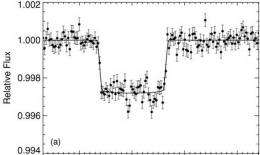
The flux from the star HD149026 and its Saturn-like planet versus time in 4.3 minute intervals, as seen by the Infrared Array Camera as the planet passes in front of the star ("transits"). Credit: Knutson et al. 2009

(PhysOrg.com) -- Of the roughly 350 known exoplanets (i.e., extrasolar planets), the one orbiting the star HD149026 is unique.

It has a mass comparable to that of Saturn but is much smaller in size, indicating that it is made up of a denser material such as ice or rocks. It is therefore quite unlike the large class of "hot Jupiters," giant exoplanets that are primarily composed of and (and that are hot because they orbit close to their parent ).

The comparatively unusual composition of this exoplanet may reflect the chemistry of the original stellar nebula, or perhaps something in the way it formed, or a combination of factors. Whatever the reasons, astronomers suspect that the atmosphere of this planet could also be comparatively unusual. As scientists explore the incredible, new field of exoplanet astronomy, these and other basic questions help to illuminate how our own earth was formed and how it is influenced by the sun.

A team of seven astronomers led by CfA scientists Heather Knutson and David Charbonneau used the IRAC camera on the (the IRAC team is led by CfA astronomer Giovanni Fazio) to measure the daytime and nighttime temperatures of the Saturn-sized exoplanet around HD149026. It happens that this is one of a few that transit its star, which is to say that its directly crosses the line-of-sight of our view of the star.

As the planet passes behind the star, beginning its so-called secondary eclipse, the daylight side of the planet becomes visible for a short time. Using the IRAC camera, the scientists were able to measure the daytime brightness by watching the brightness of the planet change during this phase, with an amazing precision of about 0.04%. They calculate the daytime temperature to be about 1440 kelvin, a value significantly smaller than previous estimates; they also find the average nighttime temperature for the first time, and report that it is about 900 kelvin.

The temperature difference between the day and night side is largely a result of the exoplanet's atmosphere. The scientists argue that the atmosphere shows evidence for some combination of atmospheric circulation, water absorption, and reflectivity. Furthermore, they are able to estimate the energy budget of the planet, and find that, like other that reflect some of the incident starlight (often due to clouds), it appears to emit less flux than it receives from its parent star, although this conclusion is tentative pending observations at other wavelengths. The new paper is a dramatic illustration of the power of the new generation of astronomical instruments whose effectiveness comes not only from their being sensitive, but also from their ability to make extremely precise measurements.

Provided by Harvard-Smithsonian Center for Astrophysics (news : web)

Explore further: Galaxy's Ring of Fire

add to favorites email to friend print save as pdf

Related Stories

Hubble Finds Carbon Dioxide on an Extrasolar Planet

Dec 09, 2008

(PhysOrg.com) -- NASA's Hubble Space Telescope has discovered carbon dioxide in the atmosphere of a planet orbiting another star. This is an important step along the trail of finding the chemical biotracers ...

Hazy red sunset on extrasolar planet

Dec 11, 2007

A team of astronomers have used the NASA/ESA Hubble Space Telescope to detect, for the first time, strong evidence of hazes in the atmosphere of a planet orbiting a distant star. The discovery comes after ...

Extreme winds rule exoplanet's weather

May 09, 2007

Supersonic winds more than six times faster than those on Jupiter are blasting through the atmosphere of a Jupiter-sized planet 60 light years away, say scientists who've analyzed results from NASA's Spitzer ...

New Era in Planetary Science

Mar 23, 2005

Astronomers from NASA said Tuesday that NASA's Spitzer Space Telescope has for the first time ever captured the light from two known Jupiter-like planets orbiting stars other than our Sun. This extraordin ...

Recommended for you

Galaxy's Ring of Fire

22 hours ago

Johnny Cash may have preferred this galaxy's burning ring of fire to the one he sang about falling into in his popular song. The "starburst ring" seen at center in red and yellow hues is not the product of ...

4C+29.30: Black hole powered jets plow into galaxy

May 15, 2013

(Phys.org) —This composite image of a galaxy illustrates how the intense gravity of a supermassive black hole can be tapped to generate immense power. The image contains X-ray data from NASA's Chandra X-ray ...

A space-time magnifying glass

May 15, 2013

(Phys.org) —Bright arcs are smeared around the heart of galaxy cluster Abell S1077 in this image taken by the NASA/ESA Hubble space telescope. The arcs are stretched images of distant galaxies distorted ...

User comments : 3

Adjust slider to filter visible comments by rank

Display comments: newest first

srikkanth_kn
3 / 5 (1) Oct 03, 2009
They usually attach so called 'artistic renditions' This paper illustrates the power of new class of instruments.
smiffy
3 / 5 (1) Oct 04, 2009
It's peculiar that this is both a rare kind of large rocky exoplanet (1 in 350) and that it's also rare in that it's one of the 'few' exoplanets that are in a direct line-of-sight with its star.
I don't know how many 'few' means but if you take it to mean 3 or so that gives a chance of 1 in 100. Taking together that gives a probability of 1 in 350,000 of this being down to chance alone. You've just got to suspect an observational selection effect (over and above the usual selection effect for big planets).

Just how solid is the evidence that the planets found so far are gas giants? Can they be sure of the radius of an object from non-line-of-sight observations? Maybe some of them also have large rocky cores? After all, it's what you might expect with them orbiting so close to their star.
Hungry4info2
4 / 5 (1) Oct 06, 2009
Sniffy, although this is indeed the only planet like this known out of 350 exoplanets, only 62 planets are known to transit. So it could easily be that some of the other 200 non-transiting planets are similar to HD 149026 b, but since we cannot determine their radii, it's impossible to know at this time.

The evidence that these planets are gaseous is a simple density measurement which is made possible through measurements of their mass and radius. Atmospheres have been detected and chemically identified for both HD 189733 b and HD 209458 b.

Three planets, Gliese 436 b, HAT-P-11 b, and CoRoT-7 b, are known to not be Jovian planets. Gliese 436 b and HAT-P-11 b are Neptunes, and CoRoT-7 b is a super-Earth.

No, the radius of a planet cannot yet be determined if the planet does not transit.

And yes, the new-born field of extrasolar planetology has many observational biases, many of which are limitations of technology. Gargantuan planets tend to stick out over little ones.

More news stories

Russia retrieves mice, newts from space

A Russian capsule filled with 45 mice and 15 newts along with other small animals returned from a month's mission in orbit on Sunday with data scientists hope will pave the way for a manned flight to Mars.

Galaxy's Ring of Fire

Johnny Cash may have preferred this galaxy's burning ring of fire to the one he sang about falling into in his popular song. The "starburst ring" seen at center in red and yellow hues is not the product of ...

German energy shift faces headwinds

Tense engineers have their eyes peeled on complex colour-coded diagrams on a wall-sized screen that makes their control room look like the inside of a spaceship.

China police billions spell profit opportunity

Mannequins in riot gear, armoured cars and drones line a police equipment and "anti-terrorism technology" trade fair in Beijing as vendors seek to profit from China's huge internal security budget.

Honeybees trained in Croatia to find land mines

(AP)—Mirjana Filipovic is still haunted by the land mine blast that killed her boyfriend and blew off her left leg while on a fishing trip nearly a decade ago. It happened in a field that was supposedly ...

Internet in 'coma' as Iran election looms

Iran is tightening control of the Internet ahead of next month's presidential election, mindful of violent street protests that social networkers inspired last time around over claims of fraud, users and ...