A Twist in the Genome Thwarts Hepatitis C
Sep 30, 2009 By Susan Brown
A Twist in the Genome Thwarts Hepatitis C
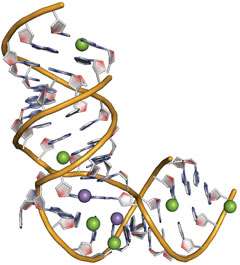
Credit: Thomas Hermann

(PhysOrg.com) -- Viruses like Hepatitis C proliferate by tricking cellular machinery into manufacturing the parts for duplicate viral particles.

Although thwarting that process might effectively treat viral infections, the few inhibiting compounds that have been identified so far aren’t good candidates for drugs. And biochemists weren’t exactly sure how they were working.

Now Thomas Hermann, assistant professor of chemistry and biochemistry, and colleagues at UC San Diego have shown that this bent loop on the viral genome changes its shape in response to the inhibitors, preventing the from reading the codes for viral proteins.

Their discovery, published online this week in Nature Chemical Biology, will guide the search for better candidates to quell the virus, which the World Health Organization estimates infects about 170 million people worldwide and causes chronic liver disease and liver cancer.

Hermann’s group is now looking for new, more easily synthesized , that might stop viral replication in a similar way.

Provided by University of California - San Diego (news : web)

Explore further: Scientists develop advanced biological computer

add to favorites email to friend print save as pdf

Related Stories

Hepatitis C virus enzyme sites revealed

Jul 24, 2006

U.S. researchers say the crystal structure of one of the hepatitis C viral proteins might offer new opportunities for antiviral drug design.

New strategy for inhibiting virus replication

Aug 14, 2009

Viruses need living cells for replication and production of virus progeny. Thus far, antiviral therapy primarily targets viral factors but often induces therapy resistance. New improved therapies attempt to targets cellular ...

Penn researchers discover new mechanism for viral replication

Aug 16, 2007

Researchers at the University of Pennsylvania School of Medicine have identified a new strategy that Kaposi’s Sarcoma Associated Herpesvirus (KSHV) uses to dupe infected cells into replicating its viral genome. This allows ...

Recommended for you

Scientists develop advanced biological computer

15 hours ago

(Phys.org) —Using only biomolecules (such as DNA and enzymes), scientists at the Technion-Israel Institute of Technology have developed and constructed an advanced biological transducer, a computing machine capable of manipulating ...

Research aims to fix long-held, inaccurate insect model

16 hours ago

(Phys.org) —In humans, a polymer called melanin determines skin, eye and hair color—the darker the skin, the more melanin in a person's body. For insects, melanin is a major aspect of their immune defense ...

Molecular modelling to help create better, safer drugs

16 hours ago

(Phys.org) —How our bodies break down the common drugs ibuprofen, diclofenac and warfarin is the subject of a new study from the University of Bristol, published in the Journal of the American Chemical So ...

User comments : 0

More news stories

Scientists develop advanced biological computer

(Phys.org) —Using only biomolecules (such as DNA and enzymes), scientists at the Technion-Israel Institute of Technology have developed and constructed an advanced biological transducer, a computing machine capable of manipulating ...

Galaxies fed by funnels of fuel

(Phys.org) —Computer simulations of galaxies growing over billions of years have revealed a likely scenario for how they feed: a cosmic version of swirly straws.

Google eyes emerging markets networks

Google has become deeply involved in a series of projects to build and operate wireless networks in emerging markets including sub-Saharan Africa and Southeast Asia, a report said Friday.