New X-ray technique illuminates reactivity of environmental contaminants
Sep 15, 2009
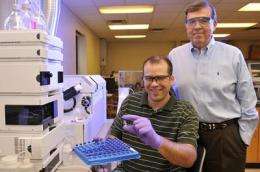
Pictured are Matthew Ginder-Vogel, left, and Donald Sparks, S. Hallock du Pont Chair of Plant and Soil Sciences and director of the Delaware Environmental Institute at the University of Delaware. Credit: Kathy F. Atkinson/University of Delaware

Thanks to a new analytical method employed by researchers at the University of Delaware, scientists can now pinpoint, at the millisecond level, what happens as harmful environmental contaminants such as arsenic begin to react with soil and water under various conditions.

Quantifying the initial rates of such reactions is essential for modeling how contaminants are transported in the environment and predicting risks.

The research method, which uses an analytical technique known as quick-scanning X-ray absorption spectroscopy (Q-XAS), was developed by a research team led by Donald Sparks, S. Hallock du Pont Chair of Plant and Soil Sciences and director of the Delaware Environmental Institute at UD. The work is reported in the Sept. 10 Early Edition of the and will be in the Sept. 22 print issue.

Postdoctoral researcher Matthew Ginder-Vogel is the first author of the study, which also involved Ph.D. student Gautier Landrot and Jason Fischel, an undergraduate student at Juniata College who has interned in Sparks's lab during the past three summers.

The research method was developed using beamline X18B at the at Brookhaven National Laboratory in Upton, N.Y. The facility is operated by the U.S. Department of Energy.

"This method is a significant advance in elucidating mechanisms of important geochemical processes, and is the first application, at millisecond time scales, to determine in real-time, the molecular scale reactions at the mineral/water interface. It has tremendous applications to many important environmental processes including sorption, redox, and precipitation," Sparks said.

"My group and I have been conducting kinetics studies on soils and soil minerals for 30 years," Sparks added. "Since the beginning I have been hopeful that someday we could follow extremely rapid reaction processes and simultaneously collect mechanistic information."

X-ray spectroscopy was invented years ago to illuminate structures and materials at the atomic level. The technique has been commonly used by physicists, chemists, materials scientists, and engineers, but only recently by environmental scientists.

"In studying kinetics, we want to know how fast a contaminant begins to stick to a mineral," Ginder-Vogel says. "In general, these reactions are very rapid -- 90 percent of the reaction is over in the first 10 seconds. Now we can measure the first few seconds of these reactions that couldn't be measured before. We can now look at things as they happen versus attempting to freeze time after the fact," he notes.

For their study, the UD researchers made millisecond measurements of the oxidation rate of arsenic by hydrous manganese oxide, which is a mineral that absorbs heavy metals and nutrients.

Contamination of drinking supplies by arsenic is a serious health concern in the United States and abroad. The poisonous element occurs naturally in rocks and minerals and is also used in a wide range of products, from wood preservatives and insecticides, to poultry feed.

The toxicity and availability of arsenic to living organisms depends on its oxidation state -- in other words, the number of electrons lost or gained by an atom when it reacts with minerals and microbes. For example, arsenite [As(III)] is more mobile and toxic than its oxidized counterpart, arsenate [As(V)].

"Our technique is important for looking at groundwater flowing through minerals," Ginder-Vogel notes. "We look at it as a very early tool that can be incorporated into predictive modeling for the environment."

Source: University of Delaware (news : web)

Explore further: Attacking MRSA with metals from antibacterial clays

add to favorites email to friend print save as pdf

Related Stories

Scientists Describe New Way to Peer Inside Bacteria

Aug 29, 2005

X-rays yield pictures and chemical clues that may help trace contaminants, thwart terrorists As part of the search for better ways to track and clean up soil contaminants, scientists at the U.S. Departmen ...

Water-stingy agriculture reduces arsenic in rice markedly

Jul 28, 2008

A new farming method first developed to conserve precious irrigation water may have the added benefit of producing rice containing much less arsenic than rice grown using traditional rice-farming methods, researchers in the ...

Arsenic and new rice

Jun 10, 2008

Amid recent reports of dangerous levels of arsenic being found in some baby rice products, scientists have found a protein in plants that could help to reduce the toxic content of crops grown in environments with high levels ...

Recommended for you

Attacking MRSA with metals from antibacterial clays

May 17, 2013

In the race to protect society from infectious microbes, the bugs are outrunning us. The need for new therapeutic agents is acute, given the emergence of novel pathogens as well as old foes bearing heightened antibiotic resistance.

Keeping fruit, vegetables and cut flowers fresh longer

May 15, 2013

New technology offers the promise of reducing billions of dollars of losses that occur each year from the silent, invisible killer of fruits, vegetables and cut flowers—a gas whose effects are familiar to everyone who has ...

Why don't beetles freeze in the winter?

May 14, 2013

For 37 years, Queen's University Biochemistry professor Peter Davies has been unraveling the mystery of why some organisms including insects and fish don't freeze in the winter. His research into insect antifreeze protein ...

The molecular basis of strawberry aroma

May 13, 2013

You know that summer is here when juicy red strawberries start to appear on the shelves. In Germany, this seasonal fruit has never been more popular: on average 3.5 kilos per head were consumed in 2012—a ...

A new dimension for 3-D protein structures

May 13, 2013

(Phys.org) —3D structures of biological molecules like proteins directly affect the way they behave in our bodies. EPFL scientists have developed a new infrared-UV laser method to more accurately determine ...

User comments : 0

More news stories

Attacking MRSA with metals from antibacterial clays

In the race to protect society from infectious microbes, the bugs are outrunning us. The need for new therapeutic agents is acute, given the emergence of novel pathogens as well as old foes bearing heightened antibiotic resistance.

Beautiful 'flowers' self-assemble in a beaker

By simply manipulating chemical gradients in a beaker of fluid, materials scientists at Harvard have found that they can control the growth behavior of crystals to create precisely tailored structures—such ...

Making gold green: New non-toxic method for mining gold

Northwestern University scientists have struck gold in the laboratory. They have discovered an inexpensive and environmentally benign method that uses simple cornstarch—instead of cyanide—to isolate gold from raw materials ...

Heat-related deaths in Manhattan projected to rise

Residents of Manhattan will not just sweat harder from rising temperatures in the future, says a new study; many may die. Researchers say deaths linked to warming climate may rise some 20 percent by the 2020s, ...

Honeybees trained in Croatia to find land mines

(AP)—Mirjana Filipovic is still haunted by the land mine blast that killed her boyfriend and blew off her left leg while on a fishing trip nearly a decade ago. It happened in a field that was supposedly ...

Mice, gerbils perish in Russia space flight

A number of mice and eight gerbils sent into space in a Russian capsule destined to find out how well organisms can withstand extended flights perished during their journey, scientists said Sunday as the ...