Spirit Rover: Computer Modeling Supplements Dusty Testing
Sep 15, 2009
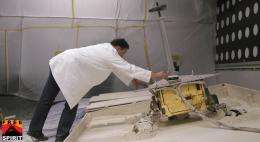
Tests of possible maneuvers for use by NASA's rover Spirit on Mars include use of this lightweight test rover at NASA's Jet Propulsion Laboratory, Pasadena, Calif.

(PhysOrg.com) -- Tests on Earth simulating Spirit's predicament on Mars have reinforced understanding that getting Spirit to rove again will be very difficult.

To supplement the tests at NASA's Jet Propulsion Laboratory in Pasadena, Calif., the rover team is refining a detailed of rover mobility, calibrated with results from testing and measurements from .

"The computer modeling will allow us to connect the results from tests performed in Earth gravity with what to expect from the rover in Mars gravity," said JPL's John Callas, project manager for Spirit and its twin, Opportunity.

Spirit became embedded in soft soil at a site called "Troy" in early May, more than five years into a mission on Mars that was originally scheduled to last for three months. The rover team suspended further driving attempts with Spirit while evaluating possibilities from tests performed at JPL simulating the Troy situation.

An additional round of testing was added to the September schedule to gain more detailed assessment of how to move Spirit while avoiding putting the rover's center of directly over a rock that is touching or nearly touching the rover's underbelly. Other added tests are using a lighter-weight test rover than the one used for most of the testing this summer. A complete "dress rehearsal" test of the extrication strategy judged to hold the best chance of success is planned in the test setup at JPL before the team commands Spirit to begin driving. That test and subsequent review of its results are expected to take several weeks. Moves by Spirit will not begin before October, according to current plans.

"We are proceeding very cautiously and exploring all reasonable options," Callas said. "There is a very real possibility that Spirit may not be able to get out, and we want to give Spirit the very best chance."

A dust storm that had reduced the electrical output from Spirit's solar panels by nearly half during late August still has some lingering effects on the skies above Spirit.

Provided by JPL/NASA (news : web)

Explore further: Field tests in Mojave Desert pave way for human exploration of small bodies

add to favorites email to friend print save as pdf

Related Stories

Second Test Rover Added to Driving Experiments

Aug 24, 2009

A second, lighter-weight test rover has entered the testing setup at JPL where rover team members are assessing strategy for getting Spirit out of soft soil where it is embedded on Mars.

Spirit rover's wheels stuck in soft Martian dirt

May 12, 2009

(PhysOrg.com) -- The five wheels that still rotate on NASA's Mars Exploration Rover Spirit have been slipping severely in soft soil during recent attempts to drive, sinking the wheels about halfway into the ...

Planned Rover Test to Run a Week or More

Aug 14, 2009

(PhysOrg.com) -- Mars rover team members are planning a long-duration experiment with the test rover at JPL beginning next week. This test will check whether favorable motion seen in earlier tests can be sustained ...

Mars Rover Team Sets Low-Power Plan for NASA's Spirit

Nov 17, 2008

(PhysOrg.com) -- After assessing data received from NASA's Mars Exploration Rover Spirit on Thursday, mission controllers laid out plans for the rover to conserve its modest energy during the next few weeks.

Recommended for you

Mars rover Opportunity examines clay clues in rock

23 hours ago

(Phys.org) —NASA's senior Mars rover, Opportunity, is driving to a new study area after a dramatic finish to 20 months on "Cape York" with examination of a rock intensely altered by water.

NASA's STEREO detects a CME from the sun

May 17, 2013

On 5:24 a.m. EDT on May 17, 2013, the sun erupted with an Earth-directed coronal mass ejection or CME, a solar phenomenon that can send billions of tons of solar particles into space that can reach Earth ...

Nine-year-old Mars rover passes 40-year-old record

May 17, 2013

While Apollo 17 astronauts Eugene Cernan and Harrison Schmitt visited Earth's moon for three days in December 1972, they drove their mission's Lunar Roving Vehicle 19.3 nautical miles (22.210 statute miles ...

Bright explosion on the Moon

May 17, 2013

For the past 8 years, NASA astronomers have been monitoring the Moon for signs of explosions caused by meteoroids hitting the lunar surface. "Lunar meteor showers" have turned out to be more common than anyone ...

User comments : 0

More news stories

Galaxy's Ring of Fire

Johnny Cash may have preferred this galaxy's burning ring of fire to the one he sang about falling into in his popular song. The "starburst ring" seen at center in red and yellow hues is not the product of ...

Earth's center is out of sync

(Phys.org) —We all know that the Earth rotates beneath our feet, but new research from ANU has revealed that the center of the Earth is out of sync with the rest of the planet, frequently speeding up and ...