New thread in fabric of insect silks
Sep 10, 2009
New thread in fabric of insect silks
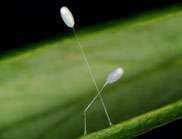
Lacewing eggs on the end of their rigid silk stalks. The egg stalk silk is produced as a droplet which is drawn out by the female and dries rapidly. Photo by: Holly Trueman

(PhysOrg.com) -- The aptly named silk worms long appeared to have the monopoly on insect silk production, but now scientists are revealing that the world of insect silks is highly complex.

Not only do different insects produce different silks but individual species can produce more than one type of silk.
CSIRO scientists have just revealed their findings on the rare and fascinating silk that lacewings use to make their egg stalks - a cross-beta silk.

“We have identified and sequenced the genes for the egg stalk silk of adult females of a common Australian green lacewing, Mallada signata,” CSIRO Entomology’s Dr Tara Sutherland said. “We found that the lacewing egg stalk silk contains two fibrous proteins which are folded up like panels in a concertina door.

“The silk in the egg stalk is produced as a liquid and dries in few seconds in air. It is very strong with a high lateral stiffness - nearly three times that of silkworm silk - and remarkable elasticity.”

A female lacewing produces the silk as a drop of liquid which she then draws out. The thread hardens in a few seconds and the female then lays an egg on its tip, protecting the egg against predators.

Dr Sutherland said this is another fascinating insight into the world of biological silks.

Scientists have long sought to produce artificial insect silks. Understanding this lacewing silk brings them closer to achieving their goal.

The lacewing’s silk is produced as a liquid which rapidly solidifies in air, making it easier to produce than through the complex systems of and spiders.

Dr Sutherland said that silk production is a multi-step process which involves making the proteins and then fabricating these into the physical structure of silk.

While the silk proteins from bee and ant silks are easier to produce chemically, it is the much simpler way lacewings fabricate their silk that has caught the scientists’ interest.

This lacewing is also a very effective biocontrol agent as its consume, amongst other things, aphids, mealybugs and mites.

More information: Sarah Weisman, Shoko Okada, Stephen T Mudie, Mickey G Huson, Holly E Trueman, Alagone Sriskantha, Victoria S. Haritos, Tara D Sutherland. (2009). Fifty years later: the sequence, structure and function of lacewing cross-beta silk. Journal of Structural Biology, doi:10.1016/j.jsb.2009.07.002

Provided by CSIRO (news : web)

Explore further: New discovery of ancient diet shatters conventional ideas of how agriculture emerged

add to favorites email to friend print save as pdf

Related Stories

Bees are the new silkworms

Nov 20, 2007

Moths and butterflies, particularly silkworms, are well known producers of silk. And we all know spiders use it for their webs. But they are not the only invertebrates who make use of the strength and versatility ...

Spider silks, the ecological materials of tomorrow?

Dec 04, 2004

Spider silks could become the intelligent materials of the future, according to a review article published this month in the journal Microbial Cell Factories. The characteristics of spider silk could have applications in ...

Stretchy spider silks can be springs or rubber

May 31, 2008

It’s stronger than steel and nylon, and more extensible than Kevlar. So what is this super-tough material? Spider silk; and learning how to spin it is one of the materials industries’ Holy Grails. John Gosline has been ...

Recommended for you

Turning up the heat on biofuels

May 16, 2013

(Phys.org) —The production of biofuels from lignocellulosic biomass would benefit on several levels if carried out at temperatures between 65 and 70 degrees Celsius. Researchers with the Energy Biosciences ...

Getting to the root of better crops

May 16, 2013

(Phys.org) —The more crop scientists know about how plant roots take up water and nutrients, the better able they will be to develop crop plants with roots that can cope with challenging soil and environmental ...

User comments : 0

More news stories

Front-row seats to climate change

By day, insects provide the white noise of the South, but the night belongs to the amphibians. In a typical year, the Southern air hangs heavy from the humidity and the sounds of wildlife.

Galaxy's Ring of Fire

Johnny Cash may have preferred this galaxy's burning ring of fire to the one he sang about falling into in his popular song. The "starburst ring" seen at center in red and yellow hues is not the product of ...

New colonoscope provides ground-breaking view of colon

A ground-breaking advance in colonoscopy technology signals the future of colorectal care, according to research presented today at Digestive Disease Week(DDW). Additional research focuses on optimizing the minimal withdrawal ...