Novel research to root out how microbes affect rice plants
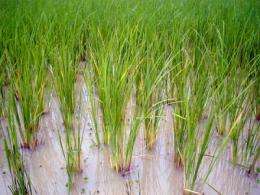
Plants that live in the soil don't live alone -- a mere teaspoon of soil teems with an estimated billion microscopic organisms.
Yet comparatively little is known about which of these tiny organisms interact with plants or how they may affect plant performance and crop yields, according to Harsh Bais, assistant professor of plant and soil sciences at the University of Delaware.
With a three-year, $1.9 million grant from the National Science Foundation, Bais is teaming up with researchers from the University of California Davis and Delaware State University to uncover the diversity and potential impacts of microbes that literally lie at the roots of rice, one of the world's most important food crops.
More than half the world's population -- over 3 billion people -- depend on rice for survival, according to the International Rice Commission.
"What is the importance of the involvement of microbes in plants? It hasn't really been examined," Bais notes. "We think that plants are doing everything on their own, but there is a whole world of microbes underground, associated with the roots of plants, that has yet to be analyzed."
Scientists have long known the symbiotic relationship between legume plants such as beans and the bacteria known as rhizobia that colonize the plants' roots and enable the plants to convert nitrogen from the air into fertilizer.
More recently, in research reported last fall, Bais and his colleagues showed that when the leaves of the small flowering plant Arabidopsis thaliana were infected by a pathogen, the plant secreted an acid to recruit beneficial bacteria in the soil (Bacillus subtilis) to come to its defense.
The study caught the attention of plant biologist Venkatesan Sundaresan and evolutionary biologist Jonathan Eisen at the University of California Davis, who are Bais's co-investigators on the rice grant.
Venugopal Kalavacharla, assistant professor of agriculture and natural resources at Delaware State University, and Gurdev Khush, an agronomist and geneticist at the University of California Davis, also are collaborators.
During the coming months, Bais will be working to set up a hydroponic method for growing rice in laboratories at the Delaware Biotechnology Institute and the College of Agriculture and Natural Resources. His colleagues in California will be growing rice in the field and supplying plant and soil samples to Bais's lab for microbial and genetic analysis.
A controlled experimental system will be established to dissect the impact of microbial associations on rice. Transcriptomic and metabolic profiling will reveal the genes actively being expressed by the plants in response to a variety of conditions.
The profiles will be analyzed for global changes in gene expression, as well as specific functional classes of genes that would reflect changes in nutrient availability, or establishment of plant immunity, for example, which can be confirmed by metabolic analysis and susceptibility to pathogens.
"A comprehensive understanding of the effects of root-associated microbes -- what we refer to as the microbiome -- on crop plants will enable the development of agricultural technologies that exploit the natural alliances among microbes and plants and may provide new avenues to increase yields beyond conventional plant genetics and breeding," Bais says. "We are very excited to get started on this research."
As part of the project, an undergraduate internship program in cutting-edge plant science will be developed for outstanding students from Delaware State University and Delaware Technical and Community College. An innovative "Field To Lab" program spanning agricultural sampling to bioinformatics will provide students with the opportunity to participate in field and laboratory studies of rice biology at both UD and the University of California Davis. The internship program is slated to begin next summer.
Source: University of Delaware (news : web)


