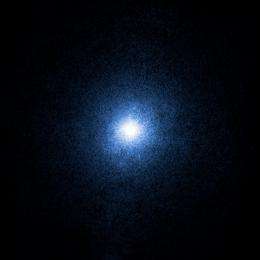
Cygnus X-1: Still a 'Star' After All Those Years
Aug 28, 2009
Credits: NASA/CXC

Since its discovery 45 years ago, Cygnus X-1 has been one of the most intensively studied cosmic X-ray sources. About a decade after its discovery, Cygnus X-1 secured a place in the history of astronomy when a combination of X-ray and optical observations led to the conclusion that it was a black hole, the first such identification.

The Cygnus X-1 system consists of a black hole with a mass about 10 times that of the Sun in a close orbit with a blue supergiant star with a mass of about 20 Suns. Gas flowing away from the supergiant in a fast stellar wind is focused by the black hole, and some of this gas forms a disk that spirals into the black hole. The gravitational energy release by this infalling gas powers the X-ray emission from Cygnus X-1.

Although more than a thousand scientific articles have been published on Cygnus X-1, its status as a bright and nearby black hole continues to attract the interest of scientists seeking to understand the nature of and how they affect their environment. Observations with Chandra and ESA's are especially valuable for studying the property of the stellar wind that fuels Cygnus X-1, and determining its rate of spin.

This latter research has revealed that Cygnus X-1 is spinning very slowly. This puzzling result could indicate that Cygnus X-1 may have formed in an unusual type of that somehow prevented the newly formed black hole from acquiring as much spin as other stellar black holes.

Provided by JPL/NASA (news : web)

Explore further: Final curtain for Europe's deep-space telescope

add to favorites email to friend print save as pdf

Related Stories

Black Hole Blows Bubble Between The Stars

Aug 11, 2005

A team of astronomers from The Netherlands and the UK has discovered a vast "jet-powered bubble" formed in the gas around a black hole in the Milky Way.

New Massive Black Hole Smashes Record

Oct 30, 2007

Using two NASA satellites, astronomers have discovered the heftiest known black hole to orbit a star. The new black hole, with a mass 24 to 33 times that of our Sun, is more massive than scientists expected ...

A new way to weigh giant black holes

Jul 16, 2008

How do you weigh the biggest black holes in the universe? One answer now comes from a completely new and independent technique that astronomers have developed using data from NASA's Chandra X-ray Observatory.

Recommended for you

Final curtain for Europe's deep-space telescope

14 hours ago

The deep-space telescope Herschel took its final bow on Monday, climaxing a successful four-year mission to observe the birth of stars and galaxies, the European Space Agency (ESA) said.

Hubble spots a very bright contortionist

19 hours ago

(Phys.org) —The contorted object captured by Hubble in this picture is IRAS 22491-1808, also known as the South America Galaxy. It is an ultra-luminous infrared galaxy (ULIRG) that emits a huge amount of ...

Study explains decades of black hole observations

Jun 14, 2013

(Phys.org) —A new study by astronomers at NASA, Johns Hopkins University and Rochester Institute of Technology confirms long-held suspicions about how stellar-mass black holes produce their highest-energy ...

User comments : 4

Adjust slider to filter visible comments by rank

Display comments: newest first

Nik_2213
not rated yet Aug 28, 2009
There's lots of scenarios that may spin-up a black-hole progenitor. What will make them spin-down ? Interaction of mag field with surrounds ?
Ashibayai
not rated yet Aug 29, 2009
Tidal deceleration.
Birger
not rated yet Aug 29, 2009
Is the visible component -the blue supergiant- the star known as HDE226868? Or am I confusing X-ray sources?
yyz
not rated yet Aug 30, 2009
@birger, yes, indeed the blue supergiant is a.k.a. HD 226868, V1367 Gyg, BD 35 3815, among many other catalog numbers :)

More news stories

Predators affect the carbon cycle, researchers show

A new study shows that the predator-prey relationship can affect the flow of carbon through an ecosystem. This previously unmeasured influence on the environment may offer a new way of looking at biodiversity management and ...

Final curtain for Europe's deep-space telescope

The deep-space telescope Herschel took its final bow on Monday, climaxing a successful four-year mission to observe the birth of stars and galaxies, the European Space Agency (ESA) said.

New language discovery reveals linguistic insights

A new language has been discovered in a remote Indigenous community in northern Australia that is generated from a unique combination of elements from other languages. Light Warlpiri has been documented by University of Michigan ...