The lost voyage: First English-led expedition to North America
(PhysOrg.com) -- Evidence of a previously unknown voyage to North America in 1499, led by a Bristol explorer, is to be published this week in the academic journal Historical Research.
The article by Dr Evan Jones, a historian at Bristol University, suggests that a Bristol merchant, William Weston, undertook a voyage to the ‘New Found Land’ just two years after the first voyage of Venetian explorer John Cabot who sailed from Bristol to ‘discover’ North America in 1497.
Cabot led a second, larger, expedition the following year (1498) to explore the new land, with support from King Henry VII. However, a third expedition undertaken by Weston in 1499 with the support of the King, has remained unknown until now.
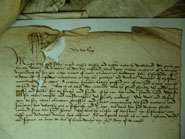
The main evidence for the voyage comes from a personal letter written by the King to his Lord Chancellor on 12 March 1499. In this, Henry VII instructs his minister to suspend an injunction served against Weston in the Court of Chancery because Weston shall shortly ‘with God’s grace pass and sail for to search and find if he can the new found land’.
While this was an independent voyage, it seems that Weston was permitted to undertake it because he was one of Cabot’s chief supporters in Bristol. This meant that, although Cabot had received monopoly rights for westwards exploration from England, Weston was covered by the terms of Cabot’s royal patent.
Dr Evan Jones said “Henry VII’s letter is an exciting find because so little is known about the early English voyages of discovery. We knew that our knowledge of the first English expeditions to the New World was very incomplete. But this is beginning to show just how incomplete it is. Up till now, no one has ever even heard of William Weston. Yet this letter reveals him to be the first Englishman to lead an expedition to North America.”
Although the letter itself does not reveal what Weston achieved, research suggests that his expedition took him up into the Labrador Sea, possibly reaching as far as the Hudson Straits. “If so”, Dr Jones continued, “this can probably be counted as the first Northwest Passage expedition, commencing a centuries-long search to locate a sea-route around North America.”
Although the publication of this research is entirely new, Dr Jones is keen to stress that the letter itself was found thirty years ago, miscataloged among a bundle of Chancery files in what is now The National Archives. The archivist who found the letter, Miss Margaret Condon, passed on the information to the eminent discovery historian, Professor David Beers Quinn in 1981. He, however, failed to publish the information because he wanted to wait for another historian, Dr Alwyn Ruddock, to publish her research on the Cabot voyages first. This, however, never happened, leaving the letter unpublished at the time of Quinn’s death in 2002.
That the letter ever came to light was only the result of a bizarre twist in events. In 2005, Dr Alwyn Ruddock died, leaving instructions that all her research notes be destroyed. This was despite the fact that, during the forty years she had been researching the Cabot voyages, she had apparently made discoveries that looked set to revolutionise the field.
Following her death, Dr Jones commenced a search to discover just what Ruddock had found, his investigations being published in a earlier edition of Historical Research. Ruddock had apparently uncovered evidence that Cabot and his supporters had explored a large section of the coast of North America from 1498-1500 and, moreover, that an offshoot of his expedition established the Continent’s first Christian community in Newfoundland. It was while investigating Ruddock’s claims that Dr Jones found out about the discoveries of Margaret Condon, made decades before.
Jones and Condon have now teamed up with researchers in Canada to carry out more work on the early voyages. “When I first started investigating Ruddock’s claims’, Dr Jones said, “some people were somewhat sceptical about her claims. It was perhaps easier to think that she might have gone a bit ‘batty’ in her old age than to believe that her extraordinary claims might be true. Now though, with the bits and pieces of evidence falling into place, the hunt to relocate the material that she found, is certainly on.”
More information:
• E. T. Jones, 'Henry VII and the Bristol expeditions to North America: the Condon documents', Historical Research. This paper will be made freely available on ‘Early View’ this week.
• E. T.Jones, 'Alwyn Ruddock: John Cabot and the Discovery of America', Historical Research Vol 81, Issue 212 pages 224-254, 5 Apr 2007
Provided by University of Bristol (news : web)
