NASA's satellite imagery sees Hilda hit a wall
Aug 27, 2009
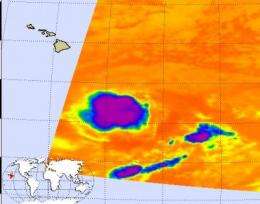
The Atmospheric Infrared Sounder (AIRS) instrument on the Aqua satellite saw Hilda's cold clouds on Aug. 26 at 7:29 a.m.EDT and didn't see an eye or the hallmark "comma shape" of the storm, just a rounded area of thunderstorms that indicated she was losing her punch. Credit: NASA JPL, Ed Olsen

Two days ago, Hilda was in prime shape to strengthen further as she tracked westward, far south of the Hawaiian Islands. Today, as a result of winds and cooler waters, she's weakened to a tropical depression, and NASA satellites helped confirm that looking at her waning winds and thunderstorms.

The Atmospheric Infrared Sounder (AIRS) instrument on the Aqua observes Hilda's cold clouds, which is an indication of strength. The colder the thunderstorms, the higher and more powerful they are, but Hilda didn't show any. AIRS imagery also didn't see an eye or the hallmark "comma shape" of the storm, just a rounded area of thunderstorms that indicated she was losing her punch.
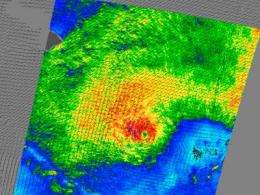
NASA's QuikScat satellite captured Tropical Depression Hilda's winds using its microwave imagery to peer through its clouds on Aug. 26 at 12:26 a.m. EDT). The strongest winds are represented in the center of circulation in the red area, which are about 34 mph. White barbs point to the few areas of heavy rain near Hilda's center. Credit: NASA JPL, Peter Falcon

NASA's QuikScat satellite also watched Hilda's winds slow from tropical storm to tropical depression-force today, August 27.

Like the Aqua satellite, every day, NASA's captures data from tropical cyclones. QuikScat reads the rotating surface wind speeds of tropical cyclones using its microwave imagery to peer through their clouds. QuikScat data are used to make images that show wind speeds in different colors and wind direction are indicated by small barbs. The highest speeds are normally shown in purple, which indicate winds over 40 knots (46 mph), but QuikScat today revealed that Hilda's highest winds in the center were only near 34 mph.

Hilda's sustained winds were near 34 mph, and fading because of the cooler waters she's moved into. Her center is located near 13.7 north and 152.5 west
She was moving west-southwest near 9 mph, and will continue tracking south of the Hawaiian Islands.

She's not expected to totally dissipate until Monday, August 31.

Source: NASA/Goddard Space Flight Center

Explore further: New atmospheric modeling paradigm breaks previously accepted notions

add to favorites email to friend print save as pdf

Related Stories

NASA satellites see remnant low Dolores go out kicking

Jul 17, 2009

The remaining clouds and showers that were once tropical storm Dolores are fading at sea, more than 940 miles west of Cabo San Lucas, Mexico. Dolores has now weakened into a remnant low pressure area but continues ...

Recommended for you

Bacterium from Canadian High Arctic and life on Mars

2 hours ago

(Phys.org) —The temperature in the permafrost on Ellesmere Island in the Canadian high Arctic is nearly as cold as that of the surface of Mars. So the recent discovery by a McGill University led team of ...

NASA's Landsat satellite looks for a cloud-free view

17 hours ago

For decades, Landsat satellites have documented the desiccation of the Aral Sea in Central Asia. Once one of the largest seas in the world, it shrunk to a tenth of its original volume after Russia diverted ...

User comments : 0

More news stories

Century-old science helps confirm global warming

(Phys.org) —Ocean measurements taken more than 135 years ago during the scientific expedition of HMS Challenger have provided further confirmation of human-produced global warming over the past century.

Bacterium from Canadian High Arctic and life on Mars

(Phys.org) —The temperature in the permafrost on Ellesmere Island in the Canadian high Arctic is nearly as cold as that of the surface of Mars. So the recent discovery by a McGill University led team of ...

Chemists find new compounds to curb staph infection

(Phys.org) —In an age when microbial pathogens are growing increasingly resistant to the conventional antibiotics used to tamp down infection, a team of Wisconsin scientists has synthesized a potent new ...

Engineers pioneer flat spray-on optical lens

A University of British Columbia engineer and a team of U.S. researchers have made a breakthrough utilizing spray-on technology that could revolutionize the way optical lenses are made and used.