A better test to detect DNA for diagnosing diease, investigating crimes
Aug 26, 2009
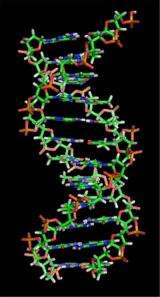
Scientists have developed a new electronic sensor that shows promise as a better way to detect DNA for diagnosing disease and investigating crimes. Credit: Wikimedia Commons

Researchers in Singapore are reporting development of a new electronic sensor that shows promise as a faster, less expensive, and more practical alternative than tests now used to detect DNA. Such tests are done for criminal investigation, disease diagnosis, and other purposes. The new lab-on-a-chip test could lead to wider, more convenient use of DNA testing, the researchers say. Their study is scheduled for the Sept. 2 issue of the Journal of the American Chemical Society.

In the new study, Zhiqiang Gao and colleagues note that current methods for detecting DNA involve the used of the (PCR). This technique "amplifies" or makes multiple copies of trace amounts of DNA, much as a photocopier produces multiple copies of documents, in order to detect the more easily. The amplification step is one reason why tests involving PCR can be too expensive, cumbersome, and imprecise for wider use.

The researchers describe development of a so-called "nanogap sensor" that appears to overcome those obstacles. The process uses a pair of micro-sized metal electrodes separated by a nanogap, 1/50,000 the width of a human hair, in combination with special chemical probes, to capture tiny segments of DNA. The newly formed "circuit" then translates the presence of DNA into an electrical signal so that it can be measured by a computer. In laboratory tests, the sensor showed "excellent" sensitivity at detecting trace amounts of human DNA and may eliminate the need for DNA amplification altogether, the researchers say.

More information: "Mass-Produced Nanogap Sensor Arrays for Ultrasensitive Detection of DNA",

Source: American Chemical Society (news : web)

Explore further: RNA capable of catalyzing electron transfer on early earth with iron's help, study says

add to favorites email to friend print save as pdf

Related Stories

Early detection of human papilloma and other viral infections

Oct 15, 2007

Scientists in Iowa are reporting development of a new, amazingly sensitive method for identifying the earliest stages of infection with human papilloma virus (HPV), a common virus that can increase the risk of cervical cancer ...

Toward a faster prenatal test for Down syndrome

Sep 18, 2007

Scientists in California are reporting an advance toward rapid testing for pre-natal detection of Down syndrome and other birth defects that involve an abnormal number of chromosomes.

Disposable sensor uses DNA to detect hazardous uranium ions

Feb 14, 2007

Researchers at the University of Illinois at Urbana-Champaign have developed a simple, disposable sensor for detecting hazardous uranium ions, with sensitivity that rivals the performance of much more sophisticated laboratory ...

Recommended for you

Attacking MRSA with metals from antibacterial clays

May 17, 2013

In the race to protect society from infectious microbes, the bugs are outrunning us. The need for new therapeutic agents is acute, given the emergence of novel pathogens as well as old foes bearing heightened antibiotic resistance.

Keeping fruit, vegetables and cut flowers fresh longer

May 15, 2013

New technology offers the promise of reducing billions of dollars of losses that occur each year from the silent, invisible killer of fruits, vegetables and cut flowers—a gas whose effects are familiar to everyone who has ...

Why don't beetles freeze in the winter?

May 14, 2013

For 37 years, Queen's University Biochemistry professor Peter Davies has been unraveling the mystery of why some organisms including insects and fish don't freeze in the winter. His research into insect antifreeze protein ...

The molecular basis of strawberry aroma

May 13, 2013

You know that summer is here when juicy red strawberries start to appear on the shelves. In Germany, this seasonal fruit has never been more popular: on average 3.5 kilos per head were consumed in 2012—a ...

A new dimension for 3-D protein structures

May 13, 2013

(Phys.org) —3D structures of biological molecules like proteins directly affect the way they behave in our bodies. EPFL scientists have developed a new infrared-UV laser method to more accurately determine ...

User comments : 1

Adjust slider to filter visible comments by rank

Display comments: newest first

Olivia
not rated yet Aug 26, 2009
Can someone please apply this technique to detect DNA in the organisms in RED RAIN OF KERALA? I anticipate multiparty results, not just results from USA teams.

More news stories

Attacking MRSA with metals from antibacterial clays

In the race to protect society from infectious microbes, the bugs are outrunning us. The need for new therapeutic agents is acute, given the emergence of novel pathogens as well as old foes bearing heightened antibiotic resistance.

Beautiful 'flowers' self-assemble in a beaker

By simply manipulating chemical gradients in a beaker of fluid, materials scientists at Harvard have found that they can control the growth behavior of crystals to create precisely tailored structures—such ...

Heat-related deaths in Manhattan projected to rise

Residents of Manhattan will not just sweat harder from rising temperatures in the future, says a new study; many may die. Researchers say deaths linked to warming climate may rise some 20 percent by the 2020s, ...

Kinks and curves at the nanoscale

One of the basic principles of nanotechnology is that when you make things extremely small—one nanometer is about five atoms wide, 100,000 times smaller than the diameter of a human hair—they are going ...