Japan robotics experts unveil sci-fi wheelchair
Aug 26, 2009
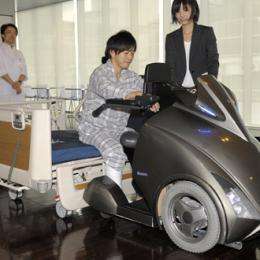
The design allows users to slide more easily on and off the vehicle, lessening reliance on care-givers to lift them. Photo: AFP

Robotics and medical experts in Japan on Wednesday unveiled the prototype of a new hi-tech electric wheelchair that resembles a scooter and promises greater mobility.

Users ride astride the four-wheeled Rodem -- rather than sitting in it, as in a conventional wheelchair -- steer it with a joystick and hold onto motorbike-style handles while the knees and chest rest on cushions.

The design allows users to slide more easily on and off the vehicle, lessening reliance on care-givers to lift them, the inventors said.

"I believe this is a whole new idea for a ," said Makoto Hashizume, head of the Veda International Research and Development Centre and a medical professor of Kyushu University.
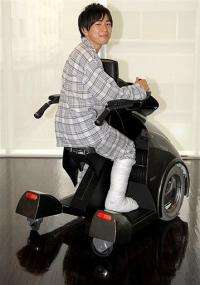
An "injured" model demonstrates the medical universal vehicle, "Rodem" during its press preview in Tokyo. Robotics and medical experts in Japan on Wednesday unveiled the prototype of a new hi-tech electric wheelchair that resembles a scooter and promises greater mobility.

"With this vehicle, users can move around more freely and more actively without much help from other people."

It is the first invention unveiled by the Veda centre, which opened in May in southwestern Munakata city and is a joint project of Japanese robot maker Tmsuk Co. and researchers from 10 universities and institutes.

The robotics and medical specialists, including from Germany and Italy, aim to invent robots for use in health and nursing, an area where high-tech , with its fast-greying population, is seen as a world leader.

The inventors said they had no immediate plans to commercialise the new vehicle, which would first have to meet government safety standards, but said they were open to offers from private companies in Japan and overseas.

Tmsuk president Yoichi Takamoto said the Rodem may also be used by people who are not disabled to simply ride and enjoy.

Takamoto said the Rodem was too simple to be called a robot, but added that it may evolve into one.

"We can add more robot-like functions in future," he said. "For example, we could add a new function so it comes to your bedside when you call."

(c) 2009 AFP

Explore further: Robots learn to take a proper handoff by following digitized human examples

add to favorites email to friend print save as pdf

Related Stories

Cyborg-walkers stride toward Japan's robotics future

Aug 03, 2009

Three Japanese cyborg look-alikes turned heads on busy Tokyo streets and subway trains Monday as they made their way to a robotics conference on a hot summer's day -- without breaking a sweat.

Recommended for you

Microsoft readies new Xbox as entertainment hub

5 hours ago

Microsoft offers a glimpse Tuesday at a new-generation Xbox as videogame consoles evolve into home entertainment centers and adapt to competition from smartphones and tablets.

Finnish start-up launches smartphone to rival giants

20 hours ago

A group of ex-Nokia employees who quit over the company's decision to abandon the planned MeeGo operating system in favour of Windows presented their own smartphone on Monday, hoping to rival the sector's ...

NEC phone is liquid-cooled and gender-specific

May 20, 2013

(Phys.org) —Pink is the color of princess fairy-tale gowns, magic slippers, upscale cupcake icing, and everything else favorable to girls who just want to be girls. "Ladyphones" appear to be concepts for ...

Expectations high for next Xbox

May 20, 2013

It's almost time for a new Xbox. Eight years have passed since Microsoft unveiled the Xbox 360, double the amount of time between the original Xbox debut in 2001 and its high-definition successor's launch ...

Congress gets mixed advice on regulating drones

May 17, 2013

(AP)—The growing use of unmanned surveillance "eyes in the sky" aircraft raises a thicket of privacy concerns, but the U.S. Congress is getting mixed advice on what, if anything, to do about it.

User comments : 5

Adjust slider to filter visible comments by rank

Display comments: newest first

joekid
4 / 5 (1) Aug 26, 2009
Wheelchairs are for convenience. This one looks to be too large to have any. I've been in a chair for four years and know bigger is the same a clumsy and space wasting. If the Japanese or anyone else wants to improve the wheelchair, thing small. Find a way to decrease the footprint of the chair sticking out from under the rider. Power's nice but how many times can back out and in to an area will be fun while you're trying to get somewhere.
david_42
not rated yet Aug 26, 2009
Small is a seat mounted on a Segway. If you don't mind falling on your face occasionally.
Simonsez
2 / 5 (1) Aug 27, 2009
To be fair, that is a Japanese man in the photo. That would be a very tiny wheelchair to Americans according to everything I have learned from the internet!
piersdad
2 / 5 (1) Aug 28, 2009
at last they are breaking away from tradition with the batteries balancing the weight of the passenger

and leaving all sorts of variations to the rear to accomidate the different disabilities

the first real breakthrough in wheel chair design in 100 years

even a swiveling chair in the rear or a sortr of hoist assisted chair
COCO
not rated yet Aug 31, 2009
looks clumsy - no mention if robust either - looking to see more than pimped up scooters - like to see AWD with a real seat - baby boomer market still untapped - obese and rich

More news stories

Finnish start-up launches smartphone to rival giants

A group of ex-Nokia employees who quit over the company's decision to abandon the planned MeeGo operating system in favour of Windows presented their own smartphone on Monday, hoping to rival the sector's ...

Expectations high for next Xbox

It's almost time for a new Xbox. Eight years have passed since Microsoft unveiled the Xbox 360, double the amount of time between the original Xbox debut in 2001 and its high-definition successor's launch ...

Congress gets mixed advice on regulating drones

(AP)—The growing use of unmanned surveillance "eyes in the sky" aircraft raises a thicket of privacy concerns, but the U.S. Congress is getting mixed advice on what, if anything, to do about it.

Study shows where scene context happens in our brain

In a remote fishing community in Venezuela, a lone fisherman sits on a cliff overlooking the southern Caribbean Sea. This man –– the lookout –– is responsible for directing his comrades on the water, ...

Green conversion of heat to electricity

Soon, it will be possible to produce electricity from heat over 30 degrees emitted from a waste incinerator, refinery, or data processor. The start-up Osmoblue has just confirmed the feasibility of this new ...