Scientists develop targeted cancer treatment using nanomaterials
Aug 19, 2009
Scientists develop targeted cancer treatment using nanomaterials
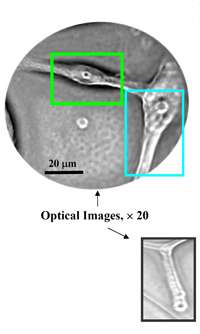
Above: X-ray fluorescent imaging of the TiO2-mAb binding to the single brain cancer cells. The bare titianium dioxide nanoparticle bonds with an antibody and attaches itself to brain cancer cells. When exposed to concentrated white light, the titanium dioxide creates free radicals of oxygen that cause the cancer cells to die.

(PhysOrg.com) -- Scientists from the U.S. Department of Energy's Argonne National Laboratory and the University of Chicago's Brain Tumor Center have developed a way to target brain cancer cells using inorganic titanium dioxide nanoparticles bonded to soft biological material.

Thousands of people die from malignant brain tumors every year, and the tumors are resistant to conventional therapies. This nano-bio technology may eventually provide an alternative form of therapy that targets only cancer cells and does not affect normal living tissue.

"It is a real example of how nano and biological interfacing can be used for biomedical application," said scientist Elena Rozhkova with Argonne's Center for . "We chose brain cancer because of its difficulty in treatment and its unique receptors."

This new therapy relies on a two-pronged approach. is a versatile photoreactive nanomaterial that can be bonded with biomolecules. When linked to an antibody nanoparticles recognize and bind specifically to cancer cells. Focused visible light is shined onto the affected region, and the localized titanium dioxide reacts to the light by creating free oxygen radicals that interact with the mitochondria in the cancer cells. Mitochondria act as cellular energy plants, and when free radicals interfere with their biochemical pathways, mitochondria receive a signal to start cell death.

"The significance of this work lies in our ability to effectively target nanoparticles to specific cell surface receptors expressed on cells," said Dr. Maciej S. Lesniak, Director of Neurosurgical Oncology at University of Chicago Brain Tumor Center. "In so doing, we have overcome a major limitation involving the application of nanoparticles in medicine, namely the potential of these agents to distribute throughout the body. We are now in a position to develop this exciting technology in preclinical models of tumors, with the hope of one day employing this new technology in patients."

X-ray fluorescence microscopy done at Argonne's Advanced Photon Source also showed that the tumors' invadopodia, actin-rich micron scale protrusions that allow the cancer to invade surrounding healthy cells, can be also attacked by the titanium dioxide.

So far, tests have been done only on cells in a laboratory setting, but animal testing is planned for the next phase. Results show an almost 100 percent cancer cell toxicity rate after six hours of illumination, and 80 percent after 48 hours.

Also, since the antibody only targets the , surrounding healthy cells are not affected, unlike other cancer treatments such as chemotherapy and radiotherapy.
Rozhkova said that a proof of concept is demonstrated, and other cancers can be treated as well using different targeting molecules, but research is in the early stages.

More information: This work is published in a Nano Letters and is available online at pubs.acs.org/doi/full/10.1021/nl901610f .

Source: Argonne National Laboratory (news : web)

Explore further: Single-cell transfection tool enables added control for biological studies

add to favorites email to friend print save as pdf

Related Stories

Clinical trial evaluating brain cancer vaccine is underway

Oct 19, 2007

A clinical trial evaluating a brain cancer vaccine in patients with newly diagnosed brain cancer has begun at NYU Medical Center. The study will evaluate the addition of the vaccine following standard therapy with surgery ...

Cancer stem cells: know thine enemy

Dec 21, 2007

Stem cells -- popularly known as a source of biological rejuvenation -- may play harmful roles in the body, specifically in the growth and spread of cancer. Amongst the wildly dividing cells of a tumor, scientists have located ...

Researchers find molecule that targets brain tumors

Dec 29, 2008

UC Davis Cancer Center researchers report today the discovery of a molecule that targets glioblastoma, a highly deadly form of cancer. The finding, which is published in the January 2009 issue of the European Journal of Nu ...

Herceptin targets breast cancer stem cells

Jul 09, 2008

A gene that is overexpressed in 20 percent of breast cancers increases the number of cancer stem cells, the cells that fuel a tumor's growth and spread, according to a new study from the University of Michigan Comprehensive ...

Recommended for you

Radioactive nanoparticles target cancer cells

May 21, 2013

Cancers of all types become most deadly when they metastasize and spread tumors throughout the body. Once cancer has reached this stage, it becomes very difficult for doctors to locate and treat the numerous tumors that can ...

How gold nanoparticles can help fight ovarian cancer

May 21, 2013

Positively charged gold nanoparticles are usually toxic to cells, but cancer cells somehow manage to avoid nanoparticle toxicity. Mayo Clinic researchers found out why, and determined how to make the nanoparticles effective ...

Advance in nanotech gene sequencing technique

May 20, 2013

(Phys.org) —The allure of personalized medicine has made new, more efficient ways of sequencing genes a top research priority. One promising technique involves reading DNA bases using changes in electrical ...

User comments : 2

Adjust slider to filter visible comments by rank

Display comments: newest first

webitube
not rated yet Aug 19, 2009
"Results show an almost 100 percent cancer cell toxicity rate after six hours of illumination, and 80 percent after 48 hours." -- Can someone please explain this? Does this mean that the toxicity rate drops from nearly 100% down to 80% as the treatment proceeds from the 6th hour to the 48th hour?
E_L_Earnhardt
not rated yet Aug 19, 2009
COOL the site and the tumor will shrink.

More news stories

Scientists develop cheaper, more efficient fuel cells

(Phys.org) —Using the Canadian Light Source (CLS) synchrotron, researchers have discovered a way to create cheaper fuel cells by dividing normally expensive platinum metal into nanoparticles (or even single ...

Weird science: Crystals melt when they're cooled

(Phys.org) —Growing thin films out of nanoparticles in ordered, crystalline sheets, to make anything from microelectronic components to solar cells, would be a boon for materials researchers, but the physics ...

Ferrets, pigs susceptible to H7N9 avian influenza virus

Chinese and U.S. scientists have used virus isolated from a person who died from H7N9 avian influenza infection to determine whether the virus could infect and be transmitted between ferrets. Ferrets are often used as a mammalian ...