Highlight: Mechanical energy dissipation in ultrananocrystalline diamond microresonators
Aug 12, 2009
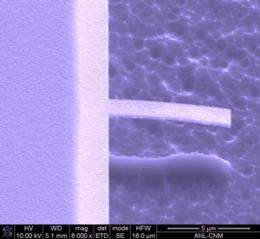
SEM micrograph of fabricated UNCD microresonator

Researchers in the Nanofabrication and Devices group at the Argonne National Laboratory, in collaboration with the University of Pennsylvania, Advanced Diamond Technologies Inc., and Innovative Micro Technology, have discovered that defects at the grain boundary in ultrananocrystalline diamond (UNCD) hold primary responsibility for the fundamental mechanism of energy dissipation.

Because of a high Young's modulus and high sound propagation velocity, UNCD materials hold potential for fabricating high-frequency microelectromechanical (MEMS) resonators.

However, their mechanical dissipation at high frequency, which is important for developing high-frequency resonator applications, is not well understood. Dissipation in UNCD cantilevers was determined by using ring-down measurement under ultrahigh-vacuum conditions, and the quality factor measured in the range of 5000-16000 at kHz resonance frequencies.

These studies reveal that dissipation in UNCD films is mainly due to the presence of defects such as nondiamond-carbon bonding at grain boundaries.

More information: V. P. Adiga, A. V. Sumant, S. Suresh, C, Gudeman, O. Auciello, J. A. Carlisle, R. W. Carpick, "Mechanical stiffness and dissipation in ultrananocrystalline diamond microresonators," Phys. Rev. B, 79, 245403 (2009)

Provided by Argonne National Laboratory (news : web)

Explore further: 3D printing tiny batteries

add to favorites email to friend print save as pdf

Related Stories

Diamond technology to revolutionize mobile communications

Aug 07, 2006

The U. S. Department of Energy's Argonne National Laboratory has teamed with industrial and academic partners under a DARPA Phase II research and development program to develop a new technology based on Ultrananocrystalline ...

Tough new probe developed for nanotechnologists

Aug 10, 2005

Since the invention of the atomic force microscope (AFM) in 1986 by Nobel laureate Gerd Binnig, the tool has been employed to advance the science of materials in many ways, from nanopatterning (dip-pen nanolithography) to ...

New Research on Nanodiamond Materials

Sep 09, 2008

In a recent special issue of Chemical Vapor Deposition devoted to nanodiamonds, editors Amanda Barnard and Oliver Williams note that "the diversity of nanocarbon structures and allotropes has led to a plet ...

Recommended for you

3D printing tiny batteries

5 hours ago

(Phys.org) —3D printing can now be used to print lithium-ion microbatteries the size of a grain of sand. The printed microbatteries could supply electricity to tiny devices in fields from medicine to communications, ...

World's most powerful microscope ready for research

11 hours ago

(Phys.org) —The world's most powerful microscope, which resides in a specially constructed room at the University of Victoria, has now been fully assembled and tested, and has a lineup of scientists and businesses eager ...

Future looks bright for carbon nanotube solar cells

11 hours ago

(Phys.org) —In an approach that could challenge silicon as the predominant photovoltaic cell material, University of Wisconsin-Madison materials engineers have developed an inexpensive solar cell that exploits ...

A breakthrough in plasmonics

Jun 17, 2013

EPFL scientists have discovered how optical signal transmission can be controlled, paving the way for the integration of plasmonics with conventional electronic circuits.

User comments : 0

More news stories

3D printing tiny batteries

(Phys.org) —3D printing can now be used to print lithium-ion microbatteries the size of a grain of sand. The printed microbatteries could supply electricity to tiny devices in fields from medicine to communications, ...

Future looks bright for carbon nanotube solar cells

(Phys.org) —In an approach that could challenge silicon as the predominant photovoltaic cell material, University of Wisconsin-Madison materials engineers have developed an inexpensive solar cell that exploits ...

Hybrid material as gold-leaf substitute

(Phys.org) —A team of researchers headed by Professor Raffaele Mezzenga has created a hybrid material out of gold and milk proteins that looks like a wafer-thin gold leaf. Thanks to its properties, it could ...

World's most powerful microscope ready for research

(Phys.org) —The world's most powerful microscope, which resides in a specially constructed room at the University of Victoria, has now been fully assembled and tested, and has a lineup of scientists and businesses eager ...

Origins of 'The Hoff' crab revealed (w/ Video)

The history of a new type of crab, nicknamed 'The Hoff' because of its hairy chest, which lives around hydrothermal vents deep beneath the Southern Ocean and Indian Ocean, has been revealed for the first ...