LED lights build communication network
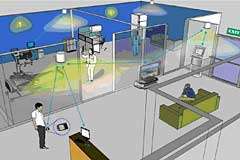
(PhysOrg.com) -- Imagine a world where bright, energy-sipping, cheap, durable LEDs light the world. A world where if you have enough light to see, you are connected. The University of California, Riverside will lead a multi-campus effort that could reshape the way we communicate and navigate in homes, offices, airports and especially in hospitals, airports and other places where radio frequency communication is prohibited.
The Center for Ubiquitous Communication by Light (UC-Light) will be funded with $3.5 million from the Multicampus Research Program and Initiatives (MRPI) competition within the University of California system.
"PDAs, HDTV, information kiosks, computers and laptops all can be interconnected wirelessly through visible light," said Zhengyuan Xu, a professor of electrical engineering at the Bourns College of Engineering, the principal investigator and director of the new research center.
He will work with researchers with expertise in communication, navigation, transportation, networking, and circuit integration from UC Riverside, UC Berkeley, UC Davis, UC Merced and the Lawrence Berkeley National Laboratory to take advantage of the communication properties presented by LED lights.
The project is anticipated to begin in January 2010 and run for five years.
Xu said the potential impacts of the research are huge. "With a proper data interface to a wired data network such as Ethernet, they make it possible to build very low-cost communication and navigation systems on existing lighting infrastructure."
The research results will likely have implications for current broadband wireless communication, HDTV signals, traffic navigation and directions, retrieving information via cell phones from electronic billboards, or allowing the refrigerator light to transmit information about what is needed on the next trip to the grocery store. Results will be especially important in areas where radio frequencies are limited, such as hospitals and airplanes.
"The visible light spectrum is several orders of magnitude larger than the crowded radiofrequency [RF] spectrum, and thus has huge potential for low cost and high data rate communication," Xu said.
Discoveries will lead to an increase in related intellectual property, which would foster further technology transfer from the university to the commercial world, and could replace or supplement current wireless communication networks.
The center will establish an advisory board consisting of invited experts and representatives from industry, government and academia. The researchers will consult advisory board members informally throughout the year, and the board will have a formal face-to-face meeting once per year.
Just like centralized heating systems contributed to the proliferations of rooms in a house, the advent of indoor plumbing contributed to the emergence of modern bathrooms and kitchens, and most dramatically the advent of the electric safety elevator allowed architects to design tall buildings; the advent of communication through common light sources could lead to a difference in the way houses and offices are designed.
"We are delighted to have this research center at our college," said Reza Abbaschian, dean of the Bourns College of Engineering. "I am confident this center will make significant advances in next-generation communication technologies."
Provided by University of California, Riverside


