When did humans return after last Ice Age?
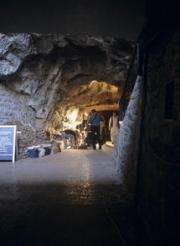
(PhysOrg.com) -- The Cheddar Gorge in Somerset was one of the first sites to be inhabited by humans when they returned to Britain near the end of the last Ice Age. According to new radio carbon dating by Oxford University researchers, outlined in the latest issue of Quaternary Science Review, humans were living in Gough's Cave 14,700 years ago.
A number of stone artefacts as well as human and animal bones from excavations, spread over more than 100 years, shed further light on the nature as well as the timing of people to the cave.
Technological advances have allowed researchers at Oxford University and London's Natural History Museum to date the bones more accurately. Previous radiocarbon dates suggested a wide span of occupation of within 1000-1500 years. The new dates show a much narrower range of dates, corresponding precisely to climate warming, providing evidence that the archaeological material in the cave could have accumulated over perhaps as little as two to three human generations, centred on 14,700 years ago.
Dr Tom Higham, Deputy Director of the Oxford Radiocarbon Accelerator Unit, commented: 'In the past, radiocarbon dates have often been influenced by contamination that modern techniques can remove much more effectively. The new results have transformed our understanding of this site because at last we have a chronology we can rely on and which we can link to climatic events here and in the wider world.'
Dr Roger Jacobi, of the British Museum and the Natural History Museum, who led the research, said: 'This is the biggest advance which we have made in understanding the story of the Palaeolithic use of this remarkable cave, and it is one which has implications for our understanding of many other British archaeological sites.'
Many of the human remains bear patterns of cutmarks, which have been interpreted as evidence of cannibalism. These were previously thought to have belonged to a more recent period of activity than that associated with the hunting of horses and red deer.
Professor Chris Stringer, Natural History Museum Palaeontologist, commented: ' We were puzzled that the human bones we excavated in Gough's Cave about 20 years ago, including those that may have been cannibalised, seemed to be up to a thousand years different in age. The new dating methods show instead that the butchery and consumption of both horses and humans occurred in a very short space of time, about 14,700 years ago. So as Europe rapidly defrosted, family groups probably followed herds of horses into Britain across grasslands where the North Sea is today.'
Further sites will be re-examined using the same approach to test whether humans returned to Britain at the time of climate warming or whether they came back before this period. More accurate dating might be possible through applying isotopic methods directly to the human teeth from the site, as well as to those of the prey animals, because this will allow a better assessment of whether the animals were hunted in a warmer or colder period. At present, the radiocarbon dates are not sufficiently precise enough to answer this key question. The work is part of the Ancient Human Occupation of Britain project, funded by the Leverhulme Trust.
Provided by Oxford University (news : web)


