Scientists closer to making implantable bone material
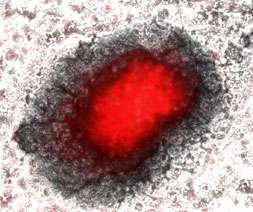
(PhysOrg.com) -- Scientists are closer to understanding how to grow replacement bones with stem cell technology, thanks to research published today in the journal Nature Materials.
Many scientists are currently trying to create bone-like materials, derived from stem cells, to implant into patients who have damaged or fractured bones, or who have had parts of diseased bones removed. The idea is that, ultimately, these bone-like materials could be inserted into cavities so that real bone could meld with it and repair the bone.
So far, scientists have found they can grow small 'nodules' of what appeared to be bone-like material in the laboratory from different types of bone cells and stem cells. All of these cell types are attracting considerable interest as promising candidates for future implants in people with clinical trials already underway. However, scientists still need to thoroughly explore and understand the in-depth chemical properties and structure of the bone-like materials they are growing.
Now, scientists from Imperial College London have compared the 'bone-like' material grown from three different commonly used clinically relevant cell types and have discovered significant differences between the quality of bone-like material that these can form.
For example, the researchers have discovered that the 'bone-like' materials that were grown from bone cells from mouse skull and mouse bone marrow stem cells successfully mimicked many of the hallmarks of real bone, which include stiffness. However, they found that the 'bone-like' material grown from mouse embryonic stem cells was much less stiff and less complex in its mineral composition when compared to the other materials. The researchers suggest that further research is now needed to explore the implications of these results for different stem cell therapies.
Professor Molly Stevens, from the Department of Materials and the Institute of Biomedical Engineering at Imperial College London, says: "Many patients who have had bone removed because of tumours or accidents live in real pain. By repairing bone defect sites in the body with bone-like material that best mimics the properties of their real bone we could improve their lives immeasurably. Our study provides an important insight into how different cell sources can really influence the quality of bone that we can produce. It brings us one step closer to developing materials that will have the highest chance of success when implanted into patients."
To carry out their analysis, researchers used laser-based raman spectroscopy to understand the detailed chemical make-up of live cells as they grew and multivariate statistical analysis techniques, which enabled them to compare and analyse data about the growth of different cell populations. They also used a nano-indenter and high resolution electron microscopy, which allowed the researchers to probe the samples so that they could understand how stiff the bone-like materials were and what their structure was at a microscopic level.
More information: "Comparative materials differences revealed in engineered bone as a function of cell-specific differentiation" Nature Materials, Sunday 26 July 2009.
Source: Imperial College London (news : web)


