Quantum memory and turbulence in ultra-cold atoms
Jul 20, 2009
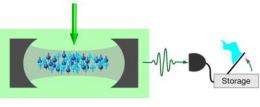
Scientists at MIT have figured out how to relay the successful storage of light in a a form of quantum memory based on a cold-atom gas. Credit: Image copyright American Physical Society [Illustration: Alan Stonebraker]

Scientists at MIT have figured out a key step toward the design of quantum information networks. The results are reported in the July 20th issue of Physical Review Letters and highlighted in APS's on-line journal Physics.

A quantum network - in which memory devices that store quantum states are interconnected with devices - is a prototype for designing a quantum internet. One path to making a quantum network is to map a light pulse onto nodes in a material system. Yet, it is one thing to catch a beam of light; it is more difficult to generate a signal that heralds that it has been successfully caught. Quantum systems follow Heisenberg's rule that observing an event may destroy it, so the system has to emit just the right kind of herald pulse so as not to erase the data.

Now, Haruka Tanji, Saikat Ghosh, Jonathan Simon, Benjamin Bloom, and Vladan Vuletic from MIT have demonstrated an atomic that heralds the successful storage of a in a cold atom gas. The atomic-ensemble memory can receive an arbitrary polarization state of an incoming photon, called a polarization qubit, announce successful storage of the qubit, and later regenerate another photon with the same polarization state. The herald signal only announces the fact the pulse has been captured, not details of the polarization, so the quantum information is preserved.

This capability will likely benefit scalable quantum networking, where it is crucial to know if operations have succeeded.
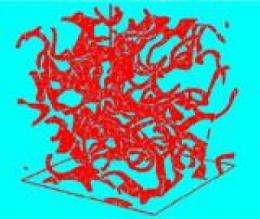

Scientists have imaged the vortices that form in the turbulent state of an ultra-cold atom gas. Credit: Image copyright American Physical Society [Illustration: Adapted from E. A. L. Henn et al. Phys. Rev. Lett. (to be published)]

Scientists in Brazil report the controllable formation of quantum turbulence in an ultra-cold atom gas. The results, which appear in the July 20 issue of and are highlighted in the APS journal Physics may make it easier to characterize quantum turbulence - and potentially even classical turbulence - because it is possible to tune many characteristics of the cold-atom gas.

Turbulence is considered a nuisance because it slows down boats and jars airplanes. But for hundreds of years, physicists have been fascinated with the notoriously difficult problem of how to describe this phenomenon, which involves the formation and disappearance of vortices - swirling regions in a gas or liquid- over many different length and time scales.

Turbulence can also occur in quantum fluids, such as ultra-cold atom gases and superfluid helium. In a quantum fluid, the motion of the vortices is quantized; and, because quantum fluids have zero viscosity, the vortices cannot easily disappear.

These properties make quantum turbulence more stable and easier to understand than classical turbulence. Now, Emanuel Henn and colleagues at the University of Sao Paulo in Brazil and the University of Florence in Italy have created quantum turbulence in a gas of ultra-cold rubidium atoms by shaking it up with a magnetic field. In this way, they are able to control the formation of vortices and generate many different kinds of turbulence to explore a number of questions relevant to both its quantum and classical forms.

Source: American Physical Society

Explore further: Superfluids: Observation of 'second sound' in a quantum gas

add to favorites email to friend print save as pdf

Related Stories

Quantum memory for light

Dec 05, 2004

Realization of quantum memory for light allows the extension of quantum communication far beyond 100 km In the macroscopic classical world, it is possible to copy information from one device into another. We do this e ...

Quantum Communication Over Flawed Networks may be Possible

Dec 14, 2007

If successfully implemented, quantum communication could be an extremely secure method of transmitting information – but there are major roadblocks to pass. Recently, physicists suggested a way, at least in theory, to overcome ...

Recommended for you

Promising doped zirconia

May 17, 2013

Materials belonging to the family of dilute magnetic oxides (DMOs)—an oxide-based variant of the dilute magnetic semiconductors—are good candidates for spintronics applications. This is the object of ...

Bringing life into focus

May 17, 2013

Spinning-disk confocal microscopy is an optical imaging technique that can be used to generate detailed three-dimensional fluorescence images of living cells and their contents. Although a powerful tool for ...

Nanocrystals grow from liquid interface

May 17, 2013

An international collaboration of scientists has discovered a unique crystalizing behavior at the interface between two immiscible liquids that could aid in sustainable energy development.

User comments : 0

More news stories

New principle may help explain why nature is quantum

Like small children, scientists are always asking the question 'why?'. One question they've yet to answer is why nature picked quantum physics, in all its weird glory, as a sensible way to behave. Researchers ...

Honeybees trained in Croatia to find land mines

(AP)—Mirjana Filipovic is still haunted by the land mine blast that killed her boyfriend and blew off her left leg while on a fishing trip nearly a decade ago. It happened in a field that was supposedly ...

Russia retrieves mice, newts from space

A Russian capsule filled with 45 mice and 15 newts along with other small animals returned from a month's mission in orbit on Sunday with data scientists hope will pave the way for a manned flight to Mars.

German energy shift faces headwinds

Tense engineers have their eyes peeled on complex colour-coded diagrams on a wall-sized screen that makes their control room look like the inside of a spaceship.