Primate archaeology sheds light on human origins
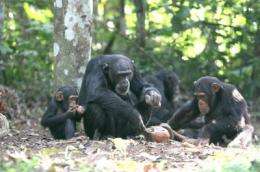
A University of Calgary archaeologist who is one of the few researchers in the world studying the material culture of human beings' closest living relatives - the great apes - is joining his colleagues in creating a new discipline devoted to the history of tool use in all primate species in order to better understand human evolution.
Julio Mercader, holder of the Canada Research Chair in Tropical Archaeology in the U of C's Department of Archaeology, is the only Canadian author of a new paper titled "Primate archaeology" published this week in the prestigious scientific journal Nature.
Mercader is one of 18 co-authors from universities including Cambridge, Rutgers, Kyoto University and schools in Spain, Italy and France. They argue that recent discoveries of tool use by a wide variety of wild primates and archaeological evidence of chimpanzees using stone tools for thousands of years is forcing experts to re-think the traditional dividing lines between humans and other primate species as well as the belief that tool use is the exclusive domain of the genus Homo. The researchers advocate for a new inter-disciplinary field of primate archaeology to examine tool use by primates in a long-term, evolutionary context. The paper is the result of the international symposium "Palaeoanthropology meets Primatology" held on Oct. 18, 2008 at Cambridge.
"There is a need for systematic collaboration between diverse research programs to understand the broader questions in human evolution and primatology," Mercader says. "For example, few archaeologists have seen a wild primate use a tool, while few primatologists have taken part in archaeological excavations," he explains.
Mercader was the lead author of a team that laid the foundations of the emerging discipline of chimpanzee archaeology in two previously-published papers in Science and the Proceedings of the National Academy of Sciences (PNAS). He is the archaeologist who uncovered the first prehistoric evidence of chimpanzee technology in 2007 — a 4,300-year-old nut-cracking site in the rainforests of Côte D'Ivoire, West Africa that provides proof of a long-standing chimpanzee "stone age" that likely emerged independently of influence from humans.
"It's not clear whether we hominins invented this kind of stone technology, or whether both humans and the great apes inherited it from a common forebear," says Mercader. "We used to think that culture and, above anything else, technology was the exclusive domain of humans, but this is not the case. We need comparable methods of data collection among researchers dealing with 2 million year old hominin sites and modern primatological assemblages."
The official inauguration of the new field of primate archaeology marks the culmination of several years of work on the part of the handful of researchers including Mercader, who joined the U of C in 2002 with the support of the Canada Research Chairs program and the Canada Foundation for Innovation.
"This is truly at the vanguard of archaeology and I am so pleased these agencies and the University of Calgary had the vision seven years ago to be a part of creating a new discipline that is seeing its birth now," Mercader says.
More information: The paper "Primate archaeology" by Michael Haslam, Adriana Hernandez-Aguilar, Victoria Ling, Susana Carvalho, Ignacio de la Torre, April DeStefano, Andrew Du, Bruce Hardy, Jack Harris, Linda Marchant, Tetsuro Matsuzawa, William McGrew, Julio Mercader, Rafael Mora, Michael Petraglia, Helene Roche, Elisabetta Visalberghi & Rebecca Warren will appear in the July 16, 2009 edition of the journal Nature and will be available online at: www.nature.com .
Source: University of Calgary (news : web)


