Rover Tests Evaluating Crabwalk Moves
Jul 13, 2009
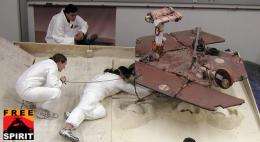
Mars Exploration Rover team members prepare a testing setup for a subsequent experiment after an experiment driving the rover in a crablike motion, with all four corner wheels angled to the right.

On firm ground, NASA's Mars Exploration Rovers can make crablike moves by turning all four steerable wheels to the same side angle, then rotating the wheels either forward or backward.

The rover team is experimenting with variations of those maneuvers in a test sandbox at JPL as part of its work to identify the best way to get Spirit out of the loose soil where the rover has become embedded on .

By Friday morning, July 10, the team had tested crabwalk patterns driving forward in the test sandbox with the wheels turned at 60 degrees to the right and 20 degrees to the right. The angle of motion was upslope in the testing setup that simulates Spirit's predicament on Mars.

Together with earlier experiments evaluating straight-forward and straight-backward driving, the latest actions completed four out of 11 maneuvers that the team has on its current testing list. Next, engineers plan to test backward (downslope) crabbing with wheels turned 60 degrees to the right.

Provided by JPL/ (news : web)

Explore further: Cassini imaging lead hopes for planet-wide celebration of the Pale Blue Dot

add to favorites email to friend print save as pdf

Related Stories

Rover Extraction Tests Begin (w/ Video)

Jul 07, 2009

Using a test rover in a sandbox at JPL with special soil simulating Spirit's predicament on Mars, engineers are assessing possible maneuvers for getting Spirit out and onto firmer ground.

Spirit rover's wheels stuck in soft Martian dirt

May 12, 2009

(PhysOrg.com) -- The five wheels that still rotate on NASA's Mars Exploration Rover Spirit have been slipping severely in soft soil during recent attempts to drive, sinking the wheels about halfway into the ...

Opportunity Begins Careful Rollout

May 16, 2005

Opportunity rotated its wheels on sol 463 for the first time since the rover dug itself into a sand dune more than two weeks earlier. The wheels made about two and a half rotations, as commanded, and the results ...

Free Spirit: Rock Under the Belly

Jul 02, 2009

Engineers placed a rock underneath the test rover at NASA's Jet Propulsion Laboratory, Pasadena, Calif., on July 1, 2009, to more closely simulate Spirit's predicament on Mars.

Rover Team Tests Mars Moves on Earth

May 07, 2005

Mars rover engineers are using a testing laboratory to simulate specific Mars surface conditions where NASA's rover Opportunity has spun its wheels in a small dune. Careful testing is preceding any commands ...

Recommended for you

Super-hurricane-force winds on Venus are getting stronger

13 hours ago

(Phys.org) —As the closest planet to Earth, Venus is a relatively easy object to observe. However, many mysteries remain, not least the super-rotation of Venus' atmosphere, which enables high altitude winds ...

ExoMars 2016 set to complete construction

17 hours ago

ESA's mission to Mars in 2016 has entered the final stage of construction with the signature of a contract today with Thales Alenia Space at the Paris Air & Space Show.

Australian team maps Moon's hidden craters

20 hours ago

Australian scientists Tuesday said they had identified a possible 280 additional craters on the Moon, a finding they said could shed light on the history of the Earth's natural satellite.

User comments : 0

More news stories

3D printing tiny batteries

(Phys.org) —3D printing can now be used to print lithium-ion microbatteries the size of a grain of sand. The printed microbatteries could supply electricity to tiny devices in fields from medicine to communications, ...

Origins of 'The Hoff' crab revealed (w/ Video)

The history of a new type of crab, nicknamed 'The Hoff' because of its hairy chest, which lives around hydrothermal vents deep beneath the Southern Ocean and Indian Ocean, has been revealed for the first ...