Scientists Discover Light Force with 'Push' Power
Jul 13, 2009
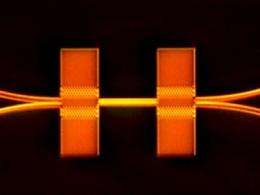
Tang's team shows how interacting lightwaves can be used to control devices on a silicon chip. Credit: Hong Tang/Yale University

(PhysOrg.com) -- A team of Yale University researchers has discovered a "repulsive" light force that can be used to control components on silicon microchips, meaning future nanodevices could be controlled by light rather than electricity.

The team previously discovered an "attractive" force of light and showed how it could be manipulated to move components in semiconducting micro- and nano-electrical systems—tiny mechanical switches on a chip. The scientists have now uncovered a complementary repulsive force. Researchers had theorized the existence of both the attractive and since 2005, but the latter had remained unproven until now. The team, led by Hong Tang, assistant professor at Yale's School of Engineering & Applied Science, reports its findings in the July 13 edition of Nature Photonics's advanced online publication.

"This completes the picture," Tang said. "We've shown that this is indeed a bipolar light force with both an attractive and repulsive component."

The attractive and repulsive light forces Tang's team discovered are separate from the force created by light's radiation pressure, which pushes against an object as light shines on it. Instead, they push out or pull in sideways from the direction the light travels.

Previously, the engineers used the attractive force they discovered to move components on the silicon chip in one direction, such as pulling on a nanoscale switch to open it, but were unable to push it in the opposite direction.

Using both forces means they can now have complete control and can manipulate components in both directions. "We've demonstrated that these are tunable forces we can engineer," Tang said.

In order to create the repulsive force, or the "push," on a silicon chip, the team split a beam of infrared light into two separate beams and forced each one to travel a different length of silicon nanowire, called a waveguide. As a result, the two light beams became out of phase with one another, creating a repulsive force with an intensity that can be controlled—the more out of phase the two light beams, the stronger the force.

"We can control how the light beams interact," said Mo Li, a postdoctoral associate in electrical engineering at Yale and lead author of the paper. "This is not possible in free space—it is only possible when light is confined in the nanoscale waveguides that are placed so close to each other on the chip."

"The light force is intriguing because it works in the opposite way as charged objects," said Wolfram Pernice, another postdoctoral fellow in Tang's group. "Opposite charges attract each other, whereas out-of-phase light beams repel each other in this case."

These light forces may one day control telecommunications devices that would require far less power but would be much faster than today's conventional counterparts, Tang said. An added benefit of using light rather than is that it can be routed through a circuit with almost no interference in signal, and it eliminates the need to lay down large numbers of electrical wires.

More information: DOI: 10.1038/NPHOTON.2009.116

Source: Yale University (news : web)

Explore further: New tool has potential for brain mapping

add to favorites email to friend print save as pdf

Related Stories

Researchers see exotic force for first time

Jan 07, 2009

(PhysOrg.com) -- For the first time, researchers have measured a long-theorized force that operates at distances so tiny they’re measured in billionths of a meter, which may have important applications in ...

A Broadband Light Amplifier on a Photonic Chip

Jul 06, 2006

Cornell University researchers have created a broadband light amplifier on a silicon chip, a major breakthrough in the quest to create photonic microchips. In such microchips, beams of light traveling through ...

Team 'tractor beam' for manipulation of cells on silicon

Oct 30, 2007

In a feat that seems like something out of a microscopic version of Star Trek, MIT researchers have found a way to use a “tractor beam” of light to pick up, hold, and move around individual cells and other ...

Using light to move and trap DNA molecules

Jan 02, 2009

(PhysOrg.com) -- A major goal of nanotechnology research is to create a "lab on a chip," in which a tiny biological sample would be carried through microscopic channels for processing. This could make possible ...

Recommended for you

New tool has potential for brain mapping

May 16, 2013

A new tool being developed by UT Arlington assistant professor of physics could help scientists map and track the interactions between neurons inside different areas of the brain.

Quantum dot LED approaches theoretical maximum efficiency

May 14, 2013

(Phys.org) —Quantum dot LEDs (QLEDs) are a promising technology for creating large-area displays that could have applications for TVs, cell phones, and digital cameras. So far, however, the highest efficiencies ...

Photonic quantum computers: A brighter future than ever

May 13, 2013

(Phys.org) —Harnessing the unique features of the quantum world promises a dramatic speed-up in information processing as compared to the fastest classical machines. Scientists from the Group of Philip ...

User comments : 10

Adjust slider to filter visible comments by rank

Display comments: newest first

earls
not rated yet Jul 13, 2009
Can you do something similar with sound waves?
DGBEACH
not rated yet Jul 13, 2009
Can you do something similar with sound waves?


The problem would be limited bandwidth
Slotin
3 / 5 (2) Jul 13, 2009
Can you do something similar with sound waves?
Yes, this is principle of so called the "acoustic levitation". The very simmilar mechanism keeps atoms of BE condensates in optical lattice and this principle is known for years..
Quarl
not rated yet Jul 13, 2009
Can you use this as a non-volatile memory? Seems like this would make a viable "optical computer".
Arikin
not rated yet Jul 13, 2009
Non-volatile memory has been done by trapping the light in a loop. But I forget what life span was. It depended on the quality of the optic fiber. But there is holographic methods for more permanent solutions.
brant
3 / 5 (2) Jul 14, 2009
Modulate the deflector beam phase!!

Aye, Captain!!!
h0dges
not rated yet Jul 14, 2009
Hello tractor beam :)
Engard
not rated yet Jul 14, 2009
Could this technology be developed to move nanoscale particles in a manufacturing process, such as the the production of virus size robots?
lysdexia
not rated yet Jul 16, 2009
Drest-up halfnews. In easier words, they constructively interfer two inverse magnetic componends of infrared so it makes radio or near-DC.

And fast is not a speed; glue is fast.
http://google.com...iterate"
Slotin
1 / 5 (1) Jul 26, 2009
..to move nanoscale particles in a manufacturing process..
Yes and it's utilized as so called optical tweezers. The problem of article is, it's not comprehensive and it makes a huge new invention from well understood phenomena - so that readers tend to reinvent wheel while reading it.

More news stories

New principle may help explain why nature is quantum

Like small children, scientists are always asking the question 'why?'. One question they've yet to answer is why nature picked quantum physics, in all its weird glory, as a sensible way to behave. Researchers ...

Manipulating Lorentz and Fano spectral line shapes

(Phys.org) —It is widely known that the optical properties of certain materials can be modified by using lasers to control the quantum states of their optical electrons. Lasers that can generate ultra-short ...

Morocco to harness the wind in energy hunt

Morocco is ploughing ahead with a programme to boost wind energy production, particularly in the southern Tarfaya region, where Africa's largest wind farm is set to open in 2014.

Galaxy's Ring of Fire

Johnny Cash may have preferred this galaxy's burning ring of fire to the one he sang about falling into in his popular song. The "starburst ring" seen at center in red and yellow hues is not the product of ...