World's oldest surviving Bible published online
Jul 06, 2009
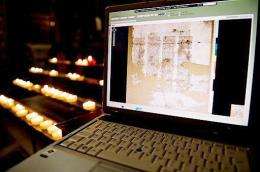
Pages of the Codex Sinaiticus, the world's oldest surviving Christian bible, are pictured on a laptop in Westminster Cathedral, central London. About 800 pages of the ancient text have been pieced together and published online, experts in Britain said.

About 800 pages of the world's oldest surviving Bible have been pieced together and published on the Internet for the first time, experts in Britain said Monday.

The Codex Sinaiticus, written in Greek on parchment leaves in the fourth century, is available online in a project involving institutions in Britain, Germany, Egypt and Russia which held different parts of the ancient book.

As part of the four-year joint project, have been taken of the reunited manuscript, allowing scholars worldwide to research in-depth the Greek text, the British Library in London said.

The library, which holds a large chunk of the Bible, also opened an exhibit Monday that includes artefacts linked to the manuscript to coincide with its online launch.

"The Codex Sinaiticus is one of the world's greatest written treasures," said Scot McKendrick, head of Western at the British Library.

"This 1600-year-old manuscript offers a window into the development of early Christianity and first-hand evidence of how the text of the Bible was transmitted from generation to generation," he said.

Originally 1,460 pages long and measuring 16 inches (40 centimetres) by 14 inches, the manuscript was handwritten by a number of scribes around the time of Constantine the Great who died in 337, experts said.

The manuscript, which was revised and corrected over the centuries, lay undisturbed in a monastery in Sinai in Egypt until it was found by a German professor in the mid-1800s and handed to Russia's Tsar Alexander II.

Britain later bought most of the book from the Soviet Union in the 1930s, while Egypt kept still more pages found in the monastery in 1975.

Professor David Parker, whose team made the electronic transcription of the manuscript, said the Internet project proved challenging with some of the pages in poor condition.

"The process of deciphering and transcribing the fragile pages of an ancient text containing over 650,000 words is a huge challenge, which has taken nearly four years," said Parker from the University of Birmingham.

"The digital images of the virtual manuscript show the beauty of the original and readers are even able to see the difference in handwriting between the different scribes who copied the text," he said.

The manuscript is available at www.codexsinaiticus.org .

(c) 2009 AFP

Explore further: Kim Dotcom slams Megaupload 'data massacre'

add to favorites email to friend print save as pdf

Related Stories

Modern Technology Reveals Ancient Science

Aug 02, 2006

Finally, after more than 1000 years in obscurity, the last unreadable pages of the works of ancient mathematician Archimedes are being deciphered, thanks to the x-ray vision at the Department of Energy’s ...

UCLA team creates virtual library of medieval manuscripts

Feb 10, 2009

Google "Edward the Confessor" and you'll get page after page of links to biographies of this 11th-century English king, to Westminster Abbey, which he founded and where he is buried, and to the Magna Carta, which was partly ...

Archimedes manuscript yields secrets under X-ray gaze

May 20, 2005

For five days in May, the ancient collided with the ultra-modern at the Stanford Linear Accelerator Center (SLAC), bringing brilliant, long-hidden ideas to light with brilliant X-ray light. A synchrotron X-ray beam at the ...

Recommended for you

Kim Dotcom slams Megaupload 'data massacre'

11 hours ago

Megaupload founder Kim Dotcom Thursday condemned a Dutch company's decision to delete million of files belonging to users of his defunct website, calling it "the largest data massacre in the history of the ...

States scramble to attract suddenly hot cybersecurity firms

20 hours ago

As data dragnets and information breaches dominate the news, states are scrambling to cash in on a rapidly expanding business sector by offering tax incentives to firms that protect sensitive information from outside attacks.

A year on, Assange stays put in Ecuadorean Embassy

Jun 19, 2013

A year ago, Julian Assange skipped out on a date with Swedish justice. Rather than comply with a British order that he go to the Scandinavian country for questioning about sex crimes allegations, the WikiLeaks ...

Google asks US secret court to lift gag order (Update)

Jun 18, 2013

Google on Tuesday sharply challenged the U.S. government's gag order on its Internet surveillance program, citing what it described as a constitutional free speech right to divulge how many requests it receives ...

User comments : 0

More news stories

Sony chief says time needed to study proposal

Sony Corp. needs more time to study a key proposal from a U.S. hedge fund to spin off a part of its entertainment unit as a way to propel its fledgling revival, the chief executive told shareholders Thursday.

Taiwan's Hon Hai to hire 3,000 after Mozilla tie-up

Taiwan's Hon Hai Precision said Thursday it aims to hire up to 3,000 new employees to develop devices and software for Mozilla's Firefox operating system as it seeks to diversify from its core manufacturing services.

Dusty surprise around giant black hole

(Phys.org) —ESO's Very Large Telescope Interferometer has gathered the most detailed observations ever of the dust around the huge black hole at the centre of an active galaxy. Rather than finding all of ...

NASA image: Rare clear view of Alaska

(Phys.org) —On most days, relentless rivers of clouds wash over Alaska, obscuring most of the state's 6,640 miles (10,690 kilometers) of coastline and 586,000 square miles (1,518,000 square kilometers) ...