A young brain for an old bee
Jul 01, 2009
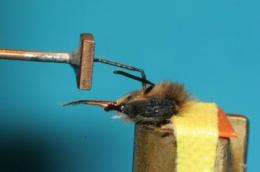
While the bee scans the tactile stimulus with her antennae, proboscis extension is elicited. When the bee extends her proboscis, she is rewarded with a droplet of sucrose solution. Credit: Dr. Ricarda Scheiner

Scientists have found that by switching the social role of honey bees, aging honey bees can keep their learning ability intact or even improve it. The research team is hoping to use them as a model to study general aging processes in the brain and how to prevent or ameliorate cognitive impairments associated with old age.

We are all familiar with the fact that cognitive function declines as we get older. Moreover, recent studies have shown that the specific kind of daily activities we engage in during the course of our lives appears to influence the extent of this decline.

A team of researchers from Technische Universität Berlin are studying how division of labour among honey bees affects their learning performance as they age. Surprisingly, they have found that, by switching their social role, aging honey bees can keep their learning ability intact or even improve it. The scientists are planning to use them as a model to study general aging processes in the brain, and they even hope that they may provide some clues on how to prevent them. Dr. Ricarda Scheiner, leader of the research team, will present these findings at the Society of Experimental Biology Annual Meeting in Glasgow on Wednesday 1st July 2009.
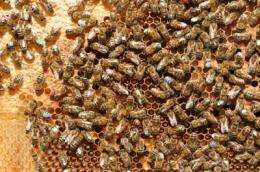
Honey bees, used as the experimental model, on an artificial comb. Nurses can be seen taking care of the brood. Credit: Dr. Ricarda Scheiner

The oldest bees in a colony are the foragers - a task that demands a high amount of energy. With increasing foraging duration, their capacity for associative learning was found to decrease. On the other hand, no decline was observed in nurse bees that remain inside the hive taking care of the brood and the queen, even though their age was the same as that of their foraging sisters. When the scientists artificially forced a subset of these foragers to revert to nursing tasks, they discovered that they learning performance improved again, demonstrating a remarkable plasticity in their circuits.

"The is a great model", explains Dr. Scheiner, "because we can learn a lot about social organisation from it and because it allows us to revert individuals into a 'younger' stage. If we remove all of the nurse bees of a colony, some of the foragers will revert to nursing behaviour and their brains become 'young' again. We thus hope to study the mechanisms responsible for age-dependent effects, like oxidative damage, and also to discover new ways to act against these aging processes."

Source: Society for Experimental Biology

Explore further: Principles of locomotion in confined spaces could help fire ant-inspired robot teams work underground (w/ video)

add to favorites email to friend print save as pdf

Related Stories

Honey bee genome holds clues to social behavior

Oct 23, 2006

By studying the humble honey bee, researchers at the University of Illinois at Urbana-Champaign have come a step closer to understanding the molecular basis of social behavior in humans.

The biochemical buzz on career changes in bees

Apr 06, 2009

Adults facing unexpected career changes, take note. Scientists from Brazil and Cuba are reporting that honey bees — a mainstay for behavioral research that cannot be done in other animals — change their ...

Honey bee chemoreceptors found for smell and taste

Oct 25, 2006

Honey bees have a much better sense of smell than fruit flies or mosquitoes, but a much worse sense of taste, according to researchers at the University of Illinois at Urbana-Champaign.

Recommended for you

Lovelorn frogs bag closest crooner

May 20, 2013

What lures a lady frog to her lover? Good looks, the sound of his voice, the size of his pad or none of the above? After weighing up their options, female strawberry poison frogs (Oophaga pumilio) bag th ...

Honeybees trained in Croatia to find land mines

May 19, 2013

(AP)—Mirjana Filipovic is still haunted by the land mine blast that killed her boyfriend and blew off her left leg while on a fishing trip nearly a decade ago. It happened in a field that was supposedly ...

User comments : 1

Adjust slider to filter visible comments by rank

Display comments: newest first

KBK
not rated yet Jul 01, 2009
Throwing old people into the streets makes them smarter and live longer? I dunno.....

On a more serious note, I do my best to learn something that stretches my mind with respect to credulity or capacity to 'grok' at least once per day. I actually get upset when a day goes by and I did not learn something new or amazing.

Otherwise, you will find that you get old before your time.

More news stories

Slow pokes: Acupuncture helps hypothermic turtles

Two endangered sea turtles that are shells of their former selves after getting stranded on Cape Cod during a cold spell are getting some help easing back into the wild—from an acupuncturist.

Making quantum encryption practical

One of the many promising applications of quantum mechanics in the information sciences is quantum key distribution (QKD), in which the counterintuitive behavior of quantum particles guarantees that no one can eavesdrop on ...

Evaluating a new way to open clogged arteries

Over the past few decades, scientists have developed many devices that can reopen clogged arteries, including angioplasty balloons and metallic stents. While generally effective, each of these treatments ...