A penny for your prions: Researchers study link between copper, mad cow disease
Jun 25, 2009

(PhysOrg.com) -- North Carolina State University researchers have discovered a link between copper and the normal functioning of prion proteins, which are associated with transmissible spongiform encephalopathy diseases such as Cruetzfeldt-Jakob in humans or "mad cow" disease in cattle.

Their work could have implications for patients suffering from these diseases, as well as from other prion-related diseases such as Alzheimers or Parkinson's.

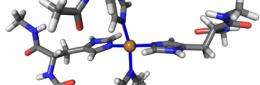
proteins, or PrPs, are commonly found in and throughout the . In humans or animals with prion diseases, these proteins deform and aggregate, creating clumps of PrPs that interfere with the nervous system's ability to function normally. A team of NC State physicists, led by Miroslav Hodak and Jerry Bernholc, has found that when PrPs bind with copper in the human body, their structure becomes more stable and less likely to misfold or aggregate.

"We believe that a prion protein's normal function is to serve as a copper buffer in the human body, binding with copper ions and keeping those ions from damaging human tissue," Hodak says. "We wanted to determine whether this was the normal function of the prion, and then look at how that binding affected the prion's structure."

The researchers created a 3-D model of the PrP using supercomputers at Oak Ridge National Laboratories. With the model, they determined that PrPs can bind up to four copper ions apiece, depending on the concentration of copper present. They also found that when the PrPs bind to the copper ions, the structure of the protein changes, becoming more stable.

Their results are published online this week in Proceedings of the National Academy of Sciences.

"Prion proteins are unusual in that half of the protein has a well-defined structure, but the other half of it - where the binding occurs - is a flexible, random tangle," Hodak says. "When we looked at the so-called 'random' portion of the PrP where that binding occurs, we found that the lend stability to the overall protein. This stability may play a role in preventing PrPs from misfolding or aggregating - which indicates that with prion diseases, copper binding may be beneficial."

More information: "Cu2+ Binding to the Prion : Functional Implications and the Role of Copper"
Authors: Miroslav Hodak, and Robin Chisnell, North Carolina State University; Wenchang Lu and Jerry Bernholc, North Carolina State University and Oak Ridge National Laboratories; Published: Online the week of June 22, 2009, in

Source: North Carolina State University (news : web)

Explore further: Attacking MRSA with metals from antibacterial clays

add to favorites email to friend print save as pdf

Related Stories

Mutant proteins result in infectious prion disease in mice

Dec 05, 2008

A worldwide group of scientists has created an infectious prion disease in a mouse model, in a step that may help unravel the mystery of this progressive disease that affects the nervous system in humans and animals. The ...

New prion protein may offer insight into mad cow disease

Aug 16, 2007

Scientists have discovered a new protein that may offer fresh insights into brain function in mad cow disease. “Our team has defined a second prion protein called ‘Shadoo’, that exists in addition to the well-known ...

Is there more to prion protein than mad cow disease?

Sep 30, 2008

Prion protein, a form of protein that triggers BSE, is associated with other brain diseases in cattle, raising the possibility of a significant increase in the range of prion disease. Publishing their findings in the open ...

Recommended for you

Attacking MRSA with metals from antibacterial clays

May 17, 2013

In the race to protect society from infectious microbes, the bugs are outrunning us. The need for new therapeutic agents is acute, given the emergence of novel pathogens as well as old foes bearing heightened antibiotic resistance.

Keeping fruit, vegetables and cut flowers fresh longer

May 15, 2013

New technology offers the promise of reducing billions of dollars of losses that occur each year from the silent, invisible killer of fruits, vegetables and cut flowers—a gas whose effects are familiar to everyone who has ...

Why don't beetles freeze in the winter?

May 14, 2013

For 37 years, Queen's University Biochemistry professor Peter Davies has been unraveling the mystery of why some organisms including insects and fish don't freeze in the winter. His research into insect antifreeze protein ...

The molecular basis of strawberry aroma

May 13, 2013

You know that summer is here when juicy red strawberries start to appear on the shelves. In Germany, this seasonal fruit has never been more popular: on average 3.5 kilos per head were consumed in 2012—a ...

A new dimension for 3-D protein structures

May 13, 2013

(Phys.org) —3D structures of biological molecules like proteins directly affect the way they behave in our bodies. EPFL scientists have developed a new infrared-UV laser method to more accurately determine ...

User comments : 0

More news stories

Attacking MRSA with metals from antibacterial clays

In the race to protect society from infectious microbes, the bugs are outrunning us. The need for new therapeutic agents is acute, given the emergence of novel pathogens as well as old foes bearing heightened antibiotic resistance.

Beautiful 'flowers' self-assemble in a beaker

By simply manipulating chemical gradients in a beaker of fluid, materials scientists at Harvard have found that they can control the growth behavior of crystals to create precisely tailored structures—such ...

Making gold green: New non-toxic method for mining gold

Northwestern University scientists have struck gold in the laboratory. They have discovered an inexpensive and environmentally benign method that uses simple cornstarch—instead of cyanide—to isolate gold from raw materials ...