Successful initial safety tests for genetically-modified rice that fights allergy
Jun 24, 2009
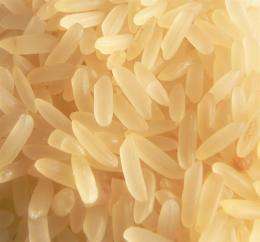
A new transgenic rice designed to fight a common pollen allergy appears safe in animals, scientists in Japan report. Credit: David.Monniaux, Wikimedia Commons

In a first-of-its-kind advance toward the next generation of genetically modified foods -- intended to improve consumers’ health -- researchers in Japan are reporting that a new transgenic rice designed to fight a common pollen allergy appears safe in animal studies. Their report is in the current issue of ACS’ Journal of Agricultural and Food Chemistry.

Fumio Takaiwa and colleagues note that the first generation of genetically-modified crops was designed to help keep crops weed and insect free. The next generation of transgenic crops is being developed to directly benefit human health. This includes veggies and grains that produce higher levels of nutrients, such as vitamins and minerals, or even medicines and vaccines. Like the first generation of transgenic foods, however, researchers are anxiously trying to determine whether foods produced from these “biopharmaceutical” will be safe for humans and the environment.

The scientists describe development of a transgenic rice plant that has been genetically- engineered to fight allergies to Japanese cedar pollen, a growing public health problem in Japan that affects about 20 percent of the population. In laboratory studies, the researchers fed a steamed version of the transgenic rice and a non-transgenic version to a group of monkeys everyday for 26 weeks. At the end of the study period, the test animals did not show any health problems, in an initial demonstration that the allergy-fighting rice may be safe for consumption, the researchers say.

More information: , Journal Article: “26-Week Oral Safety Study in macaques for Transgenic Rice Containing major Human T-Cell Epitope Peptides from Japanese Cedar Pollen Allergens”

Provided by American Chemical Society (news : web)

Explore further: RNA capable of catalyzing electron transfer on early earth with iron's help, study says

add to favorites email to friend print save as pdf

Related Stories

A built-in strategy for transgene containment

Mar 19, 2008

A method of creating selective terminable transgenic rice was reported by the scientists of Zhejiang University in this week’s PLoS ONE. Unintended spreading of transgenic rice by pollen and seed dispersal is a major concer ...

Arkansas rice farmers file a lawsuit

Aug 30, 2006

A group of Arkansas rice farmers has filed a state lawsuit against Bayer CropScience and Riceland Foods Inc., concerning genetically modified rice.

Genetically modified rice could pose risks

Jun 14, 2005

BEIJING, June 14 (UPI) -- Greenpeace China has warned that experimental, genetically modified rice is being illegally sold in southern China, posing possible risks to consumers.Researchers from the environmental group collected ...

Nothing to sneeze at: Real-time pollen forecasts

Dec 22, 2008

Researchers in Germany are reporting an advance toward development of technology that could make life easier for millions of people allergic to plant pollen. It could underpin the first automated, real-time ...

GM rice from U.S. found in EU

Sep 13, 2006

Genetically modified rice from the United States has been found in the European Union, in violation of a ban on import, growth and sale of such crops.

Recommended for you

Protein study suggests drug side effects are inevitable

2 hours ago

A new study of both computer-created and natural proteins suggests that the number of unique pockets – sites where small molecule pharmaceutical compounds can bind to proteins – is surprisingly small, meaning drug side ...

Attacking MRSA with metals from antibacterial clays

May 17, 2013

In the race to protect society from infectious microbes, the bugs are outrunning us. The need for new therapeutic agents is acute, given the emergence of novel pathogens as well as old foes bearing heightened antibiotic resistance.

Keeping fruit, vegetables and cut flowers fresh longer

May 15, 2013

New technology offers the promise of reducing billions of dollars of losses that occur each year from the silent, invisible killer of fruits, vegetables and cut flowers—a gas whose effects are familiar to everyone who has ...

Why don't beetles freeze in the winter?

May 14, 2013

For 37 years, Queen's University Biochemistry professor Peter Davies has been unraveling the mystery of why some organisms including insects and fish don't freeze in the winter. His research into insect antifreeze protein ...

The molecular basis of strawberry aroma

May 13, 2013

You know that summer is here when juicy red strawberries start to appear on the shelves. In Germany, this seasonal fruit has never been more popular: on average 3.5 kilos per head were consumed in 2012—a ...

User comments : 1

Adjust slider to filter visible comments by rank

Display comments: newest first

Sepp
not rated yet Jun 25, 2009
How do we know the rice is indeed "allergy fighting" and what is the mechanism?

More news stories

Non-wetting fabric drains sweat

(Phys.org) —Waterproof fabrics that whisk away sweat could be the latest application of microfluidic technology developed by bioengineers at the University of California, Davis.

Protein study suggests drug side effects are inevitable

A new study of both computer-created and natural proteins suggests that the number of unique pockets – sites where small molecule pharmaceutical compounds can bind to proteins – is surprisingly small, meaning drug side ...

Beautiful 'flowers' self-assemble in a beaker

By simply manipulating chemical gradients in a beaker of fluid, materials scientists at Harvard have found that they can control the growth behavior of crystals to create precisely tailored structures—such ...

Attacking MRSA with metals from antibacterial clays

In the race to protect society from infectious microbes, the bugs are outrunning us. The need for new therapeutic agents is acute, given the emergence of novel pathogens as well as old foes bearing heightened antibiotic resistance.

Study shows how bilinguals switch between languages

(Medical Xpress)—Individuals who learn two languages at an early age seem to switch back and forth between separate "sound systems" for each language, according to new research conducted at the University of Arizona.

SARS-like virus claims new life in Saudi

A Saudi man who had contracted the coronavirus has died, raising the death toll in the kingdom from the SARS-like virus to 16, the health ministry announced on Monday on its Internet website.

Study suggests new source of kidneys for transplant

Nearly 20 percent of kidneys that are recovered from deceased donors in the U.S. are refused for transplant due to factors ranging from scarring in small blood vessels of the kidney's filtering units to the organ going too ...