The future of robots is rat-shaped
Jun 07, 2009 by Annie Hautefeuille
Rat-shaped robot

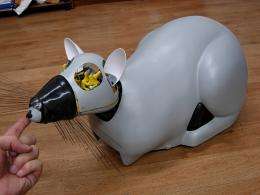
Agnes Guillot dreams of one day seeing a giant 50-centimetre (20-inch) -long white rat called Psikharpax scuttling fearlessly around her lab.

If so, it will be time to scream... but out of joy, rather than fear, for it could be a turning point in the history of robotics.

Psikharpax -- named after a cunning king of the , according to a tale attributed to Homer -- is the brainchild of European researchers who believe it may push back a frontier in .

Scientists have strived for decades to make a robot that can do some more than make repetitive, programmed gestures. These are fine for making cars or amusing small children, but are of little help in the real world.

One of the biggest obstacles is learning ability. Without the smarts to figure out dangers and opportunities, a robot is helpless without human intervention.

"The autonomy of robots today is similar to that of an insect," snorts Guillot, a researcher at France's Institute for Intelligent Systems and Robotics (ISIR), one of the "Psikharpax" team.

Such failures mean it is time to change tack, argue some roboticist.

Rather than try to replicate human intelligence, in all its furious complexities and higher levels of language and reasoning, it would be better to start at the bottom and figure out simpler abilities that humans share with other animals, they say.

These include navigating, seeking food and avoiding dangers.

And, for this job, there can be no better inspiration than the rat, which has lived cheek-by-whisker with humans since Homo sapiens took his first steps.

"The rat is the animal that scientists know best, and the structure of its brain is similar to that of humans," says Steve Nguyen, a doctoral student at ISIR, who helped show off Psikharpax at a research and innovation fair in Paris last week.

Rat robots are being built in other labs in Britain, the United States and elsewhere. Two years ago, for instance, a team at the ITAM technical institute in Mexico City reprogrammed a Sony Aibo dog using rat-simulated sofware.

But the European researchers believe that Psikharpax is unique in its biomimickry, sophistication of sensors and controls and software based on rat neurology.

Their artificial rodent has two cameras for eyes, two microphones for ears and tiny wheels, driven by a battery-powered motor, to provide movement.

A couple of dozen whiskers measuring around a dozen centimetres (four inches) stretch out impressively either side of its long, pointed snout.

The patented "vibrissae" seek to replicate a key part of the nervous system in a real-life rat, where whiskers are used to sense obstacles.

Data from these artificial organs goes to Psikharpax's "brain," a chip whose software hierarchy mimicks the structures in a rat's brain that process and analyse what is seen, heard and sensed.

For instance, if Psikharpax's eyes sense that it is dark, the software gives a greater weight of importance to data from the whiskers, in the same way that a rat, at night, relies on other sensors to compensate for loss of vision.

But one famous rat quality -- the power of smell -- is not incorporated in Psikharpax. An artificial nose was originally included in the scheme, conceived by roboticist Jean-Arcady Meyer, but proved too complex in practice.

The goal is to get Psikharpax to be able to "survive" in new environments. It would be able to spot and move around things in its way, detect when it is in danger from collision with a human in its vicinity and spot an opportunity for "feeding" -- recharging its battery at power points placed around the lab.

"We want to make robots that are able to look after themselves and depend on humans as least as possible," said Guillot.

"If we want to send a robot to Mars, or help someone in a flat that we don't know, the has to have the ability to figure out things out for itself."

(c) 2009 AFP

Explore further: Makr Shakr uses three arms for drink-recipe collabs

add to favorites email to friend print save as pdf

Related Stories

Rats' senses a whisker away from humans

Feb 15, 2007

The sophisticated way in which rats use their whiskers in their surrounding environments show significant parallels with how humans use their fingertips, according to new research carried out at the University ...

Robots That Act Like Rats

Feb 15, 2005

Robots that act like rat pups can tell us something about the behavior of both, according to UC Davis researchers. Sanjay Joshi, assistant professor of mechanical and aeronautical engineering, and associate pro ...

Scientists develop robotic rats to aid in rescue missions

Feb 11, 2008

A new initiative, bringing together nine research groups from seven countries, including teams of robotics and brain researchers from Europe, the USA and Israel, has recently been set up with the aim of imitating ...

Researchers catch rats' twitchy whiskers in action

Feb 27, 2008

Rats use their whiskers in a way that is closely related to the human sense of touch: Just as humans move their fingertips across a surface to perceive shapes and textures, rats twitch their whiskers to achieve ...

Robotic whiskers can sense 3D environment

Oct 08, 2006

Many mammals use their whiskers to explore their environment and to construct a three-dimensional image of their world. Rodents, for example, use their whiskers to determine the size, shape and texture of objects, and seals ...

Rat hair cells found to be true stem cells

Oct 04, 2005

Cells inside hair follicles are stem cells able to develop into the cell types needed for hair growth and follicle replacement, Swiss researchers claim.

Recommended for you

Congress gets mixed advice on regulating drones

11 hours ago

(AP)—The growing use of unmanned surveillance "eyes in the sky" aircraft raises a thicket of privacy concerns, but the U.S. Congress is getting mixed advice on what, if anything, to do about it.

Makr Shakr uses three arms for drink-recipe collabs

May 15, 2013

(Phys.org) —We're told it's the wave of the future. Design, make, enjoy. Beyond home-based 3-D printers, there will be new machines and display screens and apps that will invite you to have day to day products ...

Nokia unveils metallic smartphone, stock tumbles (Update)

May 14, 2013

Nokia Corp. on Tuesday unveiled its first Lumia smartphone with a metal cover, low-light camera features and new social network apps. But the new model failed to impress investors, who sent the company's stock down more than ...

User comments : 3

Adjust slider to filter visible comments by rank

Display comments: newest first

jmhenry
not rated yet Jun 07, 2009
I find it amazing how many types of robots are based on models from nature. There are robots designed from insects, spiders, snakes, beavers, and now rats. Of course, there are other examples. It turns out that nature is a source of great creativity in robot development.
DGBEACH
not rated yet Jun 08, 2009
But is it smart enough to avoid rat-traps? -:)
Wollff
not rated yet Jun 22, 2009
It turns out that nature is a source of great creativity in robot development.


Indeed. That was one of the major paradigm shifts of the 90s / 00s in robotics. After the great failiure to come to human like behaviour from the top down, starting from topics like semantics, language and reasoning, roboticists are now trying a bottom up approach inspired by nature.
Still, great breakthroughs in robotics are slow in materializing, even after that shift and after considerably scaling down the aims. And with still growing computing power.
Maybe this approach is reaching its limits already?

More news stories

Congress gets mixed advice on regulating drones

(AP)—The growing use of unmanned surveillance "eyes in the sky" aircraft raises a thicket of privacy concerns, but the U.S. Congress is getting mixed advice on what, if anything, to do about it.

Makr Shakr uses three arms for drink-recipe collabs

(Phys.org) —We're told it's the wave of the future. Design, make, enjoy. Beyond home-based 3-D printers, there will be new machines and display screens and apps that will invite you to have day to day products ...

RIM unveils cheaper BlackBerry (Update 2)

Research In Motion unveiled a lower-cost BlackBerry aimed at consumers in emerging markets on Tuesday, and said it will offer its once-popular BlackBerry Messenger service on iPhones and devices running Google's ...

US seizes Bitcoin operator accounts

US authorities seized the accounts of a Bitcoin digital currency exchange operator, claiming it was functioning as an "unlicensed money service business," court documents showed Friday.

Chinese, Indian airlines face EU pollution fines

Eight Chinese and two Indian airlines face fines of up to several million euros for not paying for their greenhouse gas emissions during flights within the bloc, the European Commission said on Friday.

Alaska volcano shoots ash 15,000 feet into the air

(AP)—One of Alaska's most restless volcanoes has shot an ash cloud 15,000 feet into the air in an ongoing eruption that has drawn attention from a nearby community but isn't expected to threaten air traffic.