Genital stimulation opens door for cryptic female choice in tsetse flies
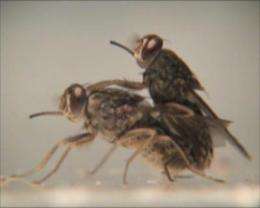
Manipulation of male and/or female genitalia results in a suite of changes in female reproductive behavior in tsetse flies, carriers of African sleeping sickness.
By snipping off parts of male genitalia and reducing genital sensation in both male and female tsetse flies, researchers induced a suite of changes in female reproduction, including reduced ovulation, reduced sperm storage and increased re-mating attempts by the females.
"To the best of our knowledge, this was the first study to look at female choice following experimental manipulation of both male and female genitalia," said William Eberhard, staff scientist at the Smithsonian Tropical Research Institute and professor of biology at the University of Costa Rica.
Cryptic female choice—the ability of females to control which sperm reaches their eggs during and after the mating process—leads to rapid evolutionary changes in genital structure and is probably influenced by the number of times a female mates with different males.
"The tsetse fly Kama Sutra is long and elaborate," said Eberhard, who described the 30-minute ritual during which the male rubs the underside of the female's abdomen with his hind legs, sings to her by buzzing his wings, rubs her eyes with his front legs, and so on.
With Daniel Briceño, professor of biology at the University of Costa Rica, Eberhard modified male genital structures by cutting off a tooth that is typical of this species of tsetse fly and by smoothing a bristly surface by applying a coat of nail polish. In addition, they modified the sensations perceived by the female from these structures by altering the female sense organs on the portions of her body that these male structures contact during copulation. "We were surprised by the number of female processes that were influenced by modifying the stimuli received by the female from the male's genitalia," said Eberhard.
Source: Smithsonian Tropical Research Institute
