Atlantis moves in on Hubble to grab telescope (Update)
May 13, 2009
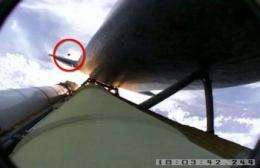
This image provided by NASA on Tuesday May 12, 2009 and annotated by source, shows debris from Atlantis' launch hitting the shuttle's right wing edge after launch on Monday May 11, 2009. The Atlantis astronauts uncovered a 21-inch stretch of nicks on their space shuttle Tuesday, but NASA said the damage did not appear to be serious. The damage was likely the result of debris that came off the fuel tank shortly after liftoff Monday. (AP Photo/NASA)

(AP) -- Shuttle Atlantis and its crew moved toward the Hubble Space Telescope for a 350-mile-high grab Wednesday that will set the stage for five days of treacherous spacewalking repairs in an orbit littered with space junk.

Late Tuesday, the got comforting news: the ugly stretch of nicks on Atlantis' thermal tiles were not considered serious, and no further inspections were needed. NASA is continuing to prep another shuttle, though, just in case a piece of space junk hits the shuttle during the mission.

Hubble's unusually high orbit is strewn with smashed satellite pieces and other debris that could pierce the shuttle or suit of a spacewalking astronaut.

Commander Scott Altman and his co-pilot fired the engines Wednesday morning and steered Atlantis into Hubble's orbit. An hour later, Altman spotted Hubble, "that star approaching from the east."

Mission Control reminded the astronauts that no one has seen the up close since 2002. "We hope to get a lot closer," Altman radioed from 268,000 feet away.

Early in the afternoon, robot arm operator Megan McArthur will use the 50-foot boom to grab the school bus-sized observatory and anchor it in Atlantis' payload bay.

The capture is expected to occur over the Indian Ocean, just northeast of Madagascar.

Hubble scientists and managers warn that Hubble may look a little ragged; it hasn't had a tuneup for seven years.

Beginning Thursday, two teams of spacewalking astronauts - two men per team - will take turns venturing outside to replace the 19-year-old Hubble's batteries and gyroscopes, and an old camera and pointing mechanism. They also will install fresh thermal covers on the telescope and a new science data-control unit - the original conked out last September and, although revived, delayed the shuttle flight by seven months.

The space repairmen also will go into the guts of two broken science instruments and attempt to fix the fried electronics. Astronauts have never attempted anything like this before at Hubble.

This is the fifth and final flight to Hubble, costing NASA just over $1 billion. The space agency hopes to get another five to 10 years of dazzling views of the cosmos, with all the planned upgrades, which should leave the observatory more powerful than ever.

The mission almost didn't happen.

A year after the 2003 Columbia tragedy, NASA canceled the repair effort, saying it was too dangerous. The astronauts would not have anywhere to seek shelter because the is in a different, inaccessible orbit.

But a new NASA regime reinstated the flight in 2006 after shuttle repair techniques were developed and tested in orbit. A plan also was put in place to have a rescue shuttle on the launch pad to blast off within days for a rescue.

That shuttle, the Endeavour, will remain on standby until Atlantis and its crew of seven head back to Earth late next week.

As for the nicks on Atlantis, they stretch over 21 inches on the right wing, on the forward edge where it joins with the fuselage. The astronauts discovered the damage Tuesday while inspecting their ship.

The nicks are shallow and embedded in thick thermal tiles, in a location that is not particularly vulnerable during re-entry at flight's end. Engineers believe those scrapes were caused by debris that came off the fuel tank 1 1/2 minutes after liftoff Monday.

Columbia's damage at launch was considerably more severe - a plate-size hole in the most sensitive part of the left wing. NASA did not pursue the matter and was unaware of the extent of the damage until the shuttle was returning home. All seven astronauts were killed.

---

On the Net:

: http://www.nasa.gov/mission-pages/hubble/main/index.html

©2009 The Associated Press. All rights reserved. This material may not be published, broadcast, rewritten or redistributed.

Explore further: Mice, gerbils perish in Russia space flight

add to favorites email to friend print save as pdf

Related Stories

Rescue shuttle moved to launch pad just in case

Apr 17, 2009

(AP) -- Space shuttle Endeavour is on a launch pad, ready to rocket off on a rescue mission if shuttle Atlantis needs help when it flies to repair the Hubble Space Telescope next month.

Rescue shuttle at launch pad for Hubble trip

May 10, 2009

(AP) -- In what's expected to be the last time ever, both of NASA's shuttle launch pads are occupied. Atlantis is on one, primed for a flight this coming week to the Hubble Space Telescope. Endeavour sits ...

NASA begins launch countdown for Hubble mission

May 08, 2009

(AP) -- NASA began the countdown for its final trip to the Hubble Space Telescope on Friday as the astronauts who will attempt the daunting repairs arrived at the launching site.

Recommended for you

Mice, gerbils perish in Russia space flight

10 hours ago

A number of mice and eight gerbils sent into space in a Russian capsule destined to find out how well organisms can withstand extended flights perished during their journey, scientists said Sunday as the ...

Mars rover Opportunity examines clay clues in rock

May 18, 2013

(Phys.org) —NASA's senior Mars rover, Opportunity, is driving to a new study area after a dramatic finish to 20 months on "Cape York" with examination of a rock intensely altered by water.

NASA's STEREO detects a CME from the sun

May 17, 2013

On 5:24 a.m. EDT on May 17, 2013, the sun erupted with an Earth-directed coronal mass ejection or CME, a solar phenomenon that can send billions of tons of solar particles into space that can reach Earth ...

Nine-year-old Mars rover passes 40-year-old record

May 17, 2013

While Apollo 17 astronauts Eugene Cernan and Harrison Schmitt visited Earth's moon for three days in December 1972, they drove their mission's Lunar Roving Vehicle 19.3 nautical miles (22.210 statute miles ...

Bright explosion on the Moon

May 17, 2013

For the past 8 years, NASA astronomers have been monitoring the Moon for signs of explosions caused by meteoroids hitting the lunar surface. "Lunar meteor showers" have turned out to be more common than anyone ...

User comments : 0

More news stories

Heat-related deaths in Manhattan projected to rise

Residents of Manhattan will not just sweat harder from rising temperatures in the future, says a new study; many may die. Researchers say deaths linked to warming climate may rise some 20 percent by the 2020s, ...

Mice, gerbils perish in Russia space flight

A number of mice and eight gerbils sent into space in a Russian capsule destined to find out how well organisms can withstand extended flights perished during their journey, scientists said Sunday as the ...

Bold action, big money needed to curb Asia floods

Asia's flood-prone megacities should fund major drainage, water recycling and waste reduction projects to stem deluges and secure clean supply for their booming populations, experts said Sunday.

Kinks and curves at the nanoscale

One of the basic principles of nanotechnology is that when you make things extremely small—one nanometer is about five atoms wide, 100,000 times smaller than the diameter of a human hair—they are going ...

Honeybees trained in Croatia to find land mines

(AP)—Mirjana Filipovic is still haunted by the land mine blast that killed her boyfriend and blew off her left leg while on a fishing trip nearly a decade ago. It happened in a field that was supposedly ...