How Social Insects Recognize Dead Nestmates
May 05, 2009
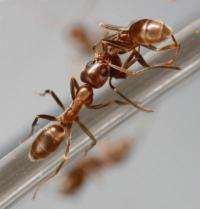
This is an Argentine ant worker carrying a dead nestmate (necrophoresis). The rapid dissipation of compounds associated with live ants allows the latent necrophoric behavior to be triggered. Credit: Dong-Hwan Choe, UC Riverside.

(PhysOrg.com) -- When an ant dies in an ant nest or near one, its body is quickly picked up by living ants and removed from the colony, thus limiting the risk of colony infection by pathogens from the corpse.

The predominant understanding among entomologists - scientists who study insects - was that dead release chemicals created by decomposition (such as ) that signal their death to the colony's living ants.

But now UC Riverside entomologists working on Argentine ants provide evidence for a different mechanism for how necrophoresis - the removal of dead nestmates from colonies - works.

In a research paper published online this week in the early edition of the , the researchers report that all ants, both living and dead, have the "death chemicals" continually, but live ants have them along with other chemicals associated with life - the "life chemicals." When an ant dies, its life chemicals dissipate or are degraded, and only the death chemicals remain.

"It's because the dead ant no longer smells like a living ant that it gets carried to the graveyard, not because its body releases new, unique chemicals after death," said Dong-Hwan Choe, the lead author of the research paper and a graduate student working towards his doctoral degree with Michael Rust, a professor of entomology at UCR.

Choe explained that the research paper's results resolve a conundrum of long-standing in animal behavior and correct a misinterpretation of previous results that has become both popular and widespread in literature.

"There is no mistaking that it is the dissipation of chemical signals associated with life rather than the increase of a decomposition product 'death cue' that triggers necrophoric behavior by Argentine ants," he said.

Along with Rust and UCR's Jocelyn Millar, a professor of entomology, Choe used techniques to identify the "signals of life" in the Argentine ant: the chemicals dolichodial and iridomyrmecin.

"These chemicals, or compounds similar to them, are found in numerous ant species that display necrophoresis," Choe said. "Therefore, these ant species also are likely to have necrophoric behavior triggered by the decrease or absence of signs of life, rather than by cues associated with death. We plan to research this next."

He added that dolichodal, iridomyrmecin, or similar compounds are found also in other insects, such as thrips, stick insects, aphids and rove beetles.

"Understanding the exact mechanism of ant necrophoresis will help researchers develop a more environmentally friendly pest management strategy by which we can achieve results with smaller amounts of insecticide," Choe said. "A recent study on Argentine ants that we did in the lab indicated that nestmates can efficiently distribute slow-acting and non-repellent insecticides among themselves via necrophoresis. When an ant exposed to an insecticide dies in the nest, other ants carry its body around, with the insecticide transferring easily from the corpse to healthy ants."

Source: University of California - Riverside (news : web)

Explore further: Navy dolphins discover rare old torpedo off Calif. coast near Coronado

add to favorites email to friend print save as pdf

Related Stories

Fire ants reappearing in Orange County

Apr 24, 2006

Fire ants are reappearing in California's Orange County the result, say some critics, of the state ending its fire ant eradication funding in 2003.

When industrious ants go too far

Apr 28, 2009

Nature is full of mutually beneficial arrangements between organisms—like the relationship between flowering plants and their bee pollinators. But sometimes these blissful relationships have a dark side, as Harvard biologist ...

Recommended for you

Scientists take a new look at an ancient crop

16 hours ago

Though the price makes you wince, you might just buy that bottle of your favorite olive oil anyway. Perhaps it's exactly what you want for the salad dressing you're making tonight and for your special stir-fry ...

Bittersweet: Bait-averse cockroaches shudder at sugar

May 23, 2013

Sugar isn't always sweet to German cockroaches, especially to the ones that avoid roach baits. In a study published May 24 in the journal Science, North Carolina State University entomologists show the ne ...

White tiger mystery solved

May 23, 2013

White tigers today are only seen in zoos, but they belong in nature, say researchers reporting new evidence about what makes those tigers white. Their spectacular white coats are produced by a single change ...

User comments : 1

Adjust slider to filter visible comments by rank

Display comments: newest first

MongHTanPhD
not rated yet May 05, 2009
RE: Chemical Intelligence in Myrmecology!?

I thought this is a new methodology and analysis of insect behaviorism in myrmecology, as the lead author Choe has accurately explained "that the research paper's results resolve a conundrum of long-standing in animal behavior and correct a misinterpretation of previous results that has become both popular and widespread in literature."

This "conundrum" in animal behaviorism and the "misinterpretation of previous results" could doubtly implicate those publications of the world-renowned Harvard myrmecologist E O Wilson, one prolific science writer who has since the 1970s been "anthropomorphizing" his studies of "ant colonies" as "human societies" in one of his most controversial and "scientistic" books "Sociobiology: The New Synthesis."

Best wishes, Mong 5/5/9usct3:28p; author "Decoding Scientism" and "Consciousness & the Subconscious" (works in progress since July 2007), "Gods, Genes, Conscience" (2006: http://www.iunive...95379907 ) and "Gods, Genes, Conscience: Global Dialogues Now" (blogging avidly since 2006: http://www2.blogg...50569778 ).

More news stories

EU bans three pesticides harmful to bees

The European Commission said Friday that it will ban for two years beginning in December pesticides blamed for killing the bees that pollinate food and fruit crops.

Galaxies fed by funnels of fuel

(Phys.org) —Computer simulations of galaxies growing over billions of years have revealed a likely scenario for how they feed: a cosmic version of swirly straws.

Google eyes emerging markets networks

Google has become deeply involved in a series of projects to build and operate wireless networks in emerging markets including sub-Saharan Africa and Southeast Asia, a report said Friday.