Team Continues Analyzing Spirit Computer Reboots and Amnesia Events
Apr 21, 2009
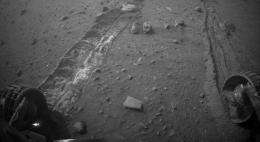
NASA's Mars Exploration Rover Spirit drove 6.98 meters (22.9 feet) southeastward on the 1,871st Martian day, or sol, of the rover's mission on Mars (April 8, 2009). As usual since losing the use of its right-front wheel in 2006, Spirit drove backward, dragging the immobile wheel. Image credit: NASA/JPL-Caltech.

(PhysOrg.com) -- After three days of completing Earth-commanded activities without incident last week, NASA's Mars Exploration Rover Spirit had a bout of temporary amnesia Friday, April 17, and rebooted its computer Saturday, April 18, behavior similar to events about a week earlier.

Engineers operating Spirit are investigating the reboots and the possibly unrelated amnesia events, in which Spirit unexpectedly fails to record data into the type of memory, called flash, where information is preserved even when power is off. Spirit has had three of these amnesia events in the past 10 days, plus one on Jan. 25. No causal link has been determined between the amnesia events and the reboots.

The most recent reboot put Spirit back into an autonomous operations mode in which the rover keeps itself healthy. Spirit experienced no problems in this autonomous mode on Sunday. The rover team at NASA's Jet Propulsion Laboratory, Pasadena, Calif., revised plans today for regaining Earth control of Spirit's operations and resuming diagnostic and recovery activities by the rover.

"We are proceeding cautiously, but we are encouraged by knowing that Spirit is stable in terms of power and thermal conditions and has been responding to all communication sessions for more than a week now," said JPL's Sharon Laubach, chief of the rover sequencing team, which develops and checks each day's set of commands.

During the past week of diagnostic activities, the rover has successfully moved its high-gain dish antenna and its camera mast, part of checking whether any mechanical issues with those components may be related to the reboots, the amnesia events, or the failure to wake up for three consecutive communication sessions two weeks ago.

Spirit and its twin rover, Opportunity, completed their original three-month prime missions on Mars in April 2004 and have continued their scientific investigations on opposite sides of the planet through multiple mission extensions. Engineers have found ways to cope with various symptoms of aging on both rovers. The current diagnostic efforts with Spirit are aimed at either recovering undiminished use of the rover or, if some capabilities have been diminished, to determine the best way to keep using the rover.

Laubach said, "For example, if we do determine that we can no longer use the flash memory reliably, we could design operations around using the random-access memory." Spirit has 128 megabytes of random-access memory, or RAM, which can store data as long as the rover is kept awake before its next downlink communications session.

Provided by JPL/NASA (news : web)

Explore further: Building a better team—on Mars

add to favorites email to friend print save as pdf

Related Stories

Mars Rover Team Diagnosing Unexpected Behavior

Jan 28, 2009

(PhysOrg.com) -- The team operating NASA's Mars Exploration Rover Spirit plans diagnostic tests this week after Spirit did not report some of its weekend activities, including a request to determine its orientation ...

Spirit Resumes Driving

Feb 03, 2009

(PhysOrg.com) -- NASA's Mars Exploration Rover Spirit resumed driving Saturday after engineers gained confidence from diagnostic activities earlier in the week evaluating how well the rover senses its orientation.

Mars Rover Team Sets Low-Power Plan for NASA's Spirit

Nov 17, 2008

(PhysOrg.com) -- After assessing data received from NASA's Mars Exploration Rover Spirit on Thursday, mission controllers laid out plans for the rover to conserve its modest energy during the next few weeks.

Spirit Healthy but Computer Reboots Raise Concerns

Apr 14, 2009

(PhysOrg.com) -- The team operating NASA's Mars Exploration Rover Spirit is examining data received from Spirit in recent days to diagnose why the rover apparently rebooted its computer at least twice over ...

Recommended for you

Building a better team—on Mars

16 hours ago

Sometime in the next quarter-century, NASA plans to send the first humans to Mars, a mission that will push the boundaries of teamwork for a handful of astronauts who will spend as long as three years together ...

User comments : 0

More news stories

NASA's BARREL mission launches 20 balloons

(Phys.org) —In Antarctica in January, 2013 – the summer at the South Pole – scientists released 20 balloons, each eight stories tall, into the air to help answer an enduring space weather question: ...

If you can remember it, you can remember it wrong

(Medical Xpress)—Native peoples in regions where cameras are uncommon sometimes react with caution when their picture is taken. The fear that something must have been stolen from them to create the photo ...

B vitamins could delay dementia

(Medical Xpress)—Despite spending billions of dollars on research and development, drug companies have been unable to come up with effective treatments for dementia and Alzheimer's Disease (AD). Now, A. ...

Encouraging signs for bee biodiversity

Declines in the biodiversity of pollinating insects and wild plants have slowed in recent years, according to a new study. Researchers led by the University of Leeds and the Naturalis Biodiversity Centre in the Netherlands ...