Implementing sustainable technology to monitor the integrity of the nation's bridges
Today, humans perform visual inspections every two years of most of the nation's older bridges. But with a scarcity of inspectors and tens of thousands of bridges, that process can be long and laborious.
While newer bridges have monitoring devices already incorporated into their design, there are thousands of bridges erected during the 1960s and '70s, when much of the nation's infrastructure was built that would benefit from such a system.
To address the issue, a team of University of Miami College of Engineering researchers are implementing a self-powered monitor system for bridges that can continuously check their condition using wireless sensors that "harvest" power from structural vibration and wind energy.
"Just as when someone goes to see a doctor and gets all sorts of tests done to see how healthy they are and how long they'll live, we're doing the same with bridges," says Antonio Nanni, professor and chair of the Department of Civil, Architectural, and Environmental Engineering and lead investigator of the nearly $14 million project.
Nanni and his team plan to place newly developed wireless sensors—some as small as a postage stamp, others no longer than a ballpoint pen—along strategic points inside the 27-year-old Long Key Bridge, in the Florida Keys and on a Northwest 103rd Street quarter-mile steel overpass that leads into Hialeah, in Florida.
The sensors, developed by project collaborators Virginia Tech University and New Jersey-based Physical Acoustics Corporation, record all sorts of data, from vibrations and stretching to acoustic waves and echoes emitted by flaws such as cracks. Even the alkaline levels in the concrete of bridge supports are being measured.
"The beauty of this project is that the data can be shared with other researchers via a Web site," Nanni says. "We could share information with the department of transportation in the UK and show them what's happening with the Long Key Bridge here in Florida. They would see the data as we see it, in real time."
Once all the information is culled and analyzed, Nanni and his team will form a prognosis of the bridges' health, and should any defects be found, the decision on how to repair the structures will be made by the Florida Department of Transportation. Nanni, who directs a College of Engineering Industry/University Cooperative Research Center supported by the National Science Foundation and called RB2C (Repair of Building and Bridges with Composites), hasn't ruled out the possibility of suggesting how to repair any damage found.
Researchers at the University of South Carolina at Columbia also are partners in the study, monitoring a series of bridges in their state and forming diagnoses jointly with UM engineers.
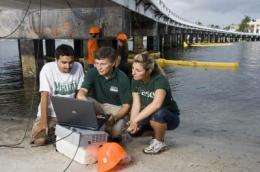
The project is the second bridge health-monitoring study being undertaken by Nanni and his colleagues. With a group of students, they are also placing sensors along Miami's Grove Isle Bridge as part of a smaller, one-year study funded by the National Science Foundation RB2C.
With the Federal Highway Administration estimating that more than 70,000 of the nation's bridges are structurally deficient, the system Nanni and his team develop could be used as a national model for monitoring the structural integrity of bridges nationwide and alerting bridge owners to potential dangers.
Source: University of Miami (news : web)


