A Flight Simulator for the World's Smallest Beam
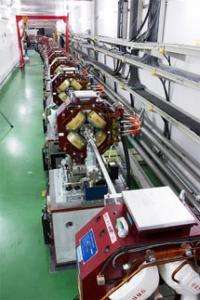
(PhysOrg.com) -- Commissioning has begun at the Japan-based Accelerator Test Facility 2, a major technology test bed for future accelerators, including the proposed International Linear Collider, or ILC. During the two-year commissioning process, SLAC National Accelerator Laboratory physicists are shuttling back and forth to KEK, the high-energy accelerator lab in Tsukuba, to join an international team of scientists working around the clock to get the accelerator's final focus system up and running. When fully commissioned, this system will squeeze the facility's electron beam down to a slender ribbon just 35 nanometers thick—the narrowest beam of particles ever achieved.
"We're making the world's smallest beam," said SLAC physicist Mark Woodley, who returned from a visit to Japan in early March. The tiny beam will be essential for the ILC, the next large scale high-energy particle collider planned by the international community, after the Large Hadron Collider. "If you can pack more electrons and positrons into a smaller space, they're more likely to collide, so you'll get more events."
At the test facility in Japan, a racetrack 139 meters in circumference delivers a beam of electrons to the final focus system, a 50-meter series of magnets. Since construction of the ATF2 began in 2007, SLAC has built and delivered several key parts, including power supplies, magnet movers, a new type of beam position monitor, and the final two quadrupole magnets. Now it's a matter of getting every component of the final focus system to work in concert to focus the beam to less than a thousandth of the width of a human hair—and keep it there.
"It's like a system of lenses," Woodley said. "There are aberrations, interplay between effects."
"Even natural movements of the ground affect it," said accelerator physicist Glen White, who returned from his most recent round in Japan in mid-March. "The beam drifts in seconds to minutes."
An essential part of the ATF2 is its system of diagnostics—ingenious devices that measure the beam's size and position. The first challenge in commissioning is calibrating these devices so that they take accurate measurements. A software program White developed is helping enormously in this process.
Dubbed the "flight simulator," the program is a virtual version of the test facility. It takes into account everything that affects the beam—magnetic field strength, temperature, even distant tremors in the Pacific plate—and generates a picture of what the beam should look like. White created it so that collaborators could improve their understanding of the ATF2 beam by playing with the parameters of a virtual beam.
On his last trip to KEK, White, with the help of Woodley and a team of collaborators, worked on adapting the program to read data from all of the ATF2's magnets and diagnostic electronics. This lets ATF physicists tweak the magnets, compare the diagnostic readouts to the software's calculated beam, and calibrate accordingly.
Achieving such a narrow beam is like balancing something on the head of a pin; tiny changes in magnet position or magnetic field strength can wreak havoc. So physicists are using the software to develop tuning algorithms, a sequence of adjustments—in magnet position, for instance, or in magnetic field strength—that produce a thinner beam.
"It's like a television, except you have maybe 20 knobs you can turn—brightness, contrast, color, etc.," White explained. "You're trying to tweak all of these things just right to get a clear picture, but at the same time there's somebody underneath, working against you."
These tuning algorithms will help transform the "flight simulator" into a sort of "autopilot" that would constantly read information about the beam and retune accordingly.
"When you're running the beam, you want something to take care of all this for you, so you can just sit and watch the beam," White said.
Although inspired by the needs of the ILC, the technical achievements of the ATF2 facility will be applicable to other designs, such as CERN's proposed Compact Linear Collider. Of even broader importance are the next generation of physicists who will leave the training ground of the ATF2 with the skills and knowledge to build the accelerators of the future, said SLAC physicist Andrei Seryi, deputy to the ATF spokesperson, responsible for the ATF2 project.
"This is a place where young people can learn accelerator physics and continue in other projects," he said.
Provided by SLAC


