Alaska's Mount Redoubt spews ash 50,000 feet high
Mar 28, 2009
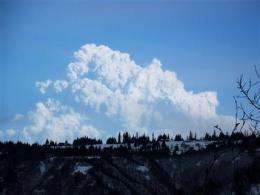
An ash cloud from the eruption of Redoubt volcano rises above the horizon in Homer, Alaska, Thursday, March 26, 2009. The eruption Thursday morning sent an ash cloud 65,000 feet above sea level, the Alaska Volcano Observatory reported. (AP Photo/Kenai Peninsula Clarion, McKibben Jackinsky)

(AP) -- Alaska's Mount Redoubt has erupted again, spewing an ash cloud 50,000 feet up into the air.

The Observatory in Anchorage says the volcano had a significant eruption at 1:20 a.m. Saturday. The ash is expected to move north toward the Alaska Range, missing Anchorage which is about 100 miles from the volcano.

The observatory says after the eruption, it detected strong lasting 20 minutes or more followed by an hours-long low-level tremor.

Since the series of eruptions began Sunday night, the volcano has had about a dozen bursts. The last time the volcano erupted was during a four-month period in 1989-90.

©2009 The Associated Press. All rights reserved. This material may not be published, broadcast, rewritten or redistributed.

Explore further: Alaska volcano shoots ash 15,000 feet into the air

add to favorites email to friend print save as pdf

Related Stories

Alaska volcano Mount Redoubt erupts 5 times

Mar 23, 2009

(AP) -- Alaska's Mount Redoubt volcano erupted five times overnight, sending an ash plume more than 9 miles into the air in the volcano's first emissions in nearly 20 years.

Alaska volcano eruptions ground flights

Jan 31, 2006

Alaska Airlines has canceled all flights to and from Anchorage because of activity at the Augustine volcano, about 180 miles southwest of Anchorage.

Recommended for you

Alaska volcano shoots ash 15,000 feet into the air

May 18, 2013

(AP)—One of Alaska's most restless volcanoes has shot an ash cloud 15,000 feet into the air in an ongoing eruption that has drawn attention from a nearby community but isn't expected to threaten air traffic.

NASA sees Cyclone Mahasen hit Bangladesh

May 17, 2013

NASA's Tropical Rainfall Measuring Mission satellite known as TRMM measured Cyclone Mahasen's rainfall rates from space as it made landfall on May 16. Mahasen has since dissipated over eastern India.

Rapid climate change ruled out ice age trees

May 17, 2013

Short, sharp fluctuations in the Earth's climate throughout the last ice age may have stopped trees from getting a foothold in Europe and northern Asia, scientists say.

User comments : 0

More news stories

Heat-related deaths in Manhattan projected to rise

Residents of Manhattan will not just sweat harder from rising temperatures in the future, says a new study; many may die. Researchers say deaths linked to warming climate may rise some 20 percent by the 2020s, ...

Mice, gerbils perish in Russia space flight

A number of mice and eight gerbils sent into space in a Russian capsule destined to find out how well organisms can withstand extended flights perished during their journey, scientists said Sunday as the ...

Kinks and curves at the nanoscale

One of the basic principles of nanotechnology is that when you make things extremely small—one nanometer is about five atoms wide, 100,000 times smaller than the diameter of a human hair—they are going ...

Honeybees trained in Croatia to find land mines

(AP)—Mirjana Filipovic is still haunted by the land mine blast that killed her boyfriend and blew off her left leg while on a fishing trip nearly a decade ago. It happened in a field that was supposedly ...