New bird discovered after its extinction
Mar 26, 2009
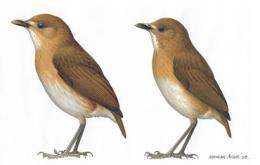
New subspecies of Colombian bird, Grallaria milleri gilesi on the left, discovered after 120 years in the Museum's collections and is now extinct. Its close relation, the antpitta Grallaria milleri milleri, is on the right. © Paintings by Norman Arlott/Natural History Museum

After almost 120 years in the Natural History Museum collections, a new Colombian bird has been discovered, and proclaimed extinct.

The bird is a new subspecies of antpitta, a thrush-sized ground-living flightless bird from forests near the Colombian city of Medellin.

It was discovered among the 1 million bird at the Natural History Museum in London, after lying unrecognised in the collection for 120 years.

Bird artist Norman Arlott uncovered the specimen in 2001 and drew it to the attention of Museum's Head of , Dr Robert Prys-Jones, and Museum scientific associate Dr Paul Salaman.

'We immediately recognised the specimen was previously undescribed,' says Dr Salaman, 'yet it seems inconceivable that this distinctive specimen could have had been overlooked for 120 years.'

Collected more than 100 years ago

The bird was originally collected in September 1878 by the British ornithologist Thomas Knight Salmon.

'There were no bird identification guides in the late 19th century,' says Dr Prys-Jones.

'So Thomas Salmon sent the specimens he’d collected to be identified by scientists in Britain, where many were deposited at the world’s largest here at London’s Natural History Museum.'

'While there were many new and exciting discoveries, one unusual specimen of an antpitta was amazingly overlooked.'

Habitat gone

The new bird, called Antioquia brown-banded antpitta (Grallaria milleri gilesi), lived in the at Santa Elena, a neighbouring town to Colombia’s third largest city, Medellin.

Formerly forested, with their cool climate and rich soils, these are prime locations for coffee cultivation, agriculture and cattle grazing. Very little of the original forests remain and the region has very few protected areas.

Bird search

Recent searches by Fundación ProAves, Colombia’s national bird conservation organisation, have failed to locate any living individuals so in the wild the bird is probably extinct.

'Sadly, the new subspecies appears to have been restricted to Andean forests,' says Dr Prys-Jones 'a habitat that has been almost completely destroyed around Medellin and replaced by non-native pine trees and exotic eucalyptus trees.'

'If we had known about this extraordinary specimen decades before, it is possible the bird could have been located and saved. But sadly it lay overlooked for generations and as a bitter consequence we have probably lost it forever,' concluded Dr Salaman.

The description of the new bird is published in the March 2009 issue of Bulletin of the British Ornithologist’s Club.

Research took place as part of Project BioMap, funded by the UK Darwin Initiative and Conservation International to database all Colombian bird specimens held in museums worldwide.

Provided by Natural History Museum

Explore further: Ants and carnivorous plants conspire for mutualistic feeding

add to favorites email to friend print save as pdf

Related Stories

Extinct parrot resurfaces in Aberdeen

Jan 30, 2007

The University of Aberdeen Zoology Museum (UK) has taken care of a case of mounted Australian birds, one of which is the spectacular but sadly extinct Paradise Parrot Psephotus pulcherrimus.

Continent's oldest bird tracks are found

Nov 23, 2005

University of Colorado scientists say they have found fossilized bird tracks in the Cedar Mountains near Moab, Utah, that are 125 million years old.

New fossil bird found

May 01, 2008

Details of a fabulous new fossil bird from the world-famous fossil deposits of Liaoning in China, are published this week in the journal Science in China. Details of the bird's bone structure and feathers are ex ...

Lost cuckoo breaks its silence

Feb 26, 2007

A team of biologists with the New York-based Wildlife Conservation Society (WCS) have recorded for the first time the call of the extremely rare Sumatran ground cuckoo, found only on the island of Sumatra in Indonesia.

Recommended for you

Scientists announce Top 10 New Species from 2012

4 hours ago

An amazing glow-in-the-dark cockroach, a harp-shaped carnivorous sponge and the smallest vertebrate on Earth are just three of the newly discovered top 10 species selected by the International Institute for ...

New cave-dwelling arachnids discovered in Brazil

15 hours ago

Two new species of cave-dwelling short-tailed whipscorpions have been discovered in northeastern Brazil, and are described in research published May 22 in the open access journal PLOS ONE by Adalberto Santos ...

Do songbirds hold key to stuttering?

21 hours ago

A tiny Australian songbird may hold the answer to discovering the biological source of stuttering, which affects 3 million Americans and is notoriously difficult to treat.

User comments : 0

More news stories

Wildlife losses now stabilising

Efforts to conserve biodiversity in the UK, Belgium and Netherlands may be working, despite the widespread perception that wildlife is in terminal decline, a new study suggests.

Unlocking secrets of cell reproduction

Research published in Open Biology today identifies, for the first time, nearly all the genes required for reproduction of a cell in a living organism.

Weird science: Crystals melt when they're cooled

(Phys.org) —Growing thin films out of nanoparticles in ordered, crystalline sheets, to make anything from microelectronic components to solar cells, would be a boon for materials researchers, but the physics ...

Researchers forward quest for quantum computing

Research teams from UW-Milwaukee and the University of York investigating the properties of ultra-thin films of new materials are helping bring quantum computing one step closer to reality.

Cold plasma successful against brain cancer cells

For the first time, physicists from the Max Planck Institute for Extraterrestrial Physics (MPE), biologists and physicians demonstrated the synergistic effect of cold atmospheric plasma - a partly ionized ...