Discovery of New Microorganisms in the Stratosphere
Mar 18, 2009

(PhysOrg.com) -- Three new species of bacteria, which are not found on Earth and which are highly resistant to ultra-violet radiation, have been discovered in the upper stratosphere by Indian scientists. One of the new species has been named as Janibacter hoylei, after the Distinguished Astrophysicist Fred Hoyle, the second as Bacillus isronensis recognising the contribution of ISRO in the balloon experiments which led to its discovery and the third as Bacillus aryabhata after India’s celebrated ancient astronomer Aryabhata and also the first satellite of ISRO.

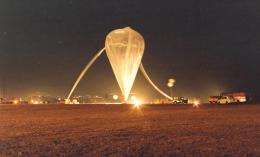
The experiment was conducted using a 26.7 million cubic feet balloon carrying a 459 kg scientific payload soaked in 38 kg of liquid Neon, which was flown from the National Balloon Facility in Hyderabad, operated by the Tata Institute of Fundamental Research (TIFR). The payload consisted of a cryosampler containing sixteen evacuated and sterilised stainless steel probes. Throughout the flight, the probes remained immersed in liquid Neon to create a cryopump effect. These cylinders, after collecting air samples from different heights ranging from 20 km to 41 km, were parachuted down and safely retrieved. These samples were analysed by scientists at the Center for Cellular and Molecular Biology, Hyderabad as well as the National Center for Cell Science (NCCS), Pune for independent examination, ensuring that both laboratories followed similar protocols to achieve homogeneity of procedure and interpretation.

In all, 12 bacterial and six fungal colonies were detected, nine of which, based on 16S RNA gene sequence, showed greater than 98% similarity with reported known on earth. Three , namely, PVAS-1, B3 W22 and B8 W22 were, however, totally new species. All the three newly identified species had significantly higher UV resistance compared to their nearest phylogenetic neighbours. Of the above, PVAS-1, identified as a member of the genus Janibacter, has been named Janibacter hoylei. sp. nov. The second new species B3 W22 was named as Bacillus isronensis sp.nov. and the third new species B8 W22 as Bacillus aryabhata.

The precautionary measures and controls operating in this experiment inspire confidence that these species were picked up in the stratosphere. While the present study does not conclusively establish the extra-terrestrial origin of , it does provide positive encouragement to continue the work in our quest to explore the origin of life.

This multi-institutional effort had Jayant Narlikar from the Inter-University Centre for Astronomy and Astrophysics, Pune as Principal Investigator and veteran Scientists U.R. Rao from ISRO and P.M. Bhargava from Anveshna supported as mentors of the experiment. S. Shivaji from CCMB and Yogesh Shouche from NCCS were the biology experts and Ravi Manchanda from TIFR was in charge of the balloon facility. C.B.S. Dutt was the Project Director from ISRO who was in charge of preparing and operating the complex payload.

This was the second such experiment conducted by ISRO, the first one being in 2001. Even though the first experiment had yielded positive results, it was decided to repeat the experiment by exercising extra care to ensure that it was totally free from any terrestrial contamination.

Provided by Indian Space Research Organization

Explore further: Wound healing: 'See-saw' switch sends cells on the march

add to favorites email to friend print save as pdf

Related Stories

Step To Determine Future Of Indian Space Program

Apr 24, 2006

Sometime next year, Polar Satellite Launch Vehicle (PSLV) will carry a payload to 800 km above the earths' surface, which will determine the future missions of the Indian space programme. The rocket will put into orbit a ...

NASA Selects Moon Mapper for Mission of Opportunity

Feb 03, 2005

NASA chose the Moon Mineralogy Mapper (M3) to fly as part of the scientific payload for the Indian Space Research Organization's (ISRO) Chandraayan-1 mission, slated for launch in 2007. The M3 is designed to create a mineral-resource ...

India To Build Independent Satellite Navigation System

Jul 06, 2006

ISRO officials met with industry representatives Tuesday to discuss the Indian government's plan to build an independent satellite navigation system using home-grown components. The project, called the Indian Regional Navigation ...

New bacteria contaminate hairspray

Mar 07, 2008

Scientists in Japan have discovered a new species of bacteria that can live in hairspray, according to the results of a study published in the March issue of the International Journal of Systematic and Evolutionary Microbiology.

Recommended for you

Single-cell sequencing

2 hours ago

When studying any kind of population—people or cells—averaging is a useful, if flawed, form of measurement. According to the US Census Bureau, the average American household size in 2010 was 2.59. Of ...

User comments : 3

Adjust slider to filter visible comments by rank

Display comments: newest first

bmcghie
not rated yet Mar 19, 2009
I would like to know how these little guys metabolize, breed, and stay aloft! Pictures people, pictures!
docknowledge
not rated yet Mar 19, 2009
Nice work. Obviously the experiment was designed to look for just such things. And a billion dollar pork barrel scientific project wasn't necessary to find something significant. Science doesn't have to be expensive or high tech, but that's what our technology-obsessed culture teaches us.
Chase_O_
not rated yet Mar 25, 2009
This is Great News! Some AstroBiologists had speculated that their might be micro-organisms living in the clouds of Venus where the temperature (in some parts) is very moderate, but it didn't seem entirely feasible because it would require a strange new life form that could live it's whole life-cycle in the air... and now here it is! Lets start looking for venetian E.T.s !!!

More news stories

Fast new, one-step genetic engineering technology

A new, streamlined approach to genetic engineering drastically reduces the time and effort needed to insert new genes into bacteria, the workhorses of biotechnology, scientists are reporting. Published in ...

Drought makes Borneo's trees flower at the same time

Tropical plants flower at supra-annual irregular intervals. In addition, mass flowering is typical for the tropical forests in Borneo and elsewhere, where hundreds of different plant timber species from the ...

100K Pathogen Genome Project maps first genomes

(Phys.org) —Striking a blow at foodborne diseases, the 100K Pathogen Genome Project at the University of California, Davis, today announced that it has sequenced the genomes of its first 10 infectious microorganisms, including ...

Strawberry fields forever and fungus-free

(Phys.org) —Strawberries are one of the most economically important berry crops in the world, and a high value export crop for the Australian horticultural industry.For the first time, researchers at The ...

Theorists weigh in on where to hunt dark matter

(Phys.org) —Now that it looks like the hunt for the Higgs boson is over, particles of dark matter are at the top of the physics "Most Wanted" list. Dozens of experiments have been searching for them, but ...

DNA damage: The dark side of respiration

(Phys.org) —Adventitious changes in cellular DNA can endanger the whole organism, as they may lead to life-threatening illnesses like cancer. Researchers at LMU now report how byproducts of respiration cause mispairing ...