NASA eyes debris as Discovery nears space station
Mar 16, 2009 By MARCIA DUNN , Associated Press Writer
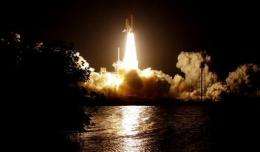
The space shuttle Discovery and a seven member crew liftoff at the Kennedy Space Center in Cape Canaveral, Fla. on Sunday, March 15, 2009. (AP Photo/Chris O'Meara)

(AP) -- NASA kept close tabs on an old piece of space junk Monday that threatened to come too close to the international space station as the shuttle Discovery raced toward the orbiting outpost for a 220-mile-high linkup.

Experts initially warned the debris from a Soviet satellite that broke up in 1981 could veer within a half-mile of the space station. But later, they said it appeared that the piece of junk - about 4 inches in size - might remain at a safe distance.

The debris was in an erratic orbit and experts were watching closely, though it appeared the space station might not have to move out of the way.

If Mission Control orders a space station maneuver to dodge the junk, it would be carried out Monday night, well ahead of the projected close approach between the station and debris early Tuesday morning. If the station were moved, Discovery would have to adjust its course for docking late Tuesday afternoon; the shuttle is delivering one last set of solar wings for the station.

On Thursday, the three space station residents had to move into their emergency getaway capsule because another piece of space junk came uncomfortably close. In that case, there was short notice and the astronauts did not have enough time to steer out of the way.

NASA has moved the space station to dodge debris eight times in the past, most recently in August. Generally, engines on the Russian living quarters or the attached Russian supply ships are fired to alter the path of the entire station. It's a relatively easy job, but uses up precious fuel.

The debris this time is from a Soviet military satellite called Kosmos 1275, which broke up somewhat mysteriously shortly after its 1981 launch. NASA orbital debris scientist Mark Matney said it may have crashed with another object that wasn't being tracked, although the Russians believe a battery explosion did the satellite in. In any event, the result was a cloud of 310 pieces of debris that slowly are falling into lower orbits, he said.

Meanwhile, on board Discovery, the seven astronauts conducted an in-depth inspection of their ship's wings and nose with a laser-tipped boom Monday afternoon. It's standard procedure the day after launch to check for any damage that may have occurred during liftoff.

Late Sunday, NASA officials said a quick look at the launch video showed nothing of significance striking Discovery. Debris has been an overriding concern for NASA since a chunk of foam insulation broke off the external fuel tank and cracked open Columbia's wing in 2003. The shuttle broke apart during re-entry, and all seven astronauts were killed.

Sunday evening's launch of Discovery followed five delays that caused the mission to be shortened by a day and a spacewalk to be cut. Concern over hydrogen valves and a hydrogen leak pushed back the flight by more than a month.

Mission managers said despite the lost day, the astronauts still should be able to complete most of their objectives. Besides installing the new solar wings, the crew will drop off a new urine processor for the space station's water-recycling system, as well as a new station resident, Japanese astronaut Koichi Wakata.

---

Associated Press Writer Mike Schneider in Cape Canaveral and AP Science Writer Seth Borenstein in Washington contributed to this report.

---

On the Net:

NASA: http://spaceflight.nasa.gov

©2009 The Associated Press. All rights reserved. This material may not be published, broadcast, rewritten or redistributed.

Explore further: Field tests in Mojave Desert pave way for human exploration of small bodies

add to favorites email to friend print save as pdf

Related Stories

NASA shooting for Sunday shuttle Discovery launch

Mar 12, 2009

(AP) -- NASA is replacing some space shuttle connections in hopes of plugging a gas leak and launching Discovery to the international space station on Sunday, after delays of more than a month.

Shuttle Discovery Launches to Fully Power Space Station

Mar 16, 2009

(PhysOrg.com) -- Space shuttle Discovery and its seven-member crew lifted off from NASA's Kennedy Space Center at 7:43 p.m. EDT Sunday to deliver the final set of power-generating solar array wings and a new ...

NASA Gives 'Go' for Space Shuttle Launch on March 11

Mar 06, 2009

(PhysOrg.com) -- NASA managers completed a review Friday of space shuttle Discovery's readiness for flight and selected the official launch date for the STS-119 mission. Commander Lee Archambault and his six ...

NASA fuels Discovery for flight to space station

Mar 11, 2009

(AP) -- NASA fueled space shuttle Discovery for a night flight to the international space station Wednesday, following a month's delay to make sure the ship's valves are just right.

Recommended for you

Mars rover Opportunity examines clay clues in rock

14 hours ago

(Phys.org) —NASA's senior Mars rover, Opportunity, is driving to a new study area after a dramatic finish to 20 months on "Cape York" with examination of a rock intensely altered by water.

NASA's STEREO detects a CME from the sun

May 17, 2013

On 5:24 a.m. EDT on May 17, 2013, the sun erupted with an Earth-directed coronal mass ejection or CME, a solar phenomenon that can send billions of tons of solar particles into space that can reach Earth ...

Nine-year-old Mars rover passes 40-year-old record

May 17, 2013

While Apollo 17 astronauts Eugene Cernan and Harrison Schmitt visited Earth's moon for three days in December 1972, they drove their mission's Lunar Roving Vehicle 19.3 nautical miles (22.210 statute miles ...

Bright explosion on the Moon

May 17, 2013

For the past 8 years, NASA astronomers have been monitoring the Moon for signs of explosions caused by meteoroids hitting the lunar surface. "Lunar meteor showers" have turned out to be more common than anyone ...

User comments : 0

More news stories

Galaxy's Ring of Fire

Johnny Cash may have preferred this galaxy's burning ring of fire to the one he sang about falling into in his popular song. The "starburst ring" seen at center in red and yellow hues is not the product of ...

Alaska volcano shoots ash 15,000 feet into the air

(AP)—One of Alaska's most restless volcanoes has shot an ash cloud 15,000 feet into the air in an ongoing eruption that has drawn attention from a nearby community but isn't expected to threaten air traffic.

Chinese, Indian airlines face EU pollution fines

Eight Chinese and two Indian airlines face fines of up to several million euros for not paying for their greenhouse gas emissions during flights within the bloc, the European Commission said on Friday.

Morocco to harness the wind in energy hunt

Morocco is ploughing ahead with a programme to boost wind energy production, particularly in the southern Tarfaya region, where Africa's largest wind farm is set to open in 2014.

US seizes Bitcoin operator accounts

US authorities seized the accounts of a Bitcoin digital currency exchange operator, claiming it was functioning as an "unlicensed money service business," court documents showed Friday.